* RE: [PATCH] minimal SAS transport class
@ 2005-08-23 16:16 James.Smart
  2005-08-23 17:28 ` Stefan Richter
  2005-08-23 17:57 ` Patrick Mansfield
  0 siblings, 2 replies; 83+ messages in thread
From: James.Smart @ 2005-08-23 16:16 UTC (permalink / raw)
  To: patmans
  Cc: luben_tuikov, hch, jejb, ltuikov, Eric.Moore, andrew.patterson,
	linux-scsi

> As others stated, id is already a tag/label. You should be
> able to pass
> whatever id you want to scsi_scan_target, like the FC ID
> (port_id), and
> then we also want an abstract iterator in fc transport for the id for
> usage in scsi_scan.c:scsi_scan_channel. Then you can lose all the
> fc_host->next_target_id code.

All nice and well, but....

How did this help things ?  The issue was the device with a changing
target id. If the device comes back at the same address each and
every time, ok. But, with FC, the Port ID is temporal. It can change
on a loop init, fabric reconfig, or with a user cable swap (kicked
the cable and replugged).

If the port id changes during run time, what are you to do ? What if
a new port is seen at the old port id, how do you now deal with the
name conflict ? You know apps are going to key off the physical bus
address being the target - if it changes, this becomes very problematic.

This approach only works as long as the transport's id fits within
the target id (an int). How would the SAS address(8byte wwn) utilize
such a scheme ?

-- james s

^ permalink raw reply	[flat|nested] 83+ messages in thread
* Re: [PATCH] minimal SAS transport class
  2005-08-23 16:16 [PATCH] minimal SAS transport class James.Smart
@ 2005-08-23 17:28 ` Stefan Richter
  2005-08-24  0:02   ` Luben Tuikov
  2005-08-23 17:57 ` Patrick Mansfield
  1 sibling, 1 reply; 83+ messages in thread
From: Stefan Richter @ 2005-08-23 17:28 UTC (permalink / raw)
  To: linux-scsi

James.Smart@Emulex.Com wrote:
>>As others stated, id is already a tag/label. You should be
>>able to pass
>>whatever id you want to scsi_scan_target, like the FC ID
>>(port_id),
[...]
> If the port id changes during run time, what are you to do ?
[...]
> This approach only works as long as the transport's id fits within
> the target id (an int). How would the SAS address(8byte wwn) utilize
> such a scheme ?

I don't understand exactly what is being discussed here. But if
anybody's intention is to extend the concept of target ID to also
provide the concept of transport specific, persistent, globally unique
identifiers*, then the datatype of target ID needs to be extended
accordingly.

Otherwise the LLDs have to implement a mapping between target IDs and
these unique identifiers. This mapping does not need to be persistent.
Persistent mappings for whatever purpose can and should be implemented
in userspace. (This is how it has always been e.g. with SBP-2.)


*) examples of transport specific, persistent, globally unique
identifiers: obviously 8 Byte address from SAS, 8 Byte EUI from SBP-2/
IEEE 1394/ ISO/IEC 13213, or maybe 88 bit GUI from ISO/IEC 13213
--
Stefan Richter
-=====-=-=-= =--- =-===
http://arcgraph.de/sr/

^ permalink raw reply	[flat|nested] 83+ messages in thread
* Re: [PATCH] minimal SAS transport class
  2005-08-23 17:28 ` Stefan Richter
@ 2005-08-24  0:02   ` Luben Tuikov
  2005-08-24  9:12     ` Christoph Hellwig
  0 siblings, 1 reply; 83+ messages in thread
From: Luben Tuikov @ 2005-08-24  0:02 UTC (permalink / raw)
  To: Stefan Richter; +Cc: linux-scsi

On 08/23/05 13:28, Stefan Richter wrote:
> James.Smart@Emulex.Com wrote:
>
>>>As others stated, id is already a tag/label. You should be
>>>able to pass
>>>whatever id you want to scsi_scan_target, like the FC ID
>>>(port_id),
>
> [...]
>
>>If the port id changes during run time, what are you to do ?
>
> [...]
>
>>This approach only works as long as the transport's id fits within
>>the target id (an int). How would the SAS address(8byte wwn) utilize
>>such a scheme ?
>
>
> I don't understand exactly what is being discussed here. But if
> anybody's intention is to extend the concept of target ID to also
> provide the concept of transport specific, persistent, globally unique
> identifiers*, then the datatype of target ID needs to be extended
> accordingly.

Hi Stefan,

No, no, no -- this is exactly what we DO NOT WANT TO DO.

Why?  Because it is the same mistake that was done when HCIL crept
up into SCSI Core 13 years ago.

Device addressing done by LLDD is completely not the business
of SCSI Core and vice versa.  They should be *completely* separate.

In effect, a native support for targets (I know... a poor choice of
words, but not everyone reads specs), has been in need for SCSI Core
since one of the first iSCSI Target and Initiator for Linux was developed
5 years ago.

In effect FC tells SCSI Core: here is a device I do not know anything
about, other than the fact that it is on the fabric and it has
a SCSI Target (or Initiator) Port: how you get to is is _my_ business,
what is done with or to the device is _your_ business.

Then SCSI Core does LU discovery using SPC and SAM on the device
using Execute Task.

All this _completely_ eliminates the need for HCIL.

How the FC layer identifies the device is the FC's layer problem.
How SCSI Core identifies the device is SCSI Core's problem.

HCIL should have never been available to SCSI Core in the first place,
but then again SAM didn't exist back then.

> Otherwise the LLDs have to implement a mapping between target IDs and

LLDD should not have to invent HCIL just because SCSI Core hasn't
seen any inovation and advancement for the last 13 years.

Currently they do.

Target ID should NOT be extended to cover whatever new transport
protocols comes up.  SCSI Core whould follow SAM if it wants to
transparently cover FC, iSCSI, SAS, etc.

> these unique identifiers. This mapping does not need to be persistent.
> Persistent mappings for whatever purpose can and should be implemented
> in userspace. (This is how it has always been e.g. with SBP-2.)
>
>
> *) examples of transport specific, persistent, globally unique
> identifiers: obviously 8 Byte address from SAS, 8 Byte EUI from SBP-2/
> IEEE 1394/ ISO/IEC 13213, or maybe 88 bit GUI from ISO/IEC 13213

Yes, you're right.

And if would be nice if all those IDs are just another label tacked
onto the domain device, opaque label.  SCSI Core can add labels
on its own (e.g. HCIL ;-) ).

	Luben


^ permalink raw reply	[flat|nested] 83+ messages in thread
* Re: [PATCH] minimal SAS transport class
  2005-08-24  0:02   ` Luben Tuikov
@ 2005-08-24  9:12     ` Christoph Hellwig
  2005-08-26 15:47       ` Luben Tuikov
  0 siblings, 1 reply; 83+ messages in thread
From: Christoph Hellwig @ 2005-08-24  9:12 UTC (permalink / raw)
  To: linux-scsi; +Cc: Stefan Richter

On Tue, Aug 23, 2005 at 08:02:39PM -0400, Luben Tuikov wrote:
> In effect FC tells SCSI Core: here is a device I do not know anything
> about, other than the fact that it is on the fabric and it has
> a SCSI Target (or Initiator) Port: how you get to is is _my_ business,
> what is done with or to the device is _your_ business.
>
> Then SCSI Core does LU discovery using SPC and SAM on the device
> using Execute Task.
>
> All this _completely_ eliminates the need for HCIL.
>
> How the FC layer identifies the device is the FC's layer problem.
> How SCSI Core identifies the device is SCSI Core's problem.
>
> HCIL should have never been available to SCSI Core in the first place,
> but then again SAM didn't exist back then.

Ok, Luben, here's the TODO list to get there:

 (1) add a sdev_printk that takes a struct scsi_device * and prints
     a sensible name for it.  Later we might or might not make this
     a transport hook, but for now it gets rid of all these ->id
     references in LLDDs
 (2) add a variant of scsi_scan_target that takes a scsi_target * to
     scan, make the old scsi_scan_target a wrapper around it and
     introduce similar wrappers for transport-specific target identifiers
     (e.g. WWNs for FC and SAS)
 (3) fix a bunch of internal functions that use ->id despite not actually
     needing it, e.g. starget_for_each_device
 (4) eventually move the traditional scsi_scan_target and other functions
     that lookup a scsi_target based on ->id into the spi transport class
 (5) add an SPI-specific taget ID accessor and move all drivers over to it


^ permalink raw reply	[flat|nested] 83+ messages in thread
* Re: [PATCH] minimal SAS transport class
2005-08-24 9:12 ` Christoph Hellwig
@ 2005-08-26 15:47 ` Luben Tuikov
2005-08-26 16:29 ` scsi device driver Yijian Wang
` (2 more replies)
0 siblings, 3 replies; 83+ messages in thread
From: Luben Tuikov @ 2005-08-26 15:47 UTC (permalink / raw)
To: Christoph Hellwig; +Cc: linux-scsi, Stefan Richter
On 08/24/05 05:12, Christoph Hellwig wrote:
> On Tue, Aug 23, 2005 at 08:02:39PM -0400, Luben Tuikov wrote:
>
>>In effect FC tells SCSI Core: here is a device I do not know anything
>>about, other than the fact that it is on the fabric and it has
>>a SCSI Target (or Initiator) Port: how you get to is is _my_ business,
>>what is done with or to the device is _your_ business.
>>
>>Then SCSI Core does LU discovery using SPC and SAM on the device
>>using Execute Task.
>>
>>All this _completely_ eliminates the need for HCIL.
>>
>>How the FC layer identifies the device is the FC's layer problem.
>>How SCSI Core identifies the device is SCSI Core's problem.
>>
>>HCIL should have never been available to SCSI Core in the first place,
>>but then again SAM didn't exist back then.
>
>
> Ok, Luben, here's the TODO list to get there:
>
> (1) add a sdev_printk that takes a struct scsi_device * and prints
> a sensible name for it. Later we might or might not make this
> a transport hook, but for now it gets rid of all these ->id
> references in LLDDs
> (2) add a variant of scsi_scan_target that takes a scsi_target * to
> scan, make the old scsi_scan_target a wrapper around it and
> introduce similar wrappers for transport-specific target identifiers
> (e.g. WWNs for FC and SAS)
Hi Christoph,
Yeah this sounds cool.
Do you think it would be beneficial to revisit struct
scsi_target to something like struct scsi_domain_device and
have a kobject in it. Then the FC/SAS/iSCSI/USB layer upon finding
a domain device, they call a suitable function which allocates them
struct scsi_domain_device, which sets the "release" method for the
kobject embedded. Then they call SCSI Core to register the domain device.
(All in all, the transport layer may also do kobject_get.)
SCSI Core does kobject_register (thus kobject_get) and starts
doing LU discovery for the device (all through the pointer to struct
scsi_domain_device), and thus the LUs are discovered and struct
scsi_device is created for each one.
Then if the device is unplugged from the domain, the protocol layer
does whatever is necessary, including kobject_put(), and then
calls the unregister function in SCSI Core to unregister the device.
SCSI Core does whatever it wants and then does kobject_unregister(kobject_put),
and the device is gone.
If OTOH, the unplug event came from userspace, SCSI Core does whatever is
necessary to finish with the device, and then calls the slave_destroy()
function (you get the idea), and then does kobject_put.
Of course the order of those doesn't have to be quite like so.
I've all this implemented for the _current_ architecture of SCSI Core.
The aforementioned was a draft to extend (move) domain devices _and_ LUs
into SCSI Core where they belong, as opposed to the transport layer
doing LU discovery _as_well_as_ domain device discovery and giving only
LUs to SCSI Core.
> (3) fix a bunch of internal functions that use ->id despite not actually
> needing it, e.g. starget_for_each_device
Yeah, that sounds cool. In effect, all you'll have is a struct list_head
of LUs, and that list_head would live in the struct scsi_domain_device.
> (4) eventually move the traditional scsi_scan_target and other functions
> that lookup a scsi_target based on ->id into the spi transport class
Even simpler: the transport layer, calls SCSI Core, saying: "Hey here is
a pointer to struct scsi_domain_device. If you want, you an send REPORT
LUNS and other things to it."
The current slave_alloc/slave_configure/slave_destroy implementation is
_very_good_, but slight adjustments would have to be made when the domain
device concept arrives at SCSI Core -- nothing unprecedented. If anything,
it would be a _simplification_, and I'm actually in _favour_ of keeping the
current infra in place as well -- no big, sudden changes.
> (5) add an SPI-specific taget ID accessor and move all drivers over to it
Yeah, sure. The transport layer would actually assign these ids as part of
it doing domain discovery. They would be some opaque string in some opaque
format, "WWN", "H:C:I:L", "X,Y", etc, which the transport layer tacked to the
domain device before announcing that it exists to SCSI Core. SCSI Core
can feel free to add more and other various labels if it wishes to do so.
Imagine a struct list_head of labels.
Luben
P.S. Transport class != Transport layer.
SCSI Core >> transport layer (FC/SAS/USB/iSCSI) >> LLDD/transport >> interconnect >> physical world.
Anything to the left is completely unaware of internals of anything to the
right. Access to the right is provided as dictated by some spec.
^ permalink raw reply [flat|nested] 83+ messages in thread* scsi device driver
2005-08-26 15:47 ` Luben Tuikov
@ 2005-08-26 16:29 ` Yijian Wang
2005-08-26 19:24 ` [PATCH] minimal SAS transport class Jeff Garzik
2005-08-29 17:16 ` Christoph Hellwig
2 siblings, 0 replies; 83+ messages in thread
From: Yijian Wang @ 2005-08-26 16:29 UTC (permalink / raw)
To: linux-scsi
Hello,all,
I am going to develop a program that can dynamically capture all the
SCSI disk I/O traffic generated by user applications in the system. Is
there any API library that can help me do this?
I am very new to this area. Any helps are highly appreciated.
Thanks,
Yijian Wang
^ permalink raw reply [flat|nested] 83+ messages in thread
* Re: [PATCH] minimal SAS transport class
  2005-08-26 15:47       ` Luben Tuikov
  2005-08-26 16:29         ` scsi device driver Yijian Wang
@ 2005-08-26 19:24         ` Jeff Garzik
  2005-08-26 19:44           ` Luben Tuikov
  2005-08-29 17:11           ` Christoph Hellwig
  2005-08-29 17:16         ` Christoph Hellwig
  2 siblings, 2 replies; 83+ messages in thread
From: Jeff Garzik @ 2005-08-26 19:24 UTC (permalink / raw)
  To: Luben Tuikov; +Cc: Christoph Hellwig, linux-scsi, Stefan Richter

Luben Tuikov wrote:
> Even simpler: the transport layer, calls SCSI Core, saying: "Hey here is
> a pointer to struct scsi_domain_device.  If you want, you an send REPORT
> LUNS and other things to it."

For the SG_IO ioctl, /dev/sg and request_queue usage, SCSI core must map
an address (currently HCIL) into a scsi_domain_device pointer.  These
upper layer kernel elements rely on this "SCSI address", and rely on the
fact that SCSI core can route from a block device straight to a SCSI
LLD, using nothing more than this "SCSI address."

That is the heart of the routing/addressing that the SCSI core must perform.

Right now the addressing is hardcoded to HCIL.  But that can be
changed...  One proposal was to use (host,string) identifiers.

	Jeff


^ permalink raw reply	[flat|nested] 83+ messages in thread
* Re: [PATCH] minimal SAS transport class
  2005-08-26 19:24         ` [PATCH] minimal SAS transport class Jeff Garzik
@ 2005-08-26 19:44           ` Luben Tuikov
  2005-08-27  1:53             ` Jeff Garzik
  2005-08-29 17:11           ` Christoph Hellwig
  1 sibling, 1 reply; 83+ messages in thread
From: Luben Tuikov @ 2005-08-26 19:44 UTC (permalink / raw)
  To: Jeff Garzik; +Cc: Christoph Hellwig, linux-scsi, Stefan Richter

On 08/26/05 15:24, Jeff Garzik wrote:
> Luben Tuikov wrote:
>
>>Even simpler: the transport layer, calls SCSI Core, saying: "Hey here is
>>a pointer to struct scsi_domain_device.  If you want, you an send REPORT
>>LUNS and other things to it."
>
>
> For the SG_IO ioctl, /dev/sg and request_queue usage, SCSI core must map
> an address (currently HCIL) into a scsi_domain_device pointer.  These

The request queue is associated with the LU, not the scsi_domain_device.
When SCSI Core discovers the LU, it sets up the request queue for it,
etc.  Again this is the role of SCSI Core, not messing up with transport
specific stuff.

> upper layer kernel elements rely on this "SCSI address", and rely on the
> fact that SCSI core can route from a block device straight to a SCSI
> LLD, using nothing more than this "SCSI address."

I don't get this.

> That is the heart of the routing/addressing that the SCSI core must perform.

Disagree: now: scsi_device <--> request_queue, then: struct LU <--> request_queue.

The LU points to the domain_device (as its parent). The domain_device
has a void *lldd_dev in it.

> Right now the addressing is hardcoded to HCIL.  But that can be
> changed...  One proposal was to use (host,string) identifiers.

Who? Who is proposing this? I never saw an email to SCSI Core about
this proposal?  Is there any more information about this proposal
and what is the justification of it?  Any specs and docs?

	Luben


^ permalink raw reply	[flat|nested] 83+ messages in thread
* Re: [PATCH] minimal SAS transport class
  2005-08-26 19:44           ` Luben Tuikov
@ 2005-08-27  1:53             ` Jeff Garzik
  2005-08-27  7:35               ` Stefan Richter
                                 ` (2 more replies)
  0 siblings, 3 replies; 83+ messages in thread
From: Jeff Garzik @ 2005-08-27  1:53 UTC (permalink / raw)
  To: Luben Tuikov; +Cc: Christoph Hellwig, linux-scsi, Stefan Richter

Luben Tuikov wrote:
> On 08/26/05 15:24, Jeff Garzik wrote:
>
>>Luben Tuikov wrote:
>>
>>
>>>Even simpler: the transport layer, calls SCSI Core, saying: "Hey here is
>>>a pointer to struct scsi_domain_device.  If you want, you an send REPORT
>>>LUNS and other things to it."
>>
>>
>>For the SG_IO ioctl, /dev/sg and request_queue usage, SCSI core must map
>>an address (currently HCIL) into a scsi_domain_device pointer.  These
>
>
> The request queue is associated with the LU, not the scsi_domain_device.
> When SCSI Core discovers the LU, it sets up the request queue for it,
> etc.  Again this is the role of SCSI Core, not messing up with transport
> specific stuff.
>
>
>>upper layer kernel elements rely on this "SCSI address", and rely on the
>>fact that SCSI core can route from a block device straight to a SCSI
>>LLD, using nothing more than this "SCSI address."
>
>
> I don't get this.

More basically...  An in-kernel C pointer, to a SCSI target device, is
not sufficient in all cases to address a target.  This plays out most
often in userland interfaces such as ioctls.


>>That is the heart of the routing/addressing that the SCSI core must perform.
>
>
> Disagree: now: scsi_device <--> request_queue, then: struct LU <--> request_queue.
>
> The LU points to the domain_device (as its parent). The domain_device
> has a void *lldd_dev in it.

The current SCSI code largely already has this stuff.


>>Right now the addressing is hardcoded to HCIL.  But that can be
>>changed...  One proposal was to use (host,string) identifiers.
>
>
> Who? Who is proposing this? I never saw an email to SCSI Core about
> this proposal?  Is there any more information about this proposal
> and what is the justification of it?  Any specs and docs?

No specs, just a comment from IRC.

(host,string) could succeed in transporting both HCIL and non-HCIL
target identifiers.

	Jeff


^ permalink raw reply	[flat|nested] 83+ messages in thread
* Re: [PATCH] minimal SAS transport class
2005-08-27 1:53 ` Jeff Garzik
@ 2005-08-27 7:35 ` Stefan Richter
2005-08-28 22:27 ` Luben Tuikov
2005-08-29 5:16 ` Stefan Richter
2 siblings, 0 replies; 83+ messages in thread
From: Stefan Richter @ 2005-08-27 7:35 UTC (permalink / raw)
To: linux-scsi; +Cc: Jeff Garzik, Luben Tuikov, Christoph Hellwig
Jeff Garzik wrote:
> An in-kernel C pointer, to a SCSI target device, is
> not sufficient in all cases to address a target. This plays out most
> often in userland interfaces such as ioctls.
The C pointer is all the interface between core and low-level needs.
All other means of addressing (IDs, labels, ... of which HCIL is only
one kind) are only meaningful to userspace. The labels may be
_generated_ at any level (low, core, high) depending on their context,
but they are _used_ only in userspace->kernel interfaces.
The core provides the map of devices<->labels.
--
Stefan Richter
-=====-=-=-= =--- ==-==
http://arcgraph.de/sr/
^ permalink raw reply [flat|nested] 83+ messages in thread
* Re: [PATCH] minimal SAS transport class
  2005-08-27  1:53             ` Jeff Garzik
  2005-08-27  7:35               ` Stefan Richter
@ 2005-08-28 22:27               ` Luben Tuikov
  2005-08-29  5:16               ` Stefan Richter
  2 siblings, 0 replies; 83+ messages in thread
From: Luben Tuikov @ 2005-08-28 22:27 UTC (permalink / raw)
  To: Jeff Garzik; +Cc: Christoph Hellwig, linux-scsi, Stefan Richter

On 08/26/05 21:53, Jeff Garzik wrote:
> Luben Tuikov wrote:
>
>>On 08/26/05 15:24, Jeff Garzik wrote:
>>
>>
>>>Luben Tuikov wrote:
>>>
>>>
>>>
>>>>Even simpler: the transport layer, calls SCSI Core, saying: "Hey here is
>>>>a pointer to struct scsi_domain_device.  If you want, you an send REPORT
>>>>LUNS and other things to it."
>>>
>>>
>>>For the SG_IO ioctl, /dev/sg and request_queue usage, SCSI core must map
>>>an address (currently HCIL) into a scsi_domain_device pointer.  These
>>
>>
>>The request queue is associated with the LU, not the scsi_domain_device.
>>When SCSI Core discovers the LU, it sets up the request queue for it,
>>etc.  Again this is the role of SCSI Core, not messing up with transport
>>specific stuff.
>>
>>
>>
>>>upper layer kernel elements rely on this "SCSI address", and rely on the
>>>fact that SCSI core can route from a block device straight to a SCSI
>>>LLD, using nothing more than this "SCSI address."
>>
>>
>>I don't get this.
>
>
> More basically...  An in-kernel C pointer, to a SCSI target device, is
> not sufficient in all cases to address a target.  This plays out most
> often in userland interfaces such as ioctls.

1. Why do I care about this stuff, when I'm so low in the layering
   infra?
2. I thought ioctls are bad.
3. So you're saying that there's an ioctl which addresses a "SCSI target
   device" by HCIL?  Which one is it please?

>>>That is the heart of the routing/addressing that the SCSI core must perform.
>>
>>
>>Disagree: now: scsi_device <--> request_queue, then: struct LU <--> request_queue.
>>
>>The LU points to the domain_device (as its parent). The domain_device
>>has a void *lldd_dev in it.
>
>
> The current SCSI code largely already has this stuff.

No, it has no concept of those things.  I mean, look at how
scsi_target is treated and implemented...

Before one start writing code about something (scsi_target)
one should ask themselves "what is that something (scsi_target)?",
and "how does it play with the rest of the objects I want to
represent?".

You can search the archives of linux-scsi and you'll see how many
times I've asked about true "scsi_target" representation, and how many
times I've been rejected by the SCSI maintainers.

Now the need for such an object is even more dire, when you have
_one_more_ SCSI transport.

It started with iSCSI...

> No specs, just a comment from IRC.

Oh, I see... this was one of those IRC sessions you had with James B,
which you talked about before.

I'd suggest sitting down with a fresh copy of SAM and SPC, reading them
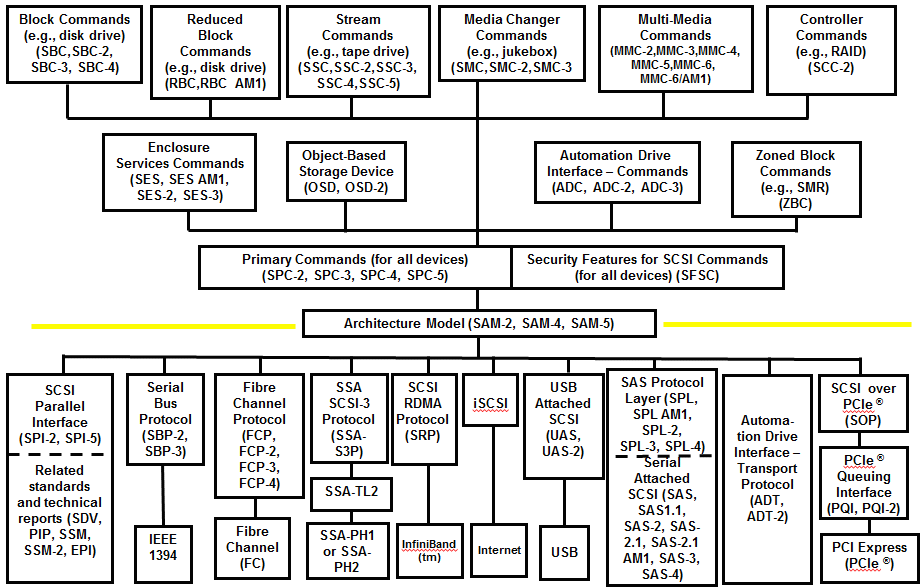
20 times, then looking at this picture:
http://www.t10.org/scsi-3.gif
and then "seeing" how _a_ SCSI Core should behave.

> (host,string) could succeed in transporting both HCIL and non-HCIL
> target identifiers.

Broken.

BTW, none of what I'm saying here has changed for the last 5 years.
It's all the same old stuff.  Now its SAS, back then it was iSCSI.

What the maintainers here fail to see is that it is all SAM and
they fail to see how it all plays together with the transports and
then with the interconnects.

The reason we don't see eye to eye is that we don't come off the
same base.  Some people here re-read every revision of SAM, SPC, etc,
when it comes out, others do not.

	Luben


^ permalink raw reply	[flat|nested] 83+ messages in thread
* Re: [PATCH] minimal SAS transport class
  2005-08-27  1:53             ` Jeff Garzik
  2005-08-27  7:35               ` Stefan Richter
  2005-08-28 22:27               ` Luben Tuikov
@ 2005-08-29  5:16               ` Stefan Richter
  2 siblings, 0 replies; 83+ messages in thread
From: Stefan Richter @ 2005-08-29  5:16 UTC (permalink / raw)
  To: linux-scsi; +Cc: Jeff Garzik, Luben Tuikov, Christoph Hellwig

Jeff Garzik wrote:
> (host,string) could succeed in transporting both HCIL and non-HCIL
> target identifiers.

What is the meaning of "host" there?
--
Stefan Richter
-=====-=-=-= =--- ===-=
http://arcgraph.de/sr/

^ permalink raw reply	[flat|nested] 83+ messages in thread
* Re: [PATCH] minimal SAS transport class
  2005-08-26 19:24         ` [PATCH] minimal SAS transport class Jeff Garzik
  2005-08-26 19:44           ` Luben Tuikov
@ 2005-08-29 17:11           ` Christoph Hellwig
  2005-08-29 17:20             ` Luben Tuikov
  1 sibling, 1 reply; 83+ messages in thread
From: Christoph Hellwig @ 2005-08-29 17:11 UTC (permalink / raw)
  To: Jeff Garzik; +Cc: Luben Tuikov, Christoph Hellwig, linux-scsi, Stefan Richter

On Fri, Aug 26, 2005 at 03:24:06PM -0400, Jeff Garzik wrote:
> Luben Tuikov wrote:
> >Even simpler: the transport layer, calls SCSI Core, saying: "Hey here is
> >a pointer to struct scsi_domain_device.  If you want, you an send REPORT
> >LUNS and other things to it."
>
> For the SG_IO ioctl, /dev/sg and request_queue usage, SCSI core must map
> an address (currently HCIL) into a scsi_domain_device pointer.  These
> upper layer kernel elements rely on this "SCSI address", and rely on the
> fact that SCSI core can route from a block device straight to a SCSI
> LLD, using nothing more than this "SCSI address."

What's a scsi_domain_device?  Anyway, we don't need any HCIL tuple for
all of the above.  SG_IO is done on a blockdevice node, /dev/sg is done
on a chardevice node.  Each of them are attached to a request_queue that's
known at the time their ->probe routine is setup - no need for HCIL here
_at all_.  There's actually only few userland interfaces that use HCIL
addressing:  the scanning through /sys/.../scan (or the old /proc/scsi/scsi
variant), using WWNs for FC and SAS here would be much nicer, but there's
a huge backwards-compatiblity issue - we'll probably have to support the
old variant forever.  Besides that there's probably only SCSI_IOCTL_GET_IDLUN,
which is superceeded by sysfs but probably still has tons of users in
hardware probing, managment utilities and all kinds of userland.


^ permalink raw reply	[flat|nested] 83+ messages in thread
* Re: [PATCH] minimal SAS transport class
  2005-08-29 17:11           ` Christoph Hellwig
@ 2005-08-29 17:20             ` Luben Tuikov
  2005-08-29 17:25               ` Christoph Hellwig
  0 siblings, 1 reply; 83+ messages in thread
From: Luben Tuikov @ 2005-08-29 17:20 UTC (permalink / raw)
  To: Christoph Hellwig; +Cc: Jeff Garzik, linux-scsi, Stefan Richter

On 08/29/05 13:11, Christoph Hellwig wrote:
> On Fri, Aug 26, 2005 at 03:24:06PM -0400, Jeff Garzik wrote:
>
>>Luben Tuikov wrote:
>>
>>>Even simpler: the transport layer, calls SCSI Core, saying: "Hey here is
>>>a pointer to struct scsi_domain_device.  If you want, you an send REPORT
>>>LUNS and other things to it."
>>
>>For the SG_IO ioctl, /dev/sg and request_queue usage, SCSI core must map
>>an address (currently HCIL) into a scsi_domain_device pointer.  These
>>upper layer kernel elements rely on this "SCSI address", and rely on the
>>fact that SCSI core can route from a block device straight to a SCSI
>>LLD, using nothing more than this "SCSI address."
>
>
> What's a scsi_domain_device?  Anyway, we don't need any HCIL tuple for
> all of the above.  SG_IO is done on a blockdevice node, /dev/sg is done
> on a chardevice node.  Each of them are attached to a request_queue that's
> known at the time their ->probe routine is setup - no need for HCIL here
> _at all_.  There's actually only few userland interfaces that use HCIL
> addressing:  the scanning through /sys/.../scan (or the old /proc/scsi/scsi
> variant), using WWNs for FC and SAS here would be much nicer, but there's

WWNs *must not* be visible _at_all_ to anyone above the SAS layer, in the
kernel.  That is, the transport addressing method *must not* be visible to
SCSI Core or anyone above it, in the kernel.

Else you'll end up with another "HCIL"... (if you get the irony).

> a huge backwards-compatiblity issue - we'll probably have to support the
> old variant forever.  Besides that there's probably only SCSI_IOCTL_GET_IDLUN,

If there's no userspace dependency, the kernel can do anything it wants.

Since HCIL is SCSI Core crud, let SCSI Core invent HCIL tuples and support them.

	Luben

> which is superceeded by sysfs but probably still has tons of users in
> hardware probing, managment utilities and all kinds of userland.


^ permalink raw reply	[flat|nested] 83+ messages in thread
* Re: [PATCH] minimal SAS transport class
  2005-08-29 17:20             ` Luben Tuikov
@ 2005-08-29 17:25               ` Christoph Hellwig
  0 siblings, 0 replies; 83+ messages in thread
From: Christoph Hellwig @ 2005-08-29 17:25 UTC (permalink / raw)
  To: Luben Tuikov; +Cc: Christoph Hellwig, Jeff Garzik, linux-scsi, Stefan Richter

On Mon, Aug 29, 2005 at 01:20:50PM -0400, Luben Tuikov wrote:
> > What's a scsi_domain_device?  Anyway, we don't need any HCIL tuple for
> > all of the above.  SG_IO is done on a blockdevice node, /dev/sg is done
> > on a chardevice node.  Each of them are attached to a request_queue that's
> > known at the time their ->probe routine is setup - no need for HCIL here
> > _at all_.  There's actually only few userland interfaces that use HCIL
> > addressing:  the scanning through /sys/.../scan (or the old /proc/scsi/scsi
> > variant), using WWNs for FC and SAS here would be much nicer, but there's
>
> WWNs *must not* be visible _at_all_ to anyone above the SAS layer, in the
> kernel.  That is, the transport addressing method *must not* be visible to
> SCSI Core or anyone above it, in the kernel.

Please read the sentence again.  I said accept them in the scan attribute,
that does _NOT_ mean adding knowledge to the scsi layer.  In fact if you
through the linux-scsi archives about the problems those attributes had
with the FC transport class I suggested moving the parsing of these
attributes into the transport class, which would be the preferred method
to implement this.


^ permalink raw reply	[flat|nested] 83+ messages in thread
* Re: [PATCH] minimal SAS transport class
  2005-08-26 15:47       ` Luben Tuikov
  2005-08-26 16:29         ` scsi device driver Yijian Wang
  2005-08-26 19:24         ` [PATCH] minimal SAS transport class Jeff Garzik
@ 2005-08-29 17:16         ` Christoph Hellwig
  2005-08-29 17:31           ` Luben Tuikov
  2005-08-29 18:09           ` James Bottomley
  2 siblings, 2 replies; 83+ messages in thread
From: Christoph Hellwig @ 2005-08-29 17:16 UTC (permalink / raw)
  To: Luben Tuikov; +Cc: linux-scsi, Stefan Richter

On Fri, Aug 26, 2005 at 11:47:22AM -0400, Luben Tuikov wrote:
> Do you think it would be beneficial to revisit struct
> scsi_target to something like struct scsi_domain_device and
> have a kobject in it.  Then the FC/SAS/iSCSI/USB layer upon finding
> a domain device, they call a suitable function which allocates them
> struct scsi_domain_device, which sets the "release" method for the
> kobject embedded.  Then they call SCSI Core to register the domain device.
> (All in all, the transport layer may also do kobject_get.)
> SCSI Core does kobject_register (thus kobject_get) and starts
> doing LU discovery for the device (all through the pointer to struct
> scsi_domain_device), and thus the LUs are discovered and struct
> scsi_device is created for each one.

No need to do silly renaming, but yes, moving creating of scsi_target
structures to the transport does make sense.  It's kinda implicit
in the todo list I posted.  I also don't really see the point of
the embedded kobject.

> Yeah, that sounds cool.  In effect, all you'll have is a struct list_head
> of LUs, and that list_head would live in the struct scsi_domain_device.

We actually already have a list in the scsi_target that chains of the
scsi_device, .devices in scsi_target and .same_target_siblings in scsi_device.
We just need to use it everywhere.

> >  (4) eventually move the traditional scsi_scan_target and other functions
> >      that lookup a scsi_target based on ->id into the spi transport class
>
> Even simpler: the transport layer, calls SCSI Core, saying: "Hey here is
> a pointer to struct scsi_domain_device.  If you want, you an send REPORT
> LUNS and other things to it."

Yes. that's what I ment with my item (3) (sorry, I hate all this
techno-babble, simple language is much easier to understand normally)


^ permalink raw reply	[flat|nested] 83+ messages in thread
* Re: [PATCH] minimal SAS transport class
  2005-08-29 17:16         ` Christoph Hellwig
@ 2005-08-29 17:31           ` Luben Tuikov
  2005-08-29 18:34             ` Luben Tuikov
  2005-08-29 18:09           ` James Bottomley
  1 sibling, 1 reply; 83+ messages in thread
From: Luben Tuikov @ 2005-08-29 17:31 UTC (permalink / raw)
  To: Christoph Hellwig; +Cc: linux-scsi, Stefan Richter

On 08/29/05 13:16, Christoph Hellwig wrote:
>
> No need to do silly renaming, but yes, moving creating of scsi_target

I'd do the "silly renaming".  I'd also create "struct scsi_domain_device",
and do "scsi_register_domain_device()".  You know, clean slate...

> structures to the transport does make sense.  It's kinda implicit

There is *nothing* implicit in a Software Project Specification!
Everything must be completely explicit.

> in the todo list I posted.  I also don't really see the point of
> the embedded kobject.

You will, once I post my code.

Think,
	- Hotplugging.
	- More than one "owner" from above.

That is, on a transport you can have a diverse set of
devices.

What if queuecommand() was *not* the only way to send a
task to the device? ;-)

> We actually already have a list in the scsi_target that chains of the
> scsi_device, .devices in scsi_target and .same_target_siblings in scsi_device.
> We just need to use it everywhere.

Yes, I've seen all this.  And I'm sorry to say, but it is *UGLY AS HELL!*

As I said: before implementing an object by a structure in a software
project one has to ask themselves what that object is?  How will it play
with the rest of the objects existsing or to be designed?  What are
the dependencies and what is the dependency graph?  Etc.

First it starts with a white sheet of paper, pencil on one side
and a spec on the other.

> Yes. that's what I ment with my item (3) (sorry, I hate all this
> techno-babble, simple language is much easier to understand normally)

Ok, sorry, it's that software specificaion "tehcno-babble" thing talking
through me again.

	Luben


^ permalink raw reply	[flat|nested] 83+ messages in thread
* Re: [PATCH] minimal SAS transport class
  2005-08-29 17:31           ` Luben Tuikov
@ 2005-08-29 18:34             ` Luben Tuikov
  0 siblings, 0 replies; 83+ messages in thread
From: Luben Tuikov @ 2005-08-29 18:34 UTC (permalink / raw)
  To: Christoph Hellwig; +Cc: linux-scsi, Stefan Richter

On 08/29/05 13:31, Luben Tuikov wrote:
> On 08/29/05 13:16, Christoph Hellwig wrote:
>
>>No need to do silly renaming, but yes, moving creating of scsi_target
>
>
> I'd do the "silly renaming".  I'd also create "struct scsi_domain_device",
> and do "scsi_register_domain_device()".  You know, clean slate...
>
>
>>structures to the transport does make sense.  It's kinda implicit
>
>
> There is *nothing* implicit in a Software Project Specification!
> Everything must be completely explicit.
>
>
>>in the todo list I posted.  I also don't really see the point of
>>the embedded kobject.
>
>
> You will, once I post my code.
>
> Think,
> 	- Hotplugging.
> 	- More than one "owner" from above.
>
> That is, on a transport you can have a diverse set of
> devices.
>
> What if queuecommand() was *not* the only way to send a
> task to the device? ;-)

Forgot to mention one more thing, which I'm sure you're
aware of:

*If* the kobject hierarchy is set right, then kobject_get()
"gets" this object and _all_ objects which are "parents"
of this object.

And kobject_put() "puts" all objects which are "parent"
of this object, including calling the release method
of each.(*)

You'll need this to support hotplugging on the fly...

	Luben

(*) Thus if your sysfs tree is built as the physical world
looks(**), you lock the object(s) when you use them, so that
if any "intervening" object is removed and you get an
event notification for it, you know what to do... ;-)

(**) Which the "transport class" doesn't give you, since it
was never _designed_ for that purpose... unless of course
you slice-it-and-dice-it pretty well. ;-)


>
>
>>We actually already have a list in the scsi_target that chains of the
>>scsi_device, .devices in scsi_target and .same_target_siblings in scsi_device.
>>We just need to use it everywhere.
>
>
> Yes, I've seen all this.  And I'm sorry to say, but it is *UGLY AS HELL!*
>
> As I said: before implementing an object by a structure in a software
> project one has to ask themselves what that object is?  How will it play
> with the rest of the objects existsing or to be designed?  What are
> the dependencies and what is the dependency graph?  Etc.
>
> First it starts with a white sheet of paper, pencil on one side
> and a spec on the other.
>
>
>>Yes. that's what I ment with my item (3) (sorry, I hate all this
>>techno-babble, simple language is much easier to understand normally)
>
>
> Ok, sorry, it's that software specificaion "tehcno-babble" thing talking
> through me again.
>
> 	Luben
>
> -
> To unsubscribe from this list: send the line "unsubscribe linux-scsi" in
> the body of a message to majordomo@vger.kernel.org
> More majordomo info at  http://vger.kernel.org/majordomo-info.html
>


^ permalink raw reply	[flat|nested] 83+ messages in thread
* Re: [PATCH] minimal SAS transport class
  2005-08-29 17:16         ` Christoph Hellwig
  2005-08-29 17:31           ` Luben Tuikov
@ 2005-08-29 18:09           ` James Bottomley
  1 sibling, 0 replies; 83+ messages in thread
From: James Bottomley @ 2005-08-29 18:09 UTC (permalink / raw)
  To: Christoph Hellwig; +Cc: Luben Tuikov, SCSI Mailing List, Stefan Richter

On Mon, 2005-08-29 at 18:16 +0100, Christoph Hellwig wrote:
> No need to do silly renaming, but yes, moving creating of scsi_target
> structures to the transport does make sense.  It's kinda implicit
> in the todo list I posted.  I also don't really see the point of
> the embedded kobject.

You might want to dust off the Mike Christie patch that did this.  The
one that eventually went in the tree was James Smarts to stop FC drivers
oopsing on remove/add lun.

There already is an embedded kobject in the scsi_target structure (it's
in struct device) and that's what we use to make it visible in the sysfs
tree.

James


^ permalink raw reply	[flat|nested] 83+ messages in thread
* Re: [PATCH] minimal SAS transport class
  2005-08-23 16:16 [PATCH] minimal SAS transport class James.Smart
  2005-08-23 17:28 ` Stefan Richter
@ 2005-08-23 17:57 ` Patrick Mansfield
  1 sibling, 0 replies; 83+ messages in thread
From: Patrick Mansfield @ 2005-08-23 17:57 UTC (permalink / raw)
  To: James.Smart
  Cc: luben_tuikov, hch, jejb, ltuikov, Eric.Moore, andrew.patterson,
	linux-scsi

On Tue, Aug 23, 2005 at 12:16:45PM -0400, James.Smart@Emulex.Com wrote:
> > As others stated, id is already a tag/label. You should be
> > able to pass
> > whatever id you want to scsi_scan_target, like the FC ID
> > (port_id), and
> > then we also want an abstract iterator in fc transport for the id for
> > usage in scsi_scan.c:scsi_scan_channel. Then you can lose all the
> > fc_host->next_target_id code.
>
> All nice and well, but....
>
> How did this help things ?  The issue was the device with a changing
> target id. If the device comes back at the same address each and
> every time, ok. But, with FC, the Port ID is temporal. It can change
> on a loop init, fabric reconfig, or with a user cable swap (kicked
> the cable and replugged).
>
> If the port id changes during run time, what are you to do ? What if
> a new port is seen at the old port id, how do you now deal with the
> name conflict ? You know apps are going to key off the physical bus
> address being the target - if it changes, this becomes very problematic.

I thought by "the target id is logical for everything but SPI" you meant
that FC enumerated the scsi_device id.

I didn't mean to address problems with persistent names, just map the
scsi_device id to an FC value. We can't keep all the values in the h:c:i:l
constant.

udev (currently, and per Hannes' email in sles9) creates /dev entries with
persistent id's. That does not help if you change scsi_device id values,
or (effectively) remove and add back the same scsi_device. dm-mp should
(eventually?) support that scenario - multipath is really 0 or more paths ...

-- Patrick Mansfield

^ permalink raw reply	[flat|nested] 83+ messages in thread
* RE: [PATCH] minimal SAS transport class
@ 2005-08-23 18:25 James.Smart
  0 siblings, 0 replies; 83+ messages in thread
From: James.Smart @ 2005-08-23 18:25 UTC (permalink / raw)
  To: patmans
  Cc: luben_tuikov, hch, jejb, ltuikov, Eric.Moore, andrew.patterson,
	linux-scsi

> I thought by "the target id is logical for everything but
> SPI" you meant
> that FC enumerated the scsi_device id.

Yes, I meant that.

> I didn't mean to address problems with persistent names, just map the
> scsi_device id to an FC value.

True. Port ID is just a bad example. Unfortunately, there's nothing in
FC, outside of wwpn (and sometimes wwnn), that you can uniquely identify
a device by. Since the wwpn didn't fit in the scsi_device id, it mandated
a translation to something that did. A simple sequential counter was
chosen. To keep things consistent, and done in a LLDD-independent manner,
the FC transport owned the assignment of the counter and the persistency
(and consistency) of the mapping.

-- james

^ permalink raw reply	[flat|nested] 83+ messages in thread
* RE: [PATCH] minimal SAS transport class
@ 2005-08-22 23:08 Moore, Eric Dean
  2005-08-24  8:59 ` Christoph Hellwig
  0 siblings, 1 reply; 83+ messages in thread
From: Moore, Eric Dean @ 2005-08-22 23:08 UTC (permalink / raw)
  To: Christoph Hellwig, James.Smart
  Cc: luben_tuikov, jejb, ltuikov, andrew.patterson, linux-scsi

On Sunday, August 21, 2005 10:53 AM, Christoph Hellwig wrote:
> This is just a brindup helper because the Fusion hardware does a SAS
> remote port to target ID mapping in firmware, in fact the firmware
> interface only addresses them using this assigned ID, which is a big
> shortcoming in the Fusion interface.  Once the more basic things are
> dealt with that will go away, similarly to how Fusion won't be able
> to use their firmware mapping for FC once they fully support the FC
> transport class.
>

Thats incorrect about the Fusion Firmware Interface.

The Sas Device Config pages offers three ways to access this config page.
They are:  (1) GetNextHandle (2) BusTargetID (3) Handle.
This is set in config page pageAddr field - bits 28-31.  Lets say you want
to know all the devices out in the sas domain that is discovered by
this HBA, you do the GetNextHandle method.  Bits 0-27 is the FormSpecific.
In FormSpecific, you pass 0xFFFF for the first request, then you pass the
devHandle for the previous config page to get the next.  The 3.02.55 code
I sent you did this discovery in mptbase.c, in a function called
mpt_sas_get_info.
All this info is stored in a link list, that currently is used for CSMI.

Eric Moore


^ permalink raw reply	[flat|nested] 83+ messages in thread
* Re: [PATCH] minimal SAS transport class
  2005-08-22 23:08 Moore, Eric Dean
@ 2005-08-24  8:59 ` Christoph Hellwig
  0 siblings, 0 replies; 83+ messages in thread
From: Christoph Hellwig @ 2005-08-24  8:59 UTC (permalink / raw)
  To: Moore, Eric Dean
  Cc: James.Smart, luben_tuikov, jejb, ltuikov, andrew.patterson,
	linux-scsi

On Mon, Aug 22, 2005 at 05:08:33PM -0600, Moore, Eric Dean wrote:
> On Sunday, August 21, 2005 10:53 AM, Christoph Hellwig wrote:
> > This is just a brindup helper because the Fusion hardware does a SAS
> > remote port to target ID mapping in firmware, in fact the firmware
> > interface only addresses them using this assigned ID, which is a big
> > shortcoming in the Fusion interface.  Once the more basic things are
> > dealt with that will go away, similarly to how Fusion won't be able
> > to use their firmware mapping for FC once they fully support the FC
> > transport class.
> >
>
> Thats incorrect about the Fusion Firmware Interface.
>
> The Sas Device Config pages offers three ways to access this config page.
> They are:  (1) GetNextHandle (2) BusTargetID (3) Handle.
> This is set in config page pageAddr field - bits 28-31.  Lets say you want
> to know all the devices out in the sas domain that is discovered by
> this HBA, you do the GetNextHandle method.  Bits 0-27 is the FormSpecific.
> In FormSpecific, you pass 0xFFFF for the first request, then you pass the
> devHandle for the previous config page to get the next.  The 3.02.55 code
> I sent you did this discovery in mptbase.c, in a function called
> mpt_sas_get_info.
> All this info is stored in a link list, that currently is used for CSMI.

That's actually what I'm doing in the patchkit I submitted (please review
it an given James a ACK/NACK, thanks), what I meant with addressing was
the I/O (or internal frame) submission path, which expects to have the
SPI-like target ID set.


^ permalink raw reply	[flat|nested] 83+ messages in thread
* RE: [PATCH] minimal SAS transport class
@ 2005-08-20  4:15 James.Smart
  2005-08-20  4:57 ` Jeff Garzik
                   ` (5 more replies)
  0 siblings, 6 replies; 83+ messages in thread
From: James.Smart @ 2005-08-20  4:15 UTC (permalink / raw)
  To: luben_tuikov; +Cc: hch, jejb, ltuikov, Eric.Moore, andrew.patterson, linux-scsi

> > This is a heck of a statement... The customers don't see it
> as SAS vs FC
> > vs SPI, they just see it as SCSI, and there's a lot of
> expectations on
> > consistent behavior. We take a lot of heat defending the community's
> > position, even from companies that you would have thought
> had signed on
> > to the 2.6 behaviors.
>
> I tried to understand this paragraph in the light of the very
> few past days,
> but I couldn't.  What is it actually saying?
>
> > I understand the need to push folks to the new 2.6 models,
> but I fully
> > expect the same complaints to come from the users of SAS
> and iSCSI as well.
>
> What kind of complaints?
>
> I ask because I'm a "user of SAS and iSCSI".

Ok, so I guess I owe you a response. I hesitate, as this discussion
always becomes larger than it should.

There are 2 key points:
- the target id is logical for everything but SPI
- following old SPI behavior, users expect the same devices to
  be enumerated at the same target ids, regardless of whether
  that enumeration is at the next link event, driver load/unload,
  or system reboot. The corollary for this is that the device's
  name should have remained the same as well.

For FC, target ids are typically assigned to devices on a
1st-seen-1st-assigned basis. For several reasons, there can be
changes in port discovery order after link events (cable pulls,
etc). For 2.4 kernels, the driver typically maintained a mapping
within the driver to ensure the same device showed up at the same
target id, even if it disappeared for some amount of time. If FC
was the boot device, wacky methods were used to ensure the mapping
persisted boot-to-boot.

For 2.6 kernels, the desire is to move away from relying on the
physical addressing. The recommendation is to use udev (preferred)
or filesystem labels (ok in some circumstances) to find the right
devices. By moving to lun/device-level id's, issues such as name
shift are better solved (note: name-shift still existed under 2.4).

We have found users having difficulty with the udev transition, as:
- From 2.4 history, old scsi behavior, and other unix's behavior
  (which functions much like 2.4), they are accustomed to not
  needing external tools or admin steps for device nameing.
  Things had just worked for the most part.
- Most view 2.6 as an upgrade and didn't expect something this
  basic to change.
- Many really don't know about or understand udev, hotplug,
  disk identifiers, and so on. Thus, there's a large education
  effort. It has to be dealt with in yet more documentation,
  help lines, etc.
- There are some real challenges in supporting a udev-named boot
  device. For the most part, it's a distro issue, which is becoming
  better. PS: for $10, name a 2.6 distro that uses udev out
  of the box for disk names and its installation. For $10 more,
  can it install/boot from one?
- For better or worse, tools and api's exist that interacted with
  the old 2.4-style behavior. Now they must wait for the tools to
  be updated, suffer their non-functionality, and/or craft their
  own tools.
- Some of these vendors come from large disk farms, and in several
  cases, the disk farms change frequently. Thus, they must flush
  and regenerate their udev configurations on each change. Not a
  fun process.
- Most could care less about, or don't understand, the technical
  justifications for the new 2.6 behaviors. Thus, they push their
  vendors for same-style behaviors as 2.4 regardless of the 2.6
  stance.

Now - back to Christoph's point....

For iSCSI, (correct me if I'm wrong) as the scsi_host is mapped 1:1
with the session, there really is no such thing as multiple targets,
so it works. Even if it isn't 1:1, it is controlled via user space
so it's likely managable. Note: instead of target id shifting, there
may now be scsi_host number shifting.

For SAS, looking at Christoph's code -
The target id comes from the LLDD. So either the LLDD maintains a
map of SAS port addresses to target ids, or the mapping could change,
same as FC. Christoph's argument is that FC's issue was historical.
SAS is sufficiently new that folks are now smart enough to use udev.
My contention is that people will expect the same behavior out of
SAS as they did w/ FC. To them its all "just SCSI".

I'm winded. Hope this helps.

-- james s

^ permalink raw reply	[flat|nested] 83+ messages in thread
* Re: [PATCH] minimal SAS transport class
2005-08-20 4:15 James.Smart
@ 2005-08-20 4:57 ` Jeff Garzik
2005-08-20 17:23 ` Luben Tuikov
` (4 subsequent siblings)
5 siblings, 0 replies; 83+ messages in thread
From: Jeff Garzik @ 2005-08-20 4:57 UTC (permalink / raw)
To: James.Smart
Cc: luben_tuikov, hch, jejb, ltuikov, Eric.Moore, andrew.patterson,
linux-scsi
James.Smart@Emulex.Com wrote:
> For SAS, looking at Christoph's code -
> The target id comes from the LLDD. So either the LLDD maintains a
> map of SAS port addresses to target ids, or the mapping could change,
> same as FC. Christoph's argument is that FC's issue was historical.
As James and I discussed on IRC, the FC mapping issue will crop up
again, such as with SAS.
A core problem is that the SCSI layer expects to address things on a
host/channel/id/lun basis, when _that_ addressing is largely a legacy
holdover from parallel SCSI.
We need to figure out a way to move SCSI layer addressing forward, and
eliminate any need for hacks such as FC's mapping.
FC's mapping hacks exist because the SCSI layer addressing needs to be
made more flexible.
Unfortunately, as James also pointed out, changing addressing will cause
lots of churn, and potentially some breakage.
Jeff
^ permalink raw reply [flat|nested] 83+ messages in thread* Re: [PATCH] minimal SAS transport class
2005-08-20 4:15 James.Smart
2005-08-20 4:57 ` Jeff Garzik
@ 2005-08-20 17:23 ` Luben Tuikov
2005-08-21 17:03 ` Christoph Hellwig
2005-08-21 16:52 ` Christoph Hellwig
` (3 subsequent siblings)
5 siblings, 1 reply; 83+ messages in thread
From: Luben Tuikov @ 2005-08-20 17:23 UTC (permalink / raw)
To: James.Smart; +Cc: hch, jejb, ltuikov, Eric.Moore, andrew.patterson, linux-scsi
On 08/20/05 00:15, James.Smart@Emulex.Com wrote:
> Ok, so I guess I owe you a response. I hesitate, as this discussion
> always becomes larger than it should.
>
> There are 2 key points:
> - the target id is logical for everything but SPI
> - following old SPI behavior, users expect the same devices to
> be enumerated at the same target ids, regardless of whether
> that enumeration is at the next link event, driver load/unload,
> or system reboot. The corollary for this is that the device's
> name should have remained the same as well.
I don't mind LLDD giving channel and id to SCSI Core. Not at all.
What I mind is the _way_ it is done.
Just consider this (and I'm sure you have the same sentiments):
slave alloc gives you channel and id and lun/2 to find out
the device it wants to poke at... And the really sad part is
that NO ONE at linux-scsi finds this objectionable. This should've
been thrown out 5 years ago (well slave alloc wasn't around then)
when iSCSI was making its way in, and when people suggested it.
Sadly it was shot down by the Maintainers and this is what we
have here today.
> For FC, target ids are typically assigned to devices on a
> 1st-seen-1st-assigned basis. For several reasons, there can be
> changes in port discovery order after link events (cable pulls,
> etc). For 2.4 kernels, the driver typically maintained a mapping
> within the driver to ensure the same device showed up at the same
> target id, even if it disappeared for some amount of time. If FC
> was the boot device, wacky methods were used to ensure the mapping
> persisted boot-to-boot.
This is all _fine_ and I don't mind it at all.
> For SAS, looking at Christoph's code -
> The target id comes from the LLDD. So either the LLDD maintains a
> map of SAS port addresses to target ids, or the mapping could change,
> same as FC. Christoph's argument is that FC's issue was historical.
> SAS is sufficiently new that folks are now smart enough to use udev.
> My contention is that people will expect the same behavior out of
> SAS as they did w/ FC. To them its all "just SCSI".
Ok, to answer both your and Jeff's email, this is how this all is done:
Let, (channel, id) tuple be *just another label*!
For a domain device or LU in a domain device you can have a myriad of
labels, depending on a myriad of things, like
- how you got to the device
- what transport you used to get the device
- what kind of device it actually is,
- what kind of interrogation methods it replies to,
- what kind of VPD it has if any,
- what the Command Set driver named it (sdX, stX),
- etc.
Now, the function of a LLDD is to provide access to the
transport, this is done by the LLDD implementing SAM's
Execute Task and the TMFs.
Next, the transport layer uses those to interrogate the domain
the LLDD provides access to and find out any domain devices.
Each domain device is then registered with SCSI Core,
using something like a "struct domain_device".
Now _that_ "struct domain_device" can have as many and as varied
_labels_ as you want: (channel, id), WWN, Funky name1, Funky name2,
name given by the Command Set driver, which as kept in the
struct domain_device.
Then you expose _those_ labels to user space and let programs
use whatever label they want. The kernel itself can use
the struct domain device to address the device, but anyone
else from user space can use one of the labels: WWN, (channel,id),
etc.
This will give you backward compatibility, plus it would allow
for SCSI Core to be completely rewritten in the spirit of
SAM and enter the 21 century.
Luben
^ permalink raw reply [flat|nested] 83+ messages in thread* Re: [PATCH] minimal SAS transport class
2005-08-20 17:23 ` Luben Tuikov
@ 2005-08-21 17:03 ` Christoph Hellwig
0 siblings, 0 replies; 83+ messages in thread
From: Christoph Hellwig @ 2005-08-21 17:03 UTC (permalink / raw)
To: Luben Tuikov
Cc: James.Smart, hch, jejb, ltuikov, Eric.Moore, andrew.patterson,
linux-scsi
On Sat, Aug 20, 2005 at 01:23:04PM -0400, Luben Tuikov wrote:
> I don't mind LLDD giving channel and id to SCSI Core. Not at all.
> What I mind is the _way_ it is done.
>
> Just consider this (and I'm sure you have the same sentiments):
> slave alloc gives you channel and id and lun/2 to find out
> the device it wants to poke at... And the really sad part is
> that NO ONE at linux-scsi finds this objectionable. This should've
> been thrown out 5 years ago (well slave alloc wasn't around then)
> when iSCSI was making its way in, and when people suggested it.
> Sadly it was shot down by the Maintainers and this is what we
> have here today.
->slave_alloc gives you a scsi_device. With proper transport class
integration that can include lots of transport-specific information.
> Ok, to answer both your and Jeff's email, this is how this all is done:
>
> Let, (channel, id) tuple be *just another label*!
They pretty much are that as far as the scsi core code is concerned.
Just do a little grep for ->channel and ->id over the scsi core, there's
very few users except printks, and most of those few are in optional
library functions that should move into the SPI transport class one day.
^ permalink raw reply [flat|nested] 83+ messages in thread
* Re: [PATCH] minimal SAS transport class
  2005-08-20  4:15 James.Smart
  2005-08-20  4:57 ` Jeff Garzik
  2005-08-20 17:23 ` Luben Tuikov
@ 2005-08-21 16:52 ` Christoph Hellwig
  2005-08-21 18:23   ` Luben Tuikov
  2005-08-22  4:55 ` Matt Domsch
                   ` (2 subsequent siblings)
  5 siblings, 1 reply; 83+ messages in thread
From: Christoph Hellwig @ 2005-08-21 16:52 UTC (permalink / raw)
  To: James.Smart
  Cc: luben_tuikov, hch, jejb, ltuikov, Eric.Moore, andrew.patterson,
	linux-scsi

On Sat, Aug 20, 2005 at 12:15:41AM -0400, James.Smart@Emulex.Com wrote:
> Now - back to Christoph's point....
>
> For iSCSI, (correct me if I'm wrong) as the scsi_host is mapped 1:1
> with the session, there really is no such thing as multiple targets,
> so it works. Even if it isn't 1:1, it is controlled via user space
> so it's likely managable. Note: instead of target id shifting, there
> may now be scsi_host number shifting.

That's the case for the open-iscsi (and the older cisco) software
initiator.  For the two iSCSI HBA drivers I've seen it's very different.

> For SAS, looking at Christoph's code -
> The target id comes from the LLDD.

This is just a brindup helper because the Fusion hardware does a SAS
remote port to target ID mapping in firmware, in fact the firmware
interface only addresses them using this assigned ID, which is a big
shortcoming in the Fusion interface.  Once the more basic things are
dealt with that will go away, similarly to how Fusion won't be able
to use their firmware mapping for FC once they fully support the FC
transport class.


^ permalink raw reply	[flat|nested] 83+ messages in thread
* Re: [PATCH] minimal SAS transport class
2005-08-21 16:52 ` Christoph Hellwig
@ 2005-08-21 18:23 ` Luben Tuikov
0 siblings, 0 replies; 83+ messages in thread
From: Luben Tuikov @ 2005-08-21 18:23 UTC (permalink / raw)
To: James.Smart
Cc: luben_tuikov, hch, jejb, ltuikov, Eric.Moore, andrew.patterson,
linux-scsi
--- Christoph Hellwig <hch@lst.de> wrote:
> > For SAS, looking at Christoph's code -
> > The target id comes from the LLDD.
>
> This is just a brindup helper because the Fusion hardware does a SAS
> remote port to target ID mapping in firmware, in fact the firmware
> interface only addresses them using this assigned ID, which is a big
> shortcoming in the Fusion interface. Once the more basic things are
:-)
> dealt with that will go away, similarly to how Fusion won't be able
> to use their firmware mapping for FC once they fully support the FC
> transport class.
You should not deny the possibility of vendors providing "HCIL" or
any other (kind of) label for the LU.
However it is possible to move into the 21st century _and_ provide
HCIL or any other (kind of) label to anyone who's interested.
Vendors would want to name the LU something, so that it is identifiable
to end users. Vendors may want to provide one or many labels.
Luben
^ permalink raw reply [flat|nested] 83+ messages in thread
* Re: [PATCH] minimal SAS transport class
  2005-08-20  4:15 James.Smart
                   ` (2 preceding siblings ...)
  2005-08-21 16:52 ` Christoph Hellwig
@ 2005-08-22  4:55 ` Matt Domsch
  2005-08-22 17:05   ` Luben Tuikov
  2005-08-23  6:27 ` Hannes Reinecke
  2005-08-23 15:42 ` Patrick Mansfield
  5 siblings, 1 reply; 83+ messages in thread
From: Matt Domsch @ 2005-08-22  4:55 UTC (permalink / raw)
  To: James.Smart
  Cc: luben_tuikov, hch, jejb, ltuikov, Eric.Moore, andrew.patterson,
	linux-scsi

On Sat, Aug 20, 2005 at 12:15:41AM -0400, James.Smart@Emulex.Com wrote:
> - There are some real challenges in supporting a udev-named boot
>   device. For the most part, it's a distro issue, which is becoming
>   better. PS: for $10, name a 2.6 distro that uses udev out
>   of the box for disk names and its installation. For $10 more,
>   can it install/boot from one?

I won't get your $10, but RHEL4 has a mechanism to specify "install
onto BIOS disk N", where N is typically 80h (it's an int13 number,
what BIOS typically boots from).  EDD in anaconda handles the mapping
of BIOS disk number to /dev/whatever.  And a few folks at Dell are
working on a udev helper to let udev know this mapping too, and
incorporating the same capability into SLES in the future.

After install, file system labels have been working great for years.
root=LABEL=/  syntax for example, and you can get as complex as you
like with that label.

Thanks,
Matt

--
Matt Domsch
Software Architect
Dell Linux Solutions linux.dell.com & www.dell.com/linux
Linux on Dell mailing lists @ http://lists.us.dell.com

^ permalink raw reply	[flat|nested] 83+ messages in thread
* Re: [PATCH] minimal SAS transport class
2005-08-22 4:55 ` Matt Domsch
@ 2005-08-22 17:05 ` Luben Tuikov
2005-08-22 21:53 ` Mike Anderson
2005-08-23 11:10 ` Douglas Gilbert
0 siblings, 2 replies; 83+ messages in thread
From: Luben Tuikov @ 2005-08-22 17:05 UTC (permalink / raw)
To: Matt Domsch
Cc: James.Smart, hch, jejb, ltuikov, Eric.Moore, andrew.patterson,
linux-scsi
On 08/22/05 00:55, Matt Domsch wrote:
> On Sat, Aug 20, 2005 at 12:15:41AM -0400, James.Smart@Emulex.Com wrote:
>
>>- There are some real challenges in supporting a udev-named boot
>> device. For the most part, it's a distro issue, which is becoming
>> better. PS: for $10, name a 2.6 distro that uses udev out
>> of the box for disk names and its installation. For $10 more,
>> can it install/boot from one?
>
>
> I won't get your $10, but RHEL4 has a mechanism to specify "install
> onto BIOS disk N", where N is typically 80h (it's an int13 number,
> what BIOS typically boots from). EDD in anaconda handles the mapping
> of BIOS disk number to /dev/whatever.
Hi Matt! How is it going?
I wonder, do you think it would advantageous to provide
another label to a disk device which includes this mapping?
(This is in lieu to the "myriad of labels" notion I've been
talking about recently, where vendors (BIOS, Dell, disk manufacturer,
transport layer, etc, etc, etc.) provide yet another label. This label
is tacked to the LU (most commonly a disk, it is *not* an FS label.))
This way, user space, or whoever, can look up the LU (disk device)
by a label, that label or whichever one.
> And a few folks at Dell are
> working on a udev helper to let udev know this mapping too, and
> incorporating the same capability into SLES in the future.
>
> After install, file system labels have been working great for years.
> root=LABEL=/ syntax for example, and you can get as complex as you
> like with that label.
Yes, that's cool.
How about specifying the LU label _and_ the FS label to "root="?
root=[<disk label>:]<fs label>
<disc label> :=
WWN,
HCIL,
Funky name 1,
Funky name 2.
<fs label> :=
filesystem specific label.
All those labels are tacked onto the LU, and are provided by
various layers: transport, LLDD, vendor, manufacturer, etc, etc, etc.
Luben
^ permalink raw reply [flat|nested] 83+ messages in thread
* Re: [PATCH] minimal SAS transport class
  2005-08-22 17:05   ` Luben Tuikov
@ 2005-08-22 21:53     ` Mike Anderson
  2005-08-23 23:55       ` Luben Tuikov
  2005-08-23 11:10     ` Douglas Gilbert
  1 sibling, 1 reply; 83+ messages in thread
From: Mike Anderson @ 2005-08-22 21:53 UTC (permalink / raw)
  To: Luben Tuikov
  Cc: Matt Domsch, James.Smart, hch, jejb, ltuikov, Eric.Moore,
	andrew.patterson, linux-scsi

Luben Tuikov <luben_tuikov@adaptec.com> wrote:
> Yes, that's cool.
>
> How about specifying the LU label _and_ the FS label to "root="?
>
> root=[<disk label>:]<fs label>
>
> <disc label> :=
> 	WWN,
> 	HCIL,
> 	Funky name 1,
> 	Funky name 2.
>
> <fs label> :=
> 	filesystem specific label.
>
> All those labels are tacked onto the LU, and are provided by
> various layers: transport, LLDD, vendor, manufacturer, etc, etc, etc.
>

What is the difference between this disk label and what you can do with a
udev rules file today? On SUSE today you can boot a system using a udev
created name "root=/dev/disk/by-id/351234560000007d0" which is one example
of using the udev rules "PROGRAM" call to generate a name. You should be
able to cover all your examples with a call-out program knowledgeable of
where to find this disk label information and create a device node for
them.

-andmike
--
Michael Anderson
andmike@us.ibm.com

^ permalink raw reply	[flat|nested] 83+ messages in thread
* Re: [PATCH] minimal SAS transport class
  2005-08-22 21:53     ` Mike Anderson
@ 2005-08-23 23:55       ` Luben Tuikov
  2005-08-24 17:12         ` Patrick Mansfield
  0 siblings, 1 reply; 83+ messages in thread
From: Luben Tuikov @ 2005-08-23 23:55 UTC (permalink / raw)
  To: Mike Anderson
  Cc: Matt Domsch, James.Smart, hch, jejb, ltuikov, Eric.Moore,
	andrew.patterson, linux-scsi

On 08/22/05 17:53, Mike Anderson wrote:
> Luben Tuikov <luben_tuikov@adaptec.com> wrote:
>
>>Yes, that's cool.
>>
>>How about specifying the LU label _and_ the FS label to "root="?
>>
>>root=[<disk label>:]<fs label>
>>
>><disc label> :=
>>	WWN,
>>	HCIL,
>>	Funky name 1,
>>	Funky name 2.
>>
>><fs label> :=
>>	filesystem specific label.
>>
>>All those labels are tacked onto the LU, and are provided by
>>various layers: transport, LLDD, vendor, manufacturer, etc, etc, etc.
>>
>
>
> What is the difference between this disk label and what you can do with a
> udev rules file today?

Where does udev get its label?

	Luben

> On SUSE today you can boot a system using a udev
> created name "root=/dev/disk/by-id/351234560000007d0" which is one example
> of using the udev rules "PROGRAM" call to generate a name. You should be
> able to cover all your examples with a call-out program knowledgeable of
> where to find this disk label information and create a device node for
> them.
>
> -andmike
> --
> Michael Anderson
> andmike@us.ibm.com
>


^ permalink raw reply	[flat|nested] 83+ messages in thread
* Re: [PATCH] minimal SAS transport class
  2005-08-23 23:55       ` Luben Tuikov
@ 2005-08-24 17:12         ` Patrick Mansfield
  2005-08-24 20:05           ` Luben Tuikov
  0 siblings, 1 reply; 83+ messages in thread
From: Patrick Mansfield @ 2005-08-24 17:12 UTC (permalink / raw)
  To: Luben Tuikov
  Cc: Mike Anderson, Matt Domsch, James.Smart, hch, jejb, ltuikov,
	Eric.Moore, andrew.patterson, linux-scsi

On Tue, Aug 23, 2005 at 07:55:37PM -0400, Luben Tuikov wrote:
>
> Where does udev get its label?

You can call any script or program from udev and use the result. There are
recent changes for persistent naming, the /dev/by-id naming used in sles9
is in current udev.

A tmp /dev node is available to called out programs, so any pass through
or regular IO can be sent to the device before it has its real name.  So
you should be able to get anything available on the scsi device that way.

udev now has an "IMPORT" rule, see usage of scsi_id, vol_id, etc. in
current udev rules.

Followup posts should go to linux-hotplug-devel@lists.sourceforge.net

-- Patrick Mansfield

^ permalink raw reply	[flat|nested] 83+ messages in thread
* Re: [PATCH] minimal SAS transport class
  2005-08-24 17:12         ` Patrick Mansfield
@ 2005-08-24 20:05           ` Luben Tuikov
  2005-08-24 20:42             ` Patrick Mansfield
  0 siblings, 1 reply; 83+ messages in thread
From: Luben Tuikov @ 2005-08-24 20:05 UTC (permalink / raw)
  To: Patrick Mansfield
  Cc: Mike Anderson, Matt Domsch, James.Smart, hch, jejb, ltuikov,
	Eric.Moore, andrew.patterson, linux-scsi

On 08/24/05 13:12, Patrick Mansfield wrote:
> On Tue, Aug 23, 2005 at 07:55:37PM -0400, Luben Tuikov wrote:
>
>>Where does udev get its label?
>
>
> You can call any script or program from udev and use the result. There are

And where does _it_ get it?

> recent changes for persistent naming, the /dev/by-id naming used in sles9
> is in current udev.
>
> A tmp /dev node is available to called out programs, so any pass through
> or regular IO can be sent to the device before it has its real name.  So
> you should be able to get anything available on the scsi device that way.

*"SCSI DEVICE"*, not SAS of FC or iSCSI or whatever.
Now, where will that *scsi device* get _its_ label?

> udev now has an "IMPORT" rule, see usage of scsi_id, vol_id, etc. in
> current udev rules.
>
> Followup posts should go to linux-hotplug-devel@lists.sourceforge.net

Hey Patrick, is there a point to this thread?
If you have an idea, please go ahead and share and/or implement it.
If you're unclear on something please ask it directly.

	Luben

^ permalink raw reply	[flat|nested] 83+ messages in thread
* Re: [PATCH] minimal SAS transport class
  2005-08-24 20:05           ` Luben Tuikov
@ 2005-08-24 20:42             ` Patrick Mansfield
  2005-08-24 21:48               ` Luben Tuikov
  0 siblings, 1 reply; 83+ messages in thread
From: Patrick Mansfield @ 2005-08-24 20:42 UTC (permalink / raw)
  To: Luben Tuikov; +Cc: ltuikov, linux-scsi

On Wed, Aug 24, 2005 at 04:05:03PM -0400, Luben Tuikov wrote:
> On 08/24/05 13:12, Patrick Mansfield wrote:
> > On Tue, Aug 23, 2005 at 07:55:37PM -0400, Luben Tuikov wrote:
> >
> >>Where does udev get its label?
> >
> >
> > You can call any script or program from udev and use the result. There are
>
> And where does _it_ get it?

You can write a program to supply it :)

And then try to get it into your favourite distribution ...

> > recent changes for persistent naming, the /dev/by-id naming used in sles9
> > is in current udev.
> >
> > A tmp /dev node is available to called out programs, so any pass through
> > or regular IO can be sent to the device before it has its real name.  So
> > you should be able to get anything available on the scsi device that way.
>
> *"SCSI DEVICE"*, not SAS of FC or iSCSI or whatever.
> Now, where will that *scsi device* get _its_ label?
>
> > udev now has an "IMPORT" rule, see usage of scsi_id, vol_id, etc. in
> > current udev rules.
> >
> > Followup posts should go to linux-hotplug-devel@lists.sourceforge.net
>
> Hey Patrick, is there a point to this thread?

Yes, at this juncture a simplified explanation about udev rules.

> If you have an idea, please go ahead and share and/or implement it.
> If you're unclear on something please ask it directly.

I thought you were asking for details about udev ... your question was
rather ambiguous.

-- Patrick Mansfield

^ permalink raw reply	[flat|nested] 83+ messages in thread
* Re: [PATCH] minimal SAS transport class
  2005-08-24 20:42             ` Patrick Mansfield
@ 2005-08-24 21:48               ` Luben Tuikov
  0 siblings, 0 replies; 83+ messages in thread
From: Luben Tuikov @ 2005-08-24 21:48 UTC (permalink / raw)
  To: Patrick Mansfield; +Cc: ltuikov, linux-scsi

On 08/24/05 16:42, Patrick Mansfield wrote:
>>And where does _it_ get it?
>
>
> You can write a program to supply it :)

Some of those would depend on the transport and I'd like
_transport_ things to "die" at _transport_ layer.

The transport layer would add as much as possible, then
SCSI Core, then sd then the block layer, then whoever is
on top.

Eventually you'd have a bunch of strings, which are labels,
with varied but ASCII contents.

>>Hey Patrick, is there a point to this thread?
>
>
> Yes, at this juncture a simplified explanation about udev rules.

Please go ahead.

>>If you have an idea, please go ahead and share and/or implement it.
>>If you're unclear on something please ask it directly.
>
> I thought you were asking for details about udev ... your question was
> rather ambiguous.

Never did.

I was at a much, _much_, lower level.  Anyway, this is a rather
important issue which vendors want to have.  In fact it's very important
for them.

Let's take it up again in several days,

	Luben


^ permalink raw reply	[flat|nested] 83+ messages in thread
* Re: [PATCH] minimal SAS transport class
  2005-08-22 17:05   ` Luben Tuikov
  2005-08-22 21:53     ` Mike Anderson
@ 2005-08-23 11:10     ` Douglas Gilbert
  1 sibling, 0 replies; 83+ messages in thread
From: Douglas Gilbert @ 2005-08-23 11:10 UTC (permalink / raw)
  To: Luben Tuikov
  Cc: Matt Domsch, James.Smart, hch, jejb, ltuikov, Eric.Moore,
	andrew.patterson, linux-scsi

Luben Tuikov wrote:
> On 08/22/05 00:55, Matt Domsch wrote:
>
>>On Sat, Aug 20, 2005 at 12:15:41AM -0400, James.Smart@Emulex.Com wrote:
>>
>>
>>>- There are some real challenges in supporting a udev-named boot
>>> device. For the most part, it's a distro issue, which is becoming
>>> better. PS: for $10, name a 2.6 distro that uses udev out
>>> of the box for disk names and its installation. For $10 more,
>>> can it install/boot from one?
>>
>>
>>I won't get your $10, but RHEL4 has a mechanism to specify "install
>>onto BIOS disk N", where N is typically 80h (it's an int13 number,
>>what BIOS typically boots from).  EDD in anaconda handles the mapping
>>of BIOS disk number to /dev/whatever.
>
>
> Hi Matt!  How is it going?
>
> I wonder, do you think it would advantageous to provide
> another label to a disk device which includes this mapping?
>
> (This is in lieu to the "myriad of labels" notion I've been
> talking about recently, where vendors (BIOS, Dell, disk manufacturer,
> transport layer, etc, etc, etc.) provide yet another label.  This label
> is tacked to the LU (most commonly a disk, it is *not* an FS label.))
>
> This way, user space, or whoever, can look up the LU (disk device)
> by a label, that label or whichever one.

A note on the subject of LU labels: recent SCSI disks from
Fujitsu, Hitachi and Maxtor (but I cannot confirm this
for Seagate disks) support the REPORT and SET DEVICE
IDENTIFIER SCSI commands. These use a non-volatile
area outside a disk's lba space in which a user can
write a label (with a max length of 16, 64 (min in current
draft) or 512 (max in current draft) bytes depending
on the vendor).

I believe recent ATA disks also have a similar area where
a disk label could be written by the OS/user.

Doug Gilbert

^ permalink raw reply	[flat|nested] 83+ messages in thread
* Re: [PATCH] minimal SAS transport class
  2005-08-20  4:15 James.Smart
                   ` (3 preceding siblings ...)
  2005-08-22  4:55 ` Matt Domsch
@ 2005-08-23  6:27 ` Hannes Reinecke
  2005-08-23 15:42 ` Patrick Mansfield
  5 siblings, 0 replies; 83+ messages in thread
From: Hannes Reinecke @ 2005-08-23  6:27 UTC (permalink / raw)
  To: James.Smart; +Cc: linux-scsi

James.Smart@Emulex.Com wrote:
> - There are some real challenges in supporting a udev-named boot
>   device. For the most part, it's a distro issue, which is becoming
>   better. PS: for $10, name a 2.6 distro that uses udev out
>   of the box for disk names and its installation. For $10 more,
>   can it install/boot from one?
Hmm. You are correct in that appearently there _is_ a large education
effort required.
SLES9 uses udev for installation and booting per default, and this works
with even the horribly old version we're having there.

> - Some of these vendors come from large disk farms, and in several
>   cases, the disk farms change frequently. Thus, they must flush
>   and regenerate their udev configurations on each change. Not a
>   fun process.
Not really. You normally shouldn't have to redo the udev configuration
as your vendor/distributor will have provided you with one which works
out of the box. Of course, you'll have to initiate a rescan of the SAN
topology, but udev is the least of the problems you're facing then.

> - Most could care less about, or don't understand, the technical
>   justifications for the new 2.6 behaviors. Thus, they push their
>   vendors for same-style behaviors as 2.4 regardless of the 2.6
>   stance.
Oh, how true. I heartily agree with you on this one.

Cheers,

Hannes
--
Dr. Hannes Reinecke			hare@suse.de
SuSE Linux Products GmbH		S390 & zSeries
Maxfeldstraße 5				+49 911 74053 688
90409 Nürnberg				http://www.suse.de

-
To unsubscribe from this list: send the line "unsubscribe linux-scsi" in
the body of a message to majordomo@vger.kernel.org
More majordomo info at  http://vger.kernel.org/majordomo-info.html

^ permalink raw reply	[flat|nested] 83+ messages in thread
* Re: [PATCH] minimal SAS transport class
2005-08-20 4:15 James.Smart
` (4 preceding siblings ...)
2005-08-23 6:27 ` Hannes Reinecke
@ 2005-08-23 15:42 ` Patrick Mansfield
2005-08-23 15:53 ` Matthew Wilcox
2005-08-24 0:13 ` Luben Tuikov
5 siblings, 2 replies; 83+ messages in thread
From: Patrick Mansfield @ 2005-08-23 15:42 UTC (permalink / raw)
To: James.Smart
Cc: luben_tuikov, hch, jejb, ltuikov, Eric.Moore, andrew.patterson,
linux-scsi
On Sat, Aug 20, 2005 at 12:15:41AM -0400, James.Smart@Emulex.Com wrote:
> - the target id is logical for everything but SPI
> For FC, target ids are typically assigned to devices on a
> 1st-seen-1st-assigned basis. For several reasons, there can be
> changes in port discovery order after link events (cable pulls,
> etc). For 2.4 kernels, the driver typically maintained a mapping
> within the driver to ensure the same device showed up at the same
> target id, even if it disappeared for some amount of time. If FC
> was the boot device, wacky methods were used to ensure the mapping
> persisted boot-to-boot.
As others stated, id is already a tag/label. You should be able to pass
whatever id you want to scsi_scan_target, like the FC ID (port_id), and
then we also want an abstract iterator in fc transport for the id for
usage in scsi_scan.c:scsi_scan_channel. Then you can lose all the
fc_host->next_target_id code.
Printing of them won't be so nice, we should have used hex values in our
device's bus_id.
Hex would also make scsi class/bus_id shorter.
We can in theory overflow it today:
(5 digits per short + 10 digits per int * 3 + 3 :'s) = 38
But BUS_ID_SIZE (KOBJ_NAME_LEN) is 20.
8 byte lun would add on another 10 bytes (if in decimal).
We generally don't have problems since channel is one digit (it should be
a char or bit), id is < 100, and host < 1000 ... lun I'm not sure about:
(3 + 1 + 2 + 10) + 3 = 19.
i.e. use port_id as the id (8 digits?) and we are more likely to go above 20.
-- Patrick Mansfield
^ permalink raw reply [flat|nested] 83+ messages in thread* Re: [PATCH] minimal SAS transport class
2005-08-23 15:42 ` Patrick Mansfield
@ 2005-08-23 15:53 ` Matthew Wilcox
2005-08-24 0:13 ` Luben Tuikov
1 sibling, 0 replies; 83+ messages in thread
From: Matthew Wilcox @ 2005-08-23 15:53 UTC (permalink / raw)
To: Patrick Mansfield
Cc: James.Smart, luben_tuikov, hch, jejb, ltuikov, Eric.Moore,
andrew.patterson, linux-scsi
On Tue, Aug 23, 2005 at 08:42:32AM -0700, Patrick Mansfield wrote:
> As others stated, id is already a tag/label. You should be able to pass
> whatever id you want to scsi_scan_target, like the FC ID (port_id), and
> then we also want an abstract iterator in fc transport for the id for
> usage in scsi_scan.c:scsi_scan_channel. Then you can lose all the
> fc_host->next_target_id code.
>
> Printing of them won't be so nice, we should have used hex values in our
> device's bus_id.
Definitely. PCI does, so SCSI should too. Most non-enterprise users
won't even notice because all their LUNs are below 8 anyway.
--
"Next the statesmen will invent cheap lies, putting the blame upon
the nation that is attacked, and every man will be glad of those
conscience-soothing falsities, and will diligently study them, and refuse
to examine any refutations of them; and thus he will by and by convince
himself that the war is just, and will thank God for the better sleep
he enjoys after this process of grotesque self-deception." -- Mark Twain
^ permalink raw reply [flat|nested] 83+ messages in thread
* Re: [PATCH] minimal SAS transport class
  2005-08-23 15:42 ` Patrick Mansfield
  2005-08-23 15:53   ` Matthew Wilcox
@ 2005-08-24  0:13   ` Luben Tuikov
  2005-08-25 19:32     ` Stefan Richter
  1 sibling, 1 reply; 83+ messages in thread
From: Luben Tuikov @ 2005-08-24  0:13 UTC (permalink / raw)
  To: Patrick Mansfield
  Cc: James.Smart, hch, jejb, ltuikov, Eric.Moore, andrew.patterson,
	linux-scsi

On 08/23/05 11:42, Patrick Mansfield wrote:
> On Sat, Aug 20, 2005 at 12:15:41AM -0400, James.Smart@Emulex.Com wrote:
>
>
>>- the target id is logical for everything but SPI
>
>
>>For FC, target ids are typically assigned to devices on a
>>1st-seen-1st-assigned basis. For several reasons, there can be
>>changes in port discovery order after link events (cable pulls,
>>etc). For 2.4 kernels, the driver typically maintained a mapping
>>within the driver to ensure the same device showed up at the same
>>target id, even if it disappeared for some amount of time. If FC
>>was the boot device, wacky methods were used to ensure the mapping
>>persisted boot-to-boot.
>
>
> As others stated, id is already a tag/label. You should be able to pass
> whatever id you want to scsi_scan_target, like the FC ID (port_id), and

No!

The whole point is to move _away_ from HCIL.  So that addressing
of devices in SCSI Core is _completely_ independent of addressing
at the protocol layer.

In fact SCSI Core neither needs to address/enumerate the devices,
nor it needs to know any kind of addressing.

All SCSI Core needs is a pointer to a structure that it can pass
to the LLDD's Execute Task, so that the task can be sent to that
device and executed.

This allows great versatility between type of device, protocol
it speaks, command set it uses, transport used to talk to the device.

> then we also want an abstract iterator in fc transport for the id for
> usage in scsi_scan.c:scsi_scan_channel. Then you can lose all the
> fc_host->next_target_id code.

This gets too complicated and unnecessary.  First there is no such
thing as scsi_scan_channel() for FC or for SAS or for iSCSI or for ...

If you use propely the kobject model, no such "container" is needed.
Hotplug works very nice too.

	Luben


^ permalink raw reply	[flat|nested] 83+ messages in thread
* Re: [PATCH] minimal SAS transport class
  2005-08-24  0:13   ` Luben Tuikov
@ 2005-08-25 19:32     ` Stefan Richter
  2005-08-25 20:06       ` Jeff Garzik
  0 siblings, 1 reply; 83+ messages in thread
From: Stefan Richter @ 2005-08-25 19:32 UTC (permalink / raw)
  To: linux-scsi; +Cc: jejb

Luben Tuikov wanted...
> to move _away_ from HCIL.  So that addressing of devices in SCSI Core
> is _completely_ independent of addressing at the protocol layer.

I second that.
--
Stefan Richter
-=====-=-=-= =--- ==--=
http://arcgraph.de/sr/

^ permalink raw reply	[flat|nested] 83+ messages in thread
* Re: [PATCH] minimal SAS transport class
  2005-08-25 19:32     ` Stefan Richter
@ 2005-08-25 20:06       ` Jeff Garzik
  2005-08-26 16:43         ` Luben Tuikov
  0 siblings, 1 reply; 83+ messages in thread
From: Jeff Garzik @ 2005-08-25 20:06 UTC (permalink / raw)
  To: linux-scsi; +Cc: jejb

Stefan Richter wrote:
> Luben Tuikov wanted...
>
>> to move _away_ from HCIL.  So that addressing of devices in SCSI Core
>> is _completely_ independent of addressing at the protocol layer.
>
>
> I second that.


A move away from forced HCIL addressing would be a good thing.

However, its impossible to completely move away from addressing, as
userspace and the SCSI core need ways to route CDBs to devices based on
address.

	Jeff


^ permalink raw reply	[flat|nested] 83+ messages in thread
* Re: [PATCH] minimal SAS transport class
  2005-08-25 20:06       ` Jeff Garzik
@ 2005-08-26 16:43         ` Luben Tuikov
  2005-08-26 17:22           ` James Bottomley
  0 siblings, 1 reply; 83+ messages in thread
From: Luben Tuikov @ 2005-08-26 16:43 UTC (permalink / raw)
  To: Jeff Garzik; +Cc: linux-scsi, jejb

On 08/25/05 16:06, Jeff Garzik wrote:
> Stefan Richter wrote:
>
>>Luben Tuikov wanted...
>>
>>
>>>to move _away_ from HCIL.  So that addressing of devices in SCSI Core
>>>is _completely_ independent of addressing at the protocol layer.
>>
>>
>>I second that.
>
>
>
> A move away from forced HCIL addressing would be a good thing.
>
> However, its impossible to completely move away from addressing, as
> userspace and the SCSI core need ways to route CDBs to devices based on
> address.

They can use _anyone_ label in the label list of the LU.

The label itself is opaque to SCSI Core.  It may mean something
to users, it may mean something to the protocol layer, but to
SCSI Core it is completely opaque, and SCSI Core should _not_
try to interpret it/them.

Anyone, at any layer can add a label: protocol, SCSI Core,
Command set drivers, block subssytem, FS.

In fact, there is a dire need for this from several
storage vendors who want customers to look at the face of
the storage box (physical world) and then look into the
OS/Linux and see/know the device (correspondence).

Doing the HCIL juggle is the _ugliest_ thing currently
amongst all OSes.  Sadly, it had to take 5 years...

	Luben
P.S. Everyone, please don't remove CC entries from the email header, else
they go into my linux-scsi folder instead of my Inbox and it is
hard to track threads I'm participating in.
If you didn't add it, don't remove it. :-) Thanks!


^ permalink raw reply	[flat|nested] 83+ messages in thread
* Re: [PATCH] minimal SAS transport class
  2005-08-26 16:43         ` Luben Tuikov
@ 2005-08-26 17:22           ` James Bottomley
  2005-08-26 18:16             ` Luben Tuikov
  0 siblings, 1 reply; 83+ messages in thread
From: James Bottomley @ 2005-08-26 17:22 UTC (permalink / raw)
  To: Luben Tuikov; +Cc: Jeff Garzik, SCSI Mailing List

On Fri, 2005-08-26 at 12:43 -0400, Luben Tuikov wrote:
> > A move away from forced HCIL addressing would be a good thing.
> >
> > However, its impossible to completely move away from addressing, as
> > userspace and the SCSI core need ways to route CDBs to devices based on
> > address.
>
> They can use _anyone_ label in the label list of the LU.

I think what Jeff means is that the mid-layer needs to know which LLD to
send the CDB to.  This is the routing information (and is really just
the host number).  The LLD takes the rest of the information to work out
where it's sending the CDB.  For SPI this is often just PUN and LUN.
For FC it's usually WWPN and LUN.  Currently the information we send
down is the endpoint, represented by the scsi_device.

> The label itself is opaque to SCSI Core.  It may mean something
> to users, it may mean something to the protocol layer, but to
> SCSI Core it is completely opaque, and SCSI Core should _not_
> try to interpret it/them.

Labelling devices is policy.  That's the bit we're trying to push up to
the user via tools like udev.  The routing information we need is
already inherent in the structure of the scsi generic device tree. So,
by and large, the mid layer doesn't care what the numbers contained
within the struct scsi_device are.  It just uses a scsi_device to send a
CDB.  The LLDs however, do care.  SPI LLDs want to find channel, id
(target) and lun numbers.  FC drivers map id to wwpn internally and so
would probably quite like a way of sticking the wwpn into the id instead
of having a fictitious number.

The point is that labels are user policy and managed at user level.  The
representations used in the generic device tree shows what the kernel
actually uses and should be the preferred form for the transport.

So what's really needed is a scheme that allows the LLDs to use the id
transparently without having to map it to what they really want while
not breaking all the current SPI users (or which patches up every SPI
driver).

James


^ permalink raw reply	[flat|nested] 83+ messages in thread
* Re: [PATCH] minimal SAS transport class
  2005-08-26 17:22           ` James Bottomley
@ 2005-08-26 18:16             ` Luben Tuikov
  2005-08-26 18:48               ` Jeff Garzik
  0 siblings, 1 reply; 83+ messages in thread
From: Luben Tuikov @ 2005-08-26 18:16 UTC (permalink / raw)
  To: James Bottomley; +Cc: Jeff Garzik, SCSI Mailing List

On 08/26/05 13:22, James Bottomley wrote:
> On Fri, 2005-08-26 at 12:43 -0400, Luben Tuikov wrote:
>
>>>A move away from forced HCIL addressing would be a good thing.
>>>
>>>However, its impossible to completely move away from addressing, as
>>>userspace and the SCSI core need ways to route CDBs to devices based on
>>>address.
>>
>>They can use _anyone_ label in the label list of the LU.
>
>
> I think what Jeff means is that the mid-layer needs to know which LLD to
> send the CDB to.

No, I thought he meant about user space apps, *NOT* SCSI Core.

Since, the transport found the device on the domain (NOT LU!)
it then calls SCSI Core to register it.

So you have:

task->scsi_domain_device->lldd->lldd_execute_task(task).

> This is the routing information (and is really just
> the host number).

No host numbers, no routing information.  This is all
transparent to SCSI Core, and NONE of its business.

> The LLD takes the rest of the information to work out
> where it's sending the CDB.  For SPI this is often just PUN and LUN.
> For FC it's usually WWPN and LUN.  Currently the information we send
> down is the endpoint, represented by the scsi_device.

Hmm, ok here we go again: FC details, SPI details, etc.

Just think about this: FC and iSCSI and USB and FireWire
_invent_ the HCIL tuple.  I repeat, they _invent_ it,
only to accomodate the ancient SCSI Core stack.

SCSI Core should know about "struct scsi_domain_device *dev".
It uses _that_ and the LUN to send a CDB to a device.
Here is the tuple:
   (struct scsi_domain_device *dev, LUN)

Please do not mention FC ro SPI details anymore.  If you do,
then you have to mention ALL possible transports' details:
including *but not limited to*: Infiniband, SAS, iSCSI, USB
FireWire, etc.

Shall we keep them separated?

>>The label itself is opaque to SCSI Core.  It may mean something
>>to users, it may mean something to the protocol layer, but to
>>SCSI Core it is completely opaque, and SCSI Core should _not_
>>try to interpret it/them.
>
> Labelling devices is policy.  That's the bit we're trying to push up to
> the user via tools like udev.  The routing information we need is
> already inherent in the structure of the scsi generic device tree. So,
> by and large, the mid layer doesn't care what the numbers contained
> within the struct scsi_device are.  It just uses a scsi_device to send a
> CDB.  The LLDs however, do care.  SPI LLDs want to find channel, id
> (target) and lun numbers.  FC drivers map id to wwpn internally and so
> would probably quite like a way of sticking the wwpn into the id instead
> of having a fictitious number.

1. I don't get it.
2. Why are you _again_ messing with transport layers and mentioning their
   details?
We all appreciate you knowledge of FC and SPI, but it is completely
irrelevant for this discussion.

LLDDs will set the (non-existant yet) void *lldd_dev pointer appropriately
in the scsi_domain_device struct.  They will _never_ know about LUs.

> The point is that labels are user policy and managed at user level.  The

Not _all_ labels.

As I said, I repeat: a storage vendor has names on the front of their
storage box: Dopey, Sleepy and Bashful of the 3 huge mega disks they
store in there.

How would you know which is which in the OS?  If the OS reports an
error to one of the disks, but the storage controller says everything
is ok, how would you map the HCIL to Dopey, Sleepy or Bashful?

Been there, done that.

Think about this: up until now, we've _inherently_ known the mapping
between /dev/sdX and the actual hardware disk in our system.

This is no longer the case when you have remote or pseudo-remote
storage, plus the fact that someone _packaged_ it for you in a nice
shiny box.  What if you have to go through 2 expanders, an FC bridge,
another, and another expander to get to the device which is enclosed in
a black box which you cannot easily open and see the WWN (which again
is just another _label_)?  But can freely look at the front and see
the names Dopey, Sleepy and Bashful?

For all those reasons, I say that labels are property of the object
and _each_ layer can add a label to the object: from the transport
to the FS, to again repeat myself.

> representations used in the generic device tree shows what the kernel
> actually uses and should be the preferred form for the transport.

So what will the kernel actually use?

Look at here: each layer adds their own label: /dev/sda, LABEL=/,
WWN, etc, etc.

Each layer communicates with the object by the label _it_ gave,
since _that_label_ makes sense to it.

> So what's really needed is a scheme that allows the LLDs to use the id
> transparently without having to map it to what they really want while

No, I completely and wholeheartedly disagree.  HCIL _must_ go away.

> not breaking all the current SPI users (or which patches up every SPI
> driver).

I agree, current SPI users shouldn't be affected.

	Luben


^ permalink raw reply	[flat|nested] 83+ messages in thread
* Re: [PATCH] minimal SAS transport class
  2005-08-26 18:16             ` Luben Tuikov
@ 2005-08-26 18:48               ` Jeff Garzik
  2005-08-26 19:37                 ` Luben Tuikov
  0 siblings, 1 reply; 83+ messages in thread
From: Jeff Garzik @ 2005-08-26 18:48 UTC (permalink / raw)
  To: Luben Tuikov; +Cc: James Bottomley, SCSI Mailing List

Luben Tuikov wrote:
> On 08/26/05 13:22, James Bottomley wrote:
>
>>On Fri, 2005-08-26 at 12:43 -0400, Luben Tuikov wrote:
>>
>>
>>>>A move away from forced HCIL addressing would be a good thing.
>>>>
>>>>However, its impossible to completely move away from addressing, as
>>>>userspace and the SCSI core need ways to route CDBs to devices based on
>>>>address.
>>>
>>>They can use _anyone_ label in the label list of the LU.
>>
>>
>>I think what Jeff means is that the mid-layer needs to know which LLD to
>>send the CDB to.
>
>
> No, I thought he meant about user space apps, *NOT* SCSI Core.
>
> Since, the transport found the device on the domain (NOT LU!)
> it then calls SCSI Core to register it.
>
> So you have:
>
> task->scsi_domain_device->lldd->lldd_execute_task(task).
>
>
>>This is the routing information (and is really just
>>the host number).
>
>
> No host numbers, no routing information.  This is all
> transparent to SCSI Core, and NONE of its business.


Routing is an essential part of the SCSI core's duties.

The SCSI core is the resource manager responsible for routing messages
[CDBs] to/from LLDs based on <scsi-specific device address>.  This
includes resolution of kernel-specific identifiers (device major/minor,
etc.) into <s.s.d.a.>.  This also includes direct use of
userspace-provided identifiers as <s.s.d.a.>, such as via SG_IO ioctl.

Moving away from HCIL requires a lot of thought, including thinking
about userland app breakage -- a big deal in Linux.

Ask yourself where all these HCIL-addressed CDBs come from...  each one
of those CDB submittors must be updated from HCIL addressing/routing to
transport-specific.

	Jeff


^ permalink raw reply	[flat|nested] 83+ messages in thread
* Re: [PATCH] minimal SAS transport class
  2005-08-26 18:48               ` Jeff Garzik
@ 2005-08-26 19:37                 ` Luben Tuikov
  2005-08-27  1:39                   ` Jeff Garzik
  0 siblings, 1 reply; 83+ messages in thread
From: Luben Tuikov @ 2005-08-26 19:37 UTC (permalink / raw)
  To: Jeff Garzik; +Cc: James Bottomley, SCSI Mailing List

On 08/26/05 14:48, Jeff Garzik wrote:
>>No host numbers, no routing information.  This is all
>>transparent to SCSI Core, and NONE of its business.
>
> Routing is an essential part of the SCSI core's duties.

[I'm not a big fan of reading mixed-message emails, but what can you do...]

> The SCSI core is the resource manager responsible for routing messages
> [CDBs] to/from LLDs based on <scsi-specific device address>.  This
> includes resolution of kernel-specific identifiers (device major/minor,
> etc.) into <s.s.d.a.>.  This also includes direct use of

This particular is the task of sd.c.  How it does it is
sd.c. job.  Not SCSI Core.

> userspace-provided identifiers as <s.s.d.a.>, such as via SG_IO ioctl.

Ah, yes, I see.  So the question is, how do we fit SG_IO ioctl?

SG_IO can be transport/protocol agnostic _if_ SCSI Core gets
the architecture right.

I.e. if I show you a picture of the objects "out there" in the
SCSI domain, you can just point to one and send something to it.
That picture will be painted by the transport layer.  SCSI Core
is _completely_ unaware of all this!  This is how you can accomodate
SMP and any future protocols that can come your way.

> Moving away from HCIL requires a lot of thought, including thinking
> about userland app breakage -- a big deal in Linux.

I never contended that userspace should be moved away from HCIL.
After all, HCIL would be just another label.

What I contend is that _internally_ SCSI Core start moving
away from HCIL and towards SAM.

Most easily this would be done by implementing a bunch of
new-way-to-do-it functions.  The request_queue wouldn't care,
and old LLDD can use the old interface, and new ones can use
the new interface.

> Ask yourself where all these HCIL-addressed CDBs come from...  each one
> of those CDB submittors must be updated from HCIL addressing/routing to
> transport-specific.

No, no transport specific -- I repeat again: the whole point is to move
away from "transport specific".  _SCSI_Core_can invent an HCIL label for them,
not LLDD as they currently do.

This way LLDD can be more "pure" and the gunk can go into SCSI Core, _plus_
those same LLDD can now work with the new interface.

	Luben


^ permalink raw reply	[flat|nested] 83+ messages in thread
* Re: [PATCH] minimal SAS transport class
  2005-08-26 19:37                 ` Luben Tuikov
@ 2005-08-27  1:39                   ` Jeff Garzik
  2005-08-27  7:11                     ` Stefan Richter
  2005-08-28 22:13                     ` Luben Tuikov
  0 siblings, 2 replies; 83+ messages in thread
From: Jeff Garzik @ 2005-08-27  1:39 UTC (permalink / raw)
  To: Luben Tuikov; +Cc: James Bottomley, SCSI Mailing List

Luben Tuikov wrote:
> On 08/26/05 14:48, Jeff Garzik wrote:
>
>>>No host numbers, no routing information.  This is all
>>>transparent to SCSI Core, and NONE of its business.
>>
>>Routing is an essential part of the SCSI core's duties.
>
>
> [I'm not a big fan of reading mixed-message emails, but what can you do...]
>
>
>>The SCSI core is the resource manager responsible for routing messages
>>[CDBs] to/from LLDs based on <scsi-specific device address>.  This
>>includes resolution of kernel-specific identifiers (device major/minor,
>>etc.) into <s.s.d.a.>.  This also includes direct use of
>
>
> This particular is the task of sd.c.  How it does it is
> sd.c. job.  Not SCSI Core.

No.  sd, sr, st, and sg all use the -common- infrastructure to execute
tasks and return results.  That common infrastructure is part of the
SCSI core.

The SCSI layer itself is a marraige between

	device classes -- sd, sr, st, sg
	transport classes -- common per-transport code
	drivers -- executes tasks via transport class
	glue -- the myriad functions that tie the above 3 together

All transport-specific knowledge that is common across hardware vendors
should be in the transport class.  The SCSI core uses the transport
class to perform transport-specific actions.


>>userspace-provided identifiers as <s.s.d.a.>, such as via SG_IO ioctl.
>
>
> Ah, yes, I see.  So the question is, how do we fit SG_IO ioctl?
>
> SG_IO can be transport/protocol agnostic _if_ SCSI Core gets
> the architecture right.
>
> I.e. if I show you a picture of the objects "out there" in the
> SCSI domain, you can just point to one and send something to it.
> That picture will be painted by the transport layer.  SCSI Core
> is _completely_ unaware of all this!  This is how you can accomodate
> SMP and any future protocols that can come your way.

The SCSI core is the common point for exporting bus topology via
transport classes.


>>Moving away from HCIL requires a lot of thought, including thinking
>>about userland app breakage -- a big deal in Linux.
>
>
> I never contended that userspace should be moved away from HCIL.

Then, by implication, SAS and FC must continue to maintain HCIL<->device
maps.


> What I contend is that _internally_ SCSI Core start moving
> away from HCIL and towards SAM.

SAM is already mostly there.  ->queuecommand is already a pretty good
execute_task().


> Most easily this would be done by implementing a bunch of
> new-way-to-do-it functions.  The request_queue wouldn't care,
> and old LLDD can use the old interface, and new ones can use
> the new interface.

Disagree.  Just follow the TODO list Christoph outlined, plus figure out
how to handle SG_IO and /dev/sg sanely.

We don't need yet more

	if (new way) {
		...
	} else {
		...
	}

code blocks :)

HCIL addressing gunk largely belongs in SPI transport class, along with
scsi_scan_host() [each transport class should build its own topology].

This achieves the result you want to achive:  new-way-to-do-it functions
live in the SAS and FC transport classes (with generic code in generic
SCSI layer), old-way-to-do-it HCIL functions live in the SPI transport
class.


>>Ask yourself where all these HCIL-addressed CDBs come from...  each one
>>of those CDB submittors must be updated from HCIL addressing/routing to
>>transport-specific.

> No, no transport specific -- I repeat again: the whole point is to move
> away from "transport specific".  _SCSI_Core_can invent an HCIL label for them,
> not LLDD as they currently do.

You will never be able to eliminate transport-specific code.  That's the
whole point of transport classes:  encapsulate common transport code.
Call it a transport library, rather than a class, if "class" gives
people the shivers.

Example:  I have access to SAS+SATA host controllers from Adaptec and
Company X.  Both are largely software-based, directly controlling the
PHY ports and manually performing all SAS+SATA discovery.

I would expect that adaptec_sas and companyx_sas drivers would share
transport-specific code via the ata_transport and sas_transport classes.

	Jeff


^ permalink raw reply	[flat|nested] 83+ messages in thread
* Re: [PATCH] minimal SAS transport class
2005-08-27 1:39 ` Jeff Garzik
@ 2005-08-27 7:11 ` Stefan Richter
2005-08-28 22:13 ` Luben Tuikov
1 sibling, 0 replies; 83+ messages in thread
From: Stefan Richter @ 2005-08-27 7:11 UTC (permalink / raw)
To: SCSI Mailing List; +Cc: Jeff Garzik, Luben Tuikov, James Bottomley
Jeff Garzik wrote:
> Luben Tuikov wrote:
>> I never contended that userspace should be moved away from HCIL.
>
> Then, by implication, SAS and FC must continue to maintain HCIL<->device
> maps.
Yes, but not in the SAS/ FC/ iSCSI/ USB/ SBP-2/... low-level. HCIL does
not exist there. HCIL is only a bonus for the interface to userspace.
Therefore HCIL should be sticked to those devices by the core, somewhere
close to the surface to userspace. The low-level should never care that
arbitrary HCIL tuples should be added for some applications in
userspace. Moreover...
>> What I contend is that _internally_ SCSI Core start moving
>> away from HCIL and towards SAM.
...the whole notion that low level provides "hosts", "channels" etc. is
often wrong. usb_storage and sbp2 always had to resort to a one target =
one "host" implementation for several reasons. But there is no "host",
there is only a bunch of targets.
[...]
> You will never be able to eliminate transport-specific code. That's the
> whole point of transport classes: encapsulate common transport code.
> Call it a transport library, rather than a class, if "class" gives
> people the shivers.
>
> Example: I have access to SAS+SATA host controllers from Adaptec and
> Company X. Both are largely software-based, directly controlling the
> PHY ports and manually performing all SAS+SATA discovery.
Yes. And there would be transport classes which do not control hardware
at all but rather push a high-level protocol (iSCSI, USB mass storage,
SBP-2...) over another whole infrastructure which they share with many
unrelated protocols. These SCSI transports are separated from hardware
by several more layers of abstraction, at least two of those layers
being in-kernel programming interfaces.
--
Stefan Richter
-=====-=-=-= =--- ==-==
http://arcgraph.de/sr/
^ permalink raw reply [flat|nested] 83+ messages in thread
* Re: [PATCH] minimal SAS transport class
  2005-08-27  1:39                   ` Jeff Garzik
  2005-08-27  7:11                     ` Stefan Richter
@ 2005-08-28 22:13                     ` Luben Tuikov
  1 sibling, 0 replies; 83+ messages in thread
From: Luben Tuikov @ 2005-08-28 22:13 UTC (permalink / raw)
  To: Jeff Garzik; +Cc: James Bottomley, SCSI Mailing List

On 08/26/05 21:39, Jeff Garzik wrote:
> Luben Tuikov wrote:
>
>>On 08/26/05 14:48, Jeff Garzik wrote:
>>
>>
>>>>No host numbers, no routing information.  This is all
>>>>transparent to SCSI Core, and NONE of its business.
>>>
>>>Routing is an essential part of the SCSI core's duties.
>>
>>
>>[I'm not a big fan of reading mixed-message emails, but what can you do...]
>>
>>
>>
>>>The SCSI core is the resource manager responsible for routing messages
>>>[CDBs] to/from LLDs based on <scsi-specific device address>.  This
>>>includes resolution of kernel-specific identifiers (device major/minor,
>>>etc.) into <s.s.d.a.>.  This also includes direct use of
>>
>>
>>This particular is the task of sd.c.  How it does it is
>>sd.c. job.  Not SCSI Core.
>
>
> No.  sd, sr, st, and sg all use the -common- infrastructure to execute
> tasks and return results.  That common infrastructure is part of the
> SCSI core.
>
> The SCSI layer itself is a marraige between
>
> 	device classes -- sd, sr, st, sg
> 	transport classes -- common per-transport code
> 	drivers -- executes tasks via transport class
> 	glue -- the myriad functions that tie the above 3 together

Yes, this is the current infrastructure and is quite messy without
clear separation between layers.

SCSI layer should sit above any transport specific layer and should
have no knowlege about the transport specifics.  Read SAM.

> All transport-specific knowledge that is common across hardware vendors
> should be in the transport class.

First, there is no such thing as "transport specific knowlege common
accross vendors" -- maybe you mean same-transport, different vendor?

Yes, this is what I'm driving at: same-transport, same transport-layer,
different vendors, *but* clear separation between them:

FS/user >> Block/char >> Command set drivers >> SCSI Core >> transport layer >> LLDD/transport >> interconnect >> physical world.

"Transport layer" is *not* James B's transport class, because it, transport
class, falls short of representing the specific concepts that a transport
may have.  Case in point: SAS.

I'd suggest looking at those figures:
SAM4r02, page 2, Figure 1 and Figure 2.
SPC4r00, page 1, Figure 1.
SAS1r09, page 33, Figure 10 -- yellow highlight is what should be SCSI Core.

>  The SCSI core uses the transport
> class to perform transport-specific actions.

And it should absolutely not.  Because the layering infratructure would be broken
then.   Or would SCSI Core know about every transport there is.
Transport specific actions should be performed only by the transport
layer, which sits _below_ SCSI Core.

> The SCSI core is the common point for exporting bus topology via
> transport classes.

Which is again: wrong.

A transport implementation sits below SCSI Core and exports
topology info in a unified way for all vendors implementing
a transport.

>>>Moving away from HCIL requires a lot of thought, including thinking
>>>about userland app breakage -- a big deal in Linux.
>>
>>
>>I never contended that userspace should be moved away from HCIL.
>
>
> Then, by implication, SAS and FC must continue to maintain HCIL<->device
> maps.

And I repeat: those should be done by SCSI Core, simply because:
	- They (HCIL) are _invented_ by SAS and FC and USB and Firewire, etc.
	- They (HCIL) are crud which only SCSI Core requires.

> SAM is already mostly there.  ->queuecommand is already a pretty good
> execute_task().

Jeff *do not spread FUD*!  SCSI Core doesn't know about SAM to save its
life!

The situation hasn't changed one bit for the last 5 years!

There are no TMF implementions, the layering infrastructure is wrong, etc, etc.

>>Most easily this would be done by implementing a bunch of
>>new-way-to-do-it functions.  The request_queue wouldn't care,
>>and old LLDD can use the old interface, and new ones can use
>>the new interface.
>
>
> Disagree.  Just follow the TODO list Christoph outlined, plus figure out

Christoph was asking me if that list was ok -- just to be clear.

> how to handle SG_IO and /dev/sg sanely.
>
> We don't need yet more
>
> 	if (new way) {
> 		...
> 	} else {
> 		...
> 	}
>
> code blocks :)

Hmm, no.  There will never be one such block.  The new way and
the old way will be completely unaware of each other.  Once a
transport layer starts registering SCSI domain devices with the
new SCSI Core, it will just "go" from there.

_Plus_ it will be so much _shorter_ and straightforward.

> HCIL addressing gunk largely belongs in SPI transport class, along with
> scsi_scan_host()

SPI transport _layer_ will handle finding devices on the SPI domain.
It then registers those with SCSI Core *in no different way* than
SAS or USB or FC or Firewire would register them.  Then SCSI Core
sticks to SPC and does LU discovery, request_queue set up (or whatever),
and announces the LUs to the Command set drivers.  (Look at the figures
I mentioned above.)

> [each transport class should build its own topology].

Agree.

> This achieves the result you want to achive:  new-way-to-do-it functions
> live in the SAS and FC transport classes (with generic code in generic
> SCSI layer), old-way-to-do-it HCIL functions live in the SPI transport
> class.

James B's "transport classes" are completely *orthogonal* to "transport layer".

That is, they have no intersection, thus they are unaware of each other,
and can coexist.

The reason for this is that "transport classes" fall short in _any_way_.

Transport layers are so diverse, that it is impossible to unite them in
a single specific way: from Firewire to USB to iSCSI: Talk about domain
discovery, error handling, etc, etc, etc.

E.g. just think about iSCSI and you'll see whant I mean: try to disect
it and you'll see the layering and how it _does_ fit with SAM, and then
maybe you'll see what I mean.  The same applies to Firewire and USB,
and FC and SAS and whatever.

James B's "transport class", not following any spec or document, is for
exporting _attributes_, not for actually _managing_ a transport.
	1. It doesn't follow (but breaks!) all layering statutes set forth
	   in documents like SAM.
	2. It is a single implmentation supposed to unite many diverse transports.
	   There is just *no way* this can happen.

>>No, no transport specific -- I repeat again: the whole point is to move
>>away from "transport specific".  _SCSI_Core_can invent an HCIL label for them,
>>not LLDD as they currently do.
>
>
> You will never be able to eliminate transport-specific code.  That's the

Eh, well, now you're talking!

So in effect, we stand on _completely_ different bases.

You think that "never be able to eliminate transport-specific code" in SCSI
Core, and I think that I can.  (Maybe already have?)

There is a lot of things which SCSI Core does right now, some of those
in not so graceful way, but most of it is good.

> whole point of transport classes:  encapsulate common transport code.

You have to be more specific: "encapsulate common transport code":
is this across transports or per transport?

Either way: the layering infra is broken -- it'll just never work.

> Call it a transport library, rather than a class, if "class" gives
> people the shivers.
>
> Example:  I have access to SAS+SATA host controllers from Adaptec and
> Company X.  Both are largely software-based, directly controlling the
> PHY ports and manually performing all SAS+SATA discovery.
>
> I would expect that adaptec_sas and companyx_sas drivers would share
> transport-specific code via the ata_transport and sas_transport classes.

Sure!  If company_X's LLDD can generate 3 basic events, plus
has a SAM Execute Task and TMF entry points, the SAS Layer would
do port management, discovery, revalidation, etc, etc, for all
devices on the domain.

Plus from userspace (or from the kernel) you'll be able to
"point" to a device and send an (SMP) request and get an (SMP)
response.

	Luben


^ permalink raw reply	[flat|nested] 83+ messages in thread
* RE: [PATCH] minimal SAS transport class
@ 2005-08-18 18:48 James.Smart
  2005-08-18 19:04 ` Jeff Garzik
                   ` (2 more replies)
  0 siblings, 3 replies; 83+ messages in thread
From: James.Smart @ 2005-08-18 18:48 UTC (permalink / raw)
  To: hch; +Cc: jejb, ltuikov, Eric.Moore, andrew.patterson, linux-scsi

> I was trying to avoid the need for an rport object, but I'm
> not yet sure
> it's feasible.  We certainly won't put in target-persistency support
> similar to FC, that was just a hack to get the existing
> drivers migrated
> without lots of complaints, it's not going in for new transports like
> SAS or iSCSI.

This is a heck of a statement... The customers don't see it as SAS vs FC
vs SPI, they just see it as SCSI, and there's a lot of expectations on
consistent behavior. We take a lot of heat defending the community's
position, even from companies that you would have thought had signed on
to the 2.6 behaviors.

I understand the need to push folks to the new 2.6 models, but I fully
expect the same complaints to come from the users of SAS and iSCSI as well.

Please note that by implementing the consistent mappings, you are lessening
the demands on the hba vendor to supply a non-upstream driver that works
around the issue.

> What we might need an rport for is to support SMP.  I'm
> not yet sure how to do SMP passthrough, but we will need some object
> to represent SMP ports.

Depending on how SATA support is implemented, it may be useful for that.

-- james s

^ permalink raw reply	[flat|nested] 83+ messages in thread
* Re: [PATCH] minimal SAS transport class
2005-08-18 18:48 James.Smart
@ 2005-08-18 19:04 ` Jeff Garzik
2005-08-19 14:06 ` Christoph Hellwig
2005-08-18 20:06 ` Luben Tuikov
2005-08-19 14:04 ` Christoph Hellwig
2 siblings, 1 reply; 83+ messages in thread
From: Jeff Garzik @ 2005-08-18 19:04 UTC (permalink / raw)
To: James.Smart; +Cc: hch, jejb, ltuikov, Eric.Moore, andrew.patterson, linux-scsi
James.Smart@Emulex.Com wrote:
>>What we might need an rport for is to support SMP. I'm
>>not yet sure how to do SMP passthrough, but we will need some object
>>to represent SMP ports.
>
>
> Depending on how SATA support is implemented, it may be useful for that.
You can already see how SATA support is implemented ;-)
We just need to wrap it in a transport class.
Jeff
^ permalink raw reply [flat|nested] 83+ messages in thread
* Re: [PATCH] minimal SAS transport class
  2005-08-18 19:04 ` Jeff Garzik
@ 2005-08-19 14:06   ` Christoph Hellwig
  2005-08-19 17:51     ` Luben Tuikov
  0 siblings, 1 reply; 83+ messages in thread
From: Christoph Hellwig @ 2005-08-19 14:06 UTC (permalink / raw)
  To: Jeff Garzik
  Cc: James.Smart, jejb, ltuikov, Eric.Moore, andrew.patterson,
	linux-scsi

On Thu, Aug 18, 2005 at 03:04:01PM -0400, Jeff Garzik wrote:
> >Depending on how SATA support is implemented, it may be useful for that.
>
>
> You can already see how SATA support is implemented ;-)
>
> We just need to wrap it in a transport class.

SATA support for SAS host adapters.  Especially when talking STP to a
bridge this is a little more complicated than the current libata model.
That doesn't mean I don't want to share code and mechanisms but it'll
need a little refactoring at least.

^ permalink raw reply	[flat|nested] 83+ messages in thread
* Re: [PATCH] minimal SAS transport class
  2005-08-19 14:06   ` Christoph Hellwig
@ 2005-08-19 17:51     ` Luben Tuikov
  2005-08-19 17:54       ` Christoph Hellwig
  0 siblings, 1 reply; 83+ messages in thread
From: Luben Tuikov @ 2005-08-19 17:51 UTC (permalink / raw)
  To: Christoph Hellwig
  Cc: Jeff Garzik, James.Smart, jejb, ltuikov, Eric.Moore,
	andrew.patterson, linux-scsi

On 08/19/05 10:06, Christoph Hellwig wrote:
> SATA support for SAS host adapters.  Especially when talking STP to a
> bridge this is a little more complicated than the current libata model.
> That doesn't mean I don't want to share code and mechanisms but it'll
> need a little refactoring at least.

I'm not understanding what you mean here.

If the lower level is implemented correctly, libata would
just pick up and "drive" the ATA device.

	Luben

^ permalink raw reply	[flat|nested] 83+ messages in thread
* Re: [PATCH] minimal SAS transport class
  2005-08-19 17:51     ` Luben Tuikov
@ 2005-08-19 17:54       ` Christoph Hellwig
  2005-08-19 17:56         ` Luben Tuikov
  0 siblings, 1 reply; 83+ messages in thread
From: Christoph Hellwig @ 2005-08-19 17:54 UTC (permalink / raw)
  To: Luben Tuikov
  Cc: Jeff Garzik, James.Smart, jejb, ltuikov, Eric.Moore,
	andrew.patterson, linux-scsi

On Fri, Aug 19, 2005 at 01:51:56PM -0400, Luben Tuikov wrote:
> On 08/19/05 10:06, Christoph Hellwig wrote:
> > SATA support for SAS host adapters.  Especially when talking STP to a
> > bridge this is a little more complicated than the current libata model.
> > That doesn't mean I don't want to share code and mechanisms but it'll
> > need a little refactoring at least.
>
> I'm not understanding what you mean here.
>
> If the lower level is implemented correctly, libata would
> just pick up and "drive" the ATA device.

Yes.  But to get that to work we'll need to fix some assumptions in
libata, define proper interfaces between the SAS LLDD, the SAS transport
class and libata.  It's doable and desirable, but it'll need some work.


^ permalink raw reply	[flat|nested] 83+ messages in thread
* Re: [PATCH] minimal SAS transport class
  2005-08-19 17:54       ` Christoph Hellwig
@ 2005-08-19 17:56         ` Luben Tuikov
  2005-08-19 17:59           ` Christoph Hellwig
  0 siblings, 1 reply; 83+ messages in thread
From: Luben Tuikov @ 2005-08-19 17:56 UTC (permalink / raw)
  To: Christoph Hellwig
  Cc: Jeff Garzik, James.Smart, jejb, ltuikov, Eric.Moore,
	andrew.patterson, linux-scsi

On 08/19/05 13:54, Christoph Hellwig wrote:
> On Fri, Aug 19, 2005 at 01:51:56PM -0400, Luben Tuikov wrote:
>
>>On 08/19/05 10:06, Christoph Hellwig wrote:
>>
>>>SATA support for SAS host adapters.  Especially when talking STP to a
>>>bridge this is a little more complicated than the current libata model.
>>>That doesn't mean I don't want to share code and mechanisms but it'll
>>>need a little refactoring at least.
>>
>>I'm not understanding what you mean here.
>>
>>If the lower level is implemented correctly, libata would
>>just pick up and "drive" the ATA device.
>
>
> Yes.  But to get that to work we'll need to fix some assumptions in
> libata, define proper interfaces between the SAS LLDD, the SAS transport
> class and libata.  It's doable and desirable, but it'll need some work.

Do you have a SAS LLDD?  Which one is it that will let you do this?

	Luben


^ permalink raw reply	[flat|nested] 83+ messages in thread
* Re: [PATCH] minimal SAS transport class
  2005-08-19 17:56         ` Luben Tuikov
@ 2005-08-19 17:59           ` Christoph Hellwig
  2005-08-19 18:07             ` Luben Tuikov
  2005-08-19 19:08             ` Luben Tuikov
  0 siblings, 2 replies; 83+ messages in thread
From: Christoph Hellwig @ 2005-08-19 17:59 UTC (permalink / raw)
  To: Luben Tuikov
  Cc: Jeff Garzik, James.Smart, jejb, ltuikov, Eric.Moore,
	andrew.patterson, linux-scsi

On Fri, Aug 19, 2005 at 01:56:39PM -0400, Luben Tuikov wrote:
> > Yes.  But to get that to work we'll need to fix some assumptions in
> > libata, define proper interfaces between the SAS LLDD, the SAS transport
> > class and libata.  It's doable and desirable, but it'll need some work.
>
> Do you have a SAS LLDD?

See the mptsas driver I posted today.

> Which one is it that will let you do this?

Currently none.  Fusion is doing the SATA command translation in firmware.
This is more for Adapters in the style of the Adaptec design where it
would be done in the host software stack.

^ permalink raw reply	[flat|nested] 83+ messages in thread
* Re: [PATCH] minimal SAS transport class
  2005-08-19 17:59           ` Christoph Hellwig
@ 2005-08-19 18:07             ` Luben Tuikov
  2005-08-19 19:59               ` James Bottomley
  2005-08-19 19:08             ` Luben Tuikov
  1 sibling, 1 reply; 83+ messages in thread
From: Luben Tuikov @ 2005-08-19 18:07 UTC (permalink / raw)
  To: Christoph Hellwig
  Cc: Jeff Garzik, James.Smart, jejb, ltuikov, Eric.Moore,
	andrew.patterson, linux-scsi

On 08/19/05 13:59, Christoph Hellwig wrote:
>>Which one is it that will let you do this?
>
> Currently none.  Fusion is doing the SATA command translation in firmware.
> This is more for Adapters in the style of the Adaptec design where it
> would be done in the host software stack.

So you're doing architectural decisions based on guesses on how
Adaptec's (design) driver is?

Why not let Jeff worry about SATA stuff?

There is a lot more areas where SCSI core needs improvement --
*that* would be commendable work.

	Luben

^ permalink raw reply	[flat|nested] 83+ messages in thread
* Re: [PATCH] minimal SAS transport class
  2005-08-19 18:07             ` Luben Tuikov
@ 2005-08-19 19:59               ` James Bottomley
  2005-08-19 20:32                 ` Luben Tuikov
  0 siblings, 1 reply; 83+ messages in thread
From: James Bottomley @ 2005-08-19 19:59 UTC (permalink / raw)
  To: Luben Tuikov
  Cc: Christoph Hellwig, Jeff Garzik, James.Smart, ltuikov, Eric.Moore,
	andrew.patterson, SCSI Mailing List

On Fri, 2005-08-19 at 14:07 -0400, Luben Tuikov wrote:
> So you're doing architectural decisions based on guesses on how
> Adaptec's (design) driver is?

You can't have it both ways.  We have to take a fully theoretical
approach (which does involve guesswork) because only the vendors have
the actual silicon and devices to set up a SAS topology.  However, it
has become equally clear that we cannot rely on the vendors to come up
with a SAS class (and this in not for want of effort on our part).

The current SAS class will only get validated when it actually meets
real SAS topologies, which is acceptable in my view just to get this
project actually moving; code can always be updated later ...

> There is a lot more areas where SCSI core needs improvement --
> *that* would be commendable work.

Patches are always welcome as long as they solve real problems or make
real improvements.  Open source is "itch driven" to a large extent (as
in if something bites you, you have the impetus to scratch the sore
place and fix it) ... remember society doesn't encourage the scratching
of other peoples itches (in public at least) ...

James


^ permalink raw reply	[flat|nested] 83+ messages in thread
* Re: [PATCH] minimal SAS transport class
  2005-08-19 19:59               ` James Bottomley
@ 2005-08-19 20:32                 ` Luben Tuikov
  2005-08-19 20:54                   ` Jeff Garzik
  2005-08-20  9:18                   ` Christoph Hellwig
  0 siblings, 2 replies; 83+ messages in thread
From: Luben Tuikov @ 2005-08-19 20:32 UTC (permalink / raw)
  To: James Bottomley
  Cc: Christoph Hellwig, Jeff Garzik, James.Smart, ltuikov, Eric.Moore,
	andrew.patterson, SCSI Mailing List

On 08/19/05 15:59, James Bottomley wrote:
> On Fri, 2005-08-19 at 14:07 -0400, Luben Tuikov wrote:
>
>>So you're doing architectural decisions based on guesses on how
>>Adaptec's (design) driver is?
>
>
> You can't have it both ways.  We have to take a fully theoretical

You just made a decision.

> approach (which does involve guesswork) because only the vendors have
> the actual silicon and devices to set up a SAS topology.  However, it

You mean, only the vendor engineers who fall asleep with a bunch of
400 page specs all over their bed.

> has become equally clear that we cannot rely on the vendors to come up
> with a SAS class (and this in not for want of effort on our part).

You just made your position clear.

> The current SAS class will only get validated when it actually meets
> real SAS topologies, which is acceptable in my view just to get this
> project actually moving; code can always be updated later ...

James, the "current SAS class" _will_go_ into the kernel because:
	- It is 3 vendor driven: LSI, Dell, HP.
	- It is being developed by you and Christoph, the people
who decide what goes in or not.

Who cares if it is validated by real SAS topoligies?  You can
_tweak_ it to do so, until you make it unmanageable.
Who cares about the technology and/or if it is anything close
to what the specs say?  Who cares if the LLDD has nothing to
do with the technology or SAS?

I mean after all, the firmware does SAS, not the LLDD,
not a SAS layer, not SCSI Core.

The state of SCSI Core is that it was developed mimicking SPI,
many many years ago, after that there hasn't been any _SCSI_storage_
improvements, other than local inventions.

All the while technologies come (and go): FC, iSCSI, USB Storage,
SATA, SAS and SCSI Core stays pretty much the same.

>>There is a lot more areas where SCSI core needs improvement --
>>*that* would be commendable work.
>
> Patches are always welcome as long as they solve real problems or make
> real improvements.  Open source is "itch driven" to a large extent (as

Well, as far as I remember it wasn't until Andi Kleen who asked if
anyone has tried scsi command allocation from a slab cache that
I posted my results for a _second_ time.  Then thanks to
Doug L. they went in, along with scsi_done_q.

Everthing is subjective -- your definition of "real problem",
"real improvements" and "solving" would differ from someone else's.
It's all about our point of view.

SCSI Core develops differently from say, the MM subsystem.
The reason, obious to everyone, is that there is so much more
vendor interest in here.

> in if something bites you, you have the impetus to scratch the sore
> place and fix it) ... remember society doesn't encourage the scratching
> of other peoples itches (in public at least) ...

Thank you for letting everyone know your position,
	Luben


>
> James
>
>
>


^ permalink raw reply	[flat|nested] 83+ messages in thread
* Re: [PATCH] minimal SAS transport class
  2005-08-19 20:32                 ` Luben Tuikov
@ 2005-08-19 20:54                   ` Jeff Garzik
  2005-08-20  9:18                   ` Christoph Hellwig
  1 sibling, 0 replies; 83+ messages in thread
From: Jeff Garzik @ 2005-08-19 20:54 UTC (permalink / raw)
  To: Luben Tuikov
  Cc: James Bottomley, Christoph Hellwig, James.Smart, ltuikov,
	Eric.Moore, andrew.patterson, SCSI Mailing List

Luben Tuikov wrote:
> James, the "current SAS class" _will_go_ into the kernel because:
> 	- It is 3 vendor driven: LSI, Dell, HP.
> 	- It is being developed by you and Christoph, the people
> who decide what goes in or not.

No, not for these reasons.

It will go in because it is small, and can be improved over time as
vendors such as Adaptec teach us the proper topology.

It is a standard problem:  engineers know their hardware, and know the
specs, but not the Linux development process.

An Adaptec SAS driver can be in the 2.6.14 kernel, if it is small.

The process then starts:
1) Luben points out a problem.
2) The best solution is discussed.
3) A patch is created to solve that one problem.
4) Go to step #1.

We grow SAS support, like growing a plant or tree.  Start with a seed,
not a full-grown tree.

	Jeff


^ permalink raw reply	[flat|nested] 83+ messages in thread
* Re: [PATCH] minimal SAS transport class
  2005-08-19 20:32                 ` Luben Tuikov
  2005-08-19 20:54                   ` Jeff Garzik
@ 2005-08-20  9:18                   ` Christoph Hellwig
  2005-08-20 17:34                     ` Luben Tuikov
  1 sibling, 1 reply; 83+ messages in thread
From: Christoph Hellwig @ 2005-08-20  9:18 UTC (permalink / raw)
  To: Luben Tuikov
  Cc: James Bottomley, Christoph Hellwig, Jeff Garzik, James.Smart,
	ltuikov, Eric.Moore, andrew.patterson, SCSI Mailing List

On Fri, Aug 19, 2005 at 04:32:15PM -0400, Luben Tuikov wrote:
> > The current SAS class will only get validated when it actually meets
> > real SAS topologies, which is acceptable in my view just to get this
> > project actually moving; code can always be updated later ...
>
> James, the "current SAS class" _will_go_ into the kernel because:
> 	- It is 3 vendor driven: LSI, Dell, HP.
> 	- It is being developed by you and Christoph, the people
> who decide what goes in or not.

No, it will go in because it's the only class actually available.

I'd still love to see any code from you posted publically.  I've been
forwarded in private some code you sent around to a few people at OLS,
but you still can't be bothered to actually posting it publically.  Not
that even if my minimal code goes in now there's absolutely no reason
we can't replace it completely later on.  See the evolution of the FC
transport class.


^ permalink raw reply	[flat|nested] 83+ messages in thread
* Re: [PATCH] minimal SAS transport class
  2005-08-20  9:18                   ` Christoph Hellwig
@ 2005-08-20 17:34                     ` Luben Tuikov
  2005-08-21  6:41                       ` Arjan van de Ven
  2005-08-21 17:07                       ` Christoph Hellwig
  0 siblings, 2 replies; 83+ messages in thread
From: Luben Tuikov @ 2005-08-20 17:34 UTC (permalink / raw)
  To: Christoph Hellwig
  Cc: James Bottomley, Jeff Garzik, James.Smart, ltuikov, Eric.Moore,
	andrew.patterson, SCSI Mailing List

On 08/20/05 05:18, Christoph Hellwig wrote:
> On Fri, Aug 19, 2005 at 04:32:15PM -0400, Luben Tuikov wrote:
>
>>>The current SAS class will only get validated when it actually meets
>>>real SAS topologies, which is acceptable in my view just to get this
>>>project actually moving; code can always be updated later ...
>>
>>James, the "current SAS class" _will_go_ into the kernel because:
>>	- It is 3 vendor driven: LSI, Dell, HP.
>>	- It is being developed by you and Christoph, the people
>>who decide what goes in or not.
>
>
> No, it will go in because it's the only class actually available.
>
> I'd still love to see any code from you posted publically.  I've been
> forwarded in private some code you sent around to a few people at OLS,

Thats good, I was hoping that you'd get it.

> but you still can't be bothered to actually posting it publically.  Not

C'mon Christoph -- no one more than me wants to see SCSI Core improved.
5 years ago because of iSCSI, now because of SAS.

It's not about "being bothered", it's just that it's not quite
finished yet.

> that even if my minimal code goes in now there's absolutely no reason
> we can't replace it completely later on.  See the evolution of the FC
> transport class.

Who makes all those decisions?

More generally, why is SCSI Core not being managed by
Documentation/ManagingStyle?

Is it because there's so much vendor interest here?

	Luben


^ permalink raw reply	[flat|nested] 83+ messages in thread
* Re: [PATCH] minimal SAS transport class
  2005-08-20 17:34                     ` Luben Tuikov
@ 2005-08-21  6:41                       ` Arjan van de Ven
  2005-08-21 17:07                       ` Christoph Hellwig
  1 sibling, 0 replies; 83+ messages in thread
From: Arjan van de Ven @ 2005-08-21  6:41 UTC (permalink / raw)
  To: Luben Tuikov
  Cc: SCSI Mailing List, andrew.patterson, Eric.Moore, ltuikov,
	James.Smart, Jeff Garzik, James Bottomley, Christoph Hellwig


>
> > that even if my minimal code goes in now there's absolutely no reason
> > we can't replace it completely later on.  See the evolution of the FC
> > transport class.
>
> Who makes all those decisions?
>
> More generally, why is SCSI Core not being managed by
> Documentation/ManagingStyle?
>
> Is it because there's so much vendor interest here?

well Christophs code is the only one out there. So why shouldn't his be
merged? If better code comes along later it's easy to replace (or
extend)... what is the problem here??


^ permalink raw reply	[flat|nested] 83+ messages in thread
* Re: [PATCH] minimal SAS transport class
  2005-08-20 17:34                     ` Luben Tuikov
  2005-08-21  6:41                       ` Arjan van de Ven
@ 2005-08-21 17:07                       ` Christoph Hellwig
  1 sibling, 0 replies; 83+ messages in thread
From: Christoph Hellwig @ 2005-08-21 17:07 UTC (permalink / raw)
  To: Luben Tuikov
  Cc: Christoph Hellwig, James Bottomley, Jeff Garzik, James.Smart,
	ltuikov, Eric.Moore, andrew.patterson, SCSI Mailing List

On Sat, Aug 20, 2005 at 01:34:49PM -0400, Luben Tuikov wrote:
> > that even if my minimal code goes in now there's absolutely no reason
> > we can't replace it completely later on.  See the evolution of the FC
> > transport class.
>
> Who makes all those decisions?

In the end James, unless he'd be over-ruled by Linus (which is rather unlikely)

> More generally, why is SCSI Core not being managed by
> Documentation/ManagingStyle?

It is.

> Is it because there's so much vendor interest here?

There's about as much vendor interest as elsewhere.


^ permalink raw reply	[flat|nested] 83+ messages in thread
* Re: [PATCH] minimal SAS transport class
  2005-08-19 17:59           ` Christoph Hellwig
  2005-08-19 18:07             ` Luben Tuikov
@ 2005-08-19 19:08             ` Luben Tuikov
  1 sibling, 0 replies; 83+ messages in thread
From: Luben Tuikov @ 2005-08-19 19:08 UTC (permalink / raw)
  To: Christoph Hellwig
  Cc: Jeff Garzik, James.Smart, jejb, ltuikov, Eric.Moore,
	andrew.patterson, linux-scsi

On 08/19/05 13:59, Christoph Hellwig wrote:
> On Fri, Aug 19, 2005 at 01:56:39PM -0400, Luben Tuikov wrote:
>
>>>Yes.  But to get that to work we'll need to fix some assumptions in
>>>libata, define proper interfaces between the SAS LLDD, the SAS transport
>>>class and libata.  It's doable and desirable, but it'll need some work.
>>
>>Do you have a SAS LLDD?
>
>
> See the mptsas driver I posted today.

Sorry, this is _not_ a SAS LLDD.  There is *nothing*, I repeat
*nothing* SAS in that code.

	Luben

>>Which one is it that will let you do this?
>
>
> Currently none.  Fusion is doing the SATA command translation in firmware.
> This is more for Adapters in the style of the Adaptec design where it
> would be done in the host software stack.
>


^ permalink raw reply	[flat|nested] 83+ messages in thread
* Re: [PATCH] minimal SAS transport class
  2005-08-18 18:48 James.Smart
  2005-08-18 19:04 ` Jeff Garzik
@ 2005-08-18 20:06 ` Luben Tuikov
  2005-08-19 14:04 ` Christoph Hellwig
  2 siblings, 0 replies; 83+ messages in thread
From: Luben Tuikov @ 2005-08-18 20:06 UTC (permalink / raw)
  To: James.Smart; +Cc: hch, jejb, ltuikov, Eric.Moore, andrew.patterson, linux-scsi

On 08/18/05 14:48, James.Smart@Emulex.Com wrote:
>
> This is a heck of a statement... The customers don't see it as SAS vs FC
> vs SPI, they just see it as SCSI, and there's a lot of expectations on
> consistent behavior. We take a lot of heat defending the community's
> position, even from companies that you would have thought had signed on
> to the 2.6 behaviors.

I tried to understand this paragraph in the light of the very few past days,
but I couldn't.  What is it actually saying?

> I understand the need to push folks to the new 2.6 models, but I fully
> expect the same complaints to come from the users of SAS and iSCSI as well.

What kind of complaints?

I ask because I'm a "user of SAS and iSCSI".

> Please note that by implementing the consistent mappings, you are lessening
> the demands on the hba vendor to supply a non-upstream driver that works
> around the issue.

So LLDD would still have to do wild "scsi transport X domain" to "SPI Centric
HCIL used by SCSI Core" translation?  I'm not quite understanding.

>>What we might need an rport for is to support SMP.  I'm
>>not yet sure how to do SMP passthrough, but we will need some object
>>to represent SMP ports.
>
> Depending on how SATA support is implemented, it may be useful for that.

Why do you need SMP ports?
Why and how are they going to be used for SATA?

Thanks,
	Luben

^ permalink raw reply	[flat|nested] 83+ messages in thread
* Re: [PATCH] minimal SAS transport class
  2005-08-18 18:48 James.Smart
  2005-08-18 19:04 ` Jeff Garzik
  2005-08-18 20:06 ` Luben Tuikov
@ 2005-08-19 14:04 ` Christoph Hellwig
  2 siblings, 0 replies; 83+ messages in thread
From: Christoph Hellwig @ 2005-08-19 14:04 UTC (permalink / raw)
  To: James.Smart; +Cc: jejb, ltuikov, Eric.Moore, andrew.patterson, linux-scsi

On Thu, Aug 18, 2005 at 02:48:50PM -0400, James.Smart@Emulex.Com wrote:
> This is a heck of a statement... The customers don't see it as SAS vs FC
> vs SPI, they just see it as SCSI, and there's a lot of expectations on
> consistent behavior. We take a lot of heat defending the community's
> position, even from companies that you would have thought had signed on
> to the 2.6 behaviors.

Please forward such complaints to use (that is linux-scsi if possible,
else to James and me).

> I understand the need to push folks to the new 2.6 models, but I fully
> expect the same complaints to come from the users of SAS and iSCSI as well.
>
> Please note that by implementing the consistent mappings, you are lessening
> the demands on the hba vendor to supply a non-upstream driver that works
> around the issue.

I think we fortunately have agreements with the distributors in place
to not make that happens, if the vendors decided to do it anyway it's
their fault.  We finally have the infrastructure for fully persistant
device names in place in the major distributions [1], so there's really
no need to do it anymore at the implementation detail level.

[1] http://www.kroah.com/log/2005/08/18/#2005_08_18-persistent

^ permalink raw reply	[flat|nested] 83+ messages in thread
* RE: [PATCH] minimal SAS transport class
@ 2005-08-18 14:43 James.Smart
  0 siblings, 0 replies; 83+ messages in thread
From: James.Smart @ 2005-08-18 14:43 UTC (permalink / raw)
  To: James.Smart, hch, jejb; +Cc: ltuikov, Eric.Moore, andrew.patterson, linux-scsi

One more thing missing...

As there is a transport object between the scsi_host and scsi_target,
the transport needs to pick up the changes made to deal with scans
made outside of the transport (after a scsi_target has been removed).

The fix that got merged into the scsi-misc tree can be seen at:
http://www.kernel.org/pub/linux/kernel/people/jejb/scsi-rc-fixes-2.6.changelog
http://www.kernel.org/pub/linux/kernel/people/jejb/scsi-rc-fixes-2.6.diff

and correspond to the patch at:
http://marc.theaimsgroup.com/?l=linux-scsi&m=111845669410785&w=2

-- james s


^ permalink raw reply	[flat|nested] 83+ messages in thread
* RE: [PATCH] minimal SAS transport class
@ 2005-08-18 14:02 James.Smart
  2005-08-18 17:56 ` Christoph Hellwig
  0 siblings, 1 reply; 83+ messages in thread
From: James.Smart @ 2005-08-18 14:02 UTC (permalink / raw)
  To: James.Smart, hch, jejb; +Cc: ltuikov, Eric.Moore, andrew.patterson, linux-scsi

Ok, so I'm going to have to revert my statement. After perusing the
sas transport, I went to the previous patch, which added pre-init
data to scsi_scan_target calls.  I didn't understand why this was
needed.

In tracking how you were using the patch, it highlighted that you
were skipping a step.  The api is such that it does not expect remote
SAS ports to be instantiated.  They should have be (just like FC).
Your api is written only to instantiate local initiator SAS ports.
It needs to instantiate remote SAS ports as well. If it does so, the
remote port is the parent, and the pre-init data doesn't need to be
passed around. The remote SAS ports need to also implement consistent
target id bindings, just like FC.

Also, it appears that your api is allowing multiple SAS initiator
ports to SCSI host. This doesn't make sense, unless you are going to
map SAS ports to the scsi "channel" designator in the address.
In FC, there is a 1:1 correlation of the scsi_host to the local FC
port, so there's no need for a local port transport object as it's
simply the transport for the host.  Also, I prefer a distinction
between the local port and remote port as the functionality of each
will be different (e.g. for local port, you'll have statistics,
more attributes, and more functions that can be performed. The remote
ports are rarely more than a reporting element, so they are less
featured).

-- James


> -----Original Message-----
> From: linux-scsi-owner@vger.kernel.org
> [mailto:linux-scsi-owner@vger.kernel.org]On Behalf Of Smart, James
> Sent: Thursday, August 18, 2005 7:58 AM
> To: hch@lst.de; jejb@steeleye.com
> Cc: ltuikov@yahoo.com; Eric.Moore@lsil.com; andrew.patterson@hp.com;
> linux-scsi@vger.kernel.org
> Subject: RE: [PATCH] minimal SAS transport class
>
>
> Christoph,
>
> I like it, and have no real complaints.
>
> As familiar as this looks, there were a couple of conventions
> in the FC
> transport that I thought should have carried over here. Namely, I saw
> not all attributes being the same, thus I created 3 categories of
> attributes:
>   Private:
>     These are attributes fully owned by the transport. The LLDD does
>     not directly access them, or participate in the sysfs calls.
>     LLDD interaction is strictly indirect via transport functions.
>   Fixed:
>     These attributes, once set, are not expected to change. The LLDD
>     does set these values directly, but should only do so at
>     initialization. The sysfs functions will be handled solely by
>     the transport w/ no interaction with the LLDD.
>   Dynamic (Normal):
>     Values can change. Sysfs functions utilize LLDD to get/set values.
>
> I expect that the SAS transport has much the same categories, and it
> would be beneficial to indicate which category the different
> attributes
> fall into. This can be as simple as comments, grouping, or
> name prefixes.
>
> Also, I see your enums set explicit values. Just a caution. When I did
> the FC transport, there were cases where I specifically did not use
> specification-specific values, as the transport was a subset
> or extension
> of the spec. This made anyone interacting with the transport
> realize that
> this area was not just a reincarnation of the spec (plus, spec writers
> sometimes do stupid things).
>
> -- james s
>
> -
> To unsubscribe from this list: send the line "unsubscribe
> linux-scsi" in
> the body of a message to majordomo@vger.kernel.org
> More majordomo info at  http://vger.kernel.org/majordomo-info.html
>

^ permalink raw reply	[flat|nested] 83+ messages in thread
* Re: [PATCH] minimal SAS transport class
  2005-08-18 14:02 James.Smart
@ 2005-08-18 17:56 ` Christoph Hellwig
  2005-08-18 20:05   ` Luben Tuikov
  0 siblings, 1 reply; 83+ messages in thread
From: Christoph Hellwig @ 2005-08-18 17:56 UTC (permalink / raw)
  To: James.Smart; +Cc: jejb, ltuikov, Eric.Moore, andrew.patterson, linux-scsi

On Thu, Aug 18, 2005 at 10:02:21AM -0400, James.Smart@Emulex.Com wrote:
> In tracking how you were using the patch, it highlighted that you
> were skipping a step.  The api is such that it does not expect remote
> SAS ports to be instantiated.  They should have be (just like FC).
> Your api is written only to instantiate local initiator SAS ports.
> It needs to instantiate remote SAS ports as well. If it does so, the
> remote port is the parent, and the pre-init data doesn't need to be
> passed around. The remote SAS ports need to also implement consistent
> target id bindings, just like FC.

I was trying to avoid the need for an rport object, but I'm not yet sure
it's feasible.  We certainly won't put in target-persistency support
similar to FC, that was just a hack to get the existing drivers migrated
without lots of complaints, it's not going in for new transports like
SAS or iSCSI.  What we might need an rport for is to support SMP.  I'm
not yet sure how to do SMP passthrough, but we will need some object
to represent SMP ports.

> Also, it appears that your api is allowing multiple SAS initiator
> ports to SCSI host.

Yes.  I think we will have to do that because all the resource managment
is per chip, and thus we need to treat the different ports as a single
scsi_host so all the queueing logic gets the resource handling right.

> In FC, there is a 1:1 correlation of the scsi_host to the local FC
> port, so there's no need for a local port transport object as it's
> simply the transport for the host.  Also, I prefer a distinction
> between the local port and remote port as the functionality of each
> will be different (e.g. for local port, you'll have statistics,
> more attributes, and more functions that can be performed. The remote
> ports are rarely more than a reporting element, so they are less
> featured).

The port object in the patch is purely a local port, the remove port
attributes are in the target currently.

^ permalink raw reply	[flat|nested] 83+ messages in thread
* Re: [PATCH] minimal SAS transport class
  2005-08-18 17:56 ` Christoph Hellwig
@ 2005-08-18 20:05   ` Luben Tuikov
  2005-08-19 14:15     ` Christoph Hellwig
  0 siblings, 1 reply; 83+ messages in thread
From: Luben Tuikov @ 2005-08-18 20:05 UTC (permalink / raw)
  To: Christoph Hellwig
  Cc: James.Smart, jejb, ltuikov, Eric.Moore, andrew.patterson,
	linux-scsi

On 08/18/05 13:56, Christoph Hellwig wrote:
> I was trying to avoid the need for an rport object, but I'm not yet sure
> it's feasible.  We certainly won't put in target-persistency support
> similar to FC, that was just a hack to get the existing drivers migrated
> without lots of complaints, it's not going in for new transports like
> SAS or iSCSI.

Hmm, I remember working on iSCSI exactly 5 years ago.
Is this considered new?  (er, I mean in light of SCSI Core)

I also remember it was that time when I asked about 8 byte LUNs
to be supported transparently by SCSI Core.

It was also that time when I asked for "target" to be supported
without "channel" and "id" as this had to be invented by
the iSCSI LLDD as it needs to be invented by FC and USB.

It was also that time when I asked for "target" to be
represented transparently so that SCSI Core can do LU
discovery and register the devices found and register
them with the Command Set Drivers (sd, st, etc).

On all three points I saw great opposition from the maintainers.

Sadly, I had implemented all those things, but the products
(target and initiator) was closed source.

This is where scsi_done_q and scsi commands from slab cache came from...

>  What we might need an rport for is to support SMP.  I'm
> not yet sure how to do SMP passthrough, but we will need some object
> to represent SMP ports.

Why?  How is this going to be used?  What is the architecture model?

	Luben

^ permalink raw reply	[flat|nested] 83+ messages in thread
* Re: [PATCH] minimal SAS transport class
  2005-08-18 20:05   ` Luben Tuikov
@ 2005-08-19 14:15     ` Christoph Hellwig
  0 siblings, 0 replies; 83+ messages in thread
From: Christoph Hellwig @ 2005-08-19 14:15 UTC (permalink / raw)
  To: Luben Tuikov
  Cc: Christoph Hellwig, James.Smart, jejb, ltuikov, Eric.Moore,
	andrew.patterson, linux-scsi

On Thu, Aug 18, 2005 at 04:05:29PM -0400, Luben Tuikov wrote:
> On 08/18/05 13:56, Christoph Hellwig wrote:
> > I was trying to avoid the need for an rport object, but I'm not yet sure
> > it's feasible.  We certainly won't put in target-persistency support
> > similar to FC, that was just a hack to get the existing drivers migrated
> > without lots of complaints, it's not going in for new transports like
> > SAS or iSCSI.
>
> Hmm, I remember working on iSCSI exactly 5 years ago.
> Is this considered new?  (er, I mean in light of SCSI Core)

We've just added the first iSCSI LLDD (the open-iscsi software
initiator) to the scsi git trees, so yes, this is considered new.

> I also remember it was that time when I asked about 8 byte LUNs
> to be supported transparently by SCSI Core.
>
> It was also that time when I asked for "target" to be supported
> without "channel" and "id" as this had to be invented by
> the iSCSI LLDD as it needs to be invented by FC and USB.

Or just ignored.

> >  What we might need an rport for is to support SMP.  I'm
> > not yet sure how to do SMP passthrough, but we will need some object
> > to represent SMP ports.
>
> Why?  How is this going to be used?  What is the architecture model?

We need some way to implement SMP passthrough.  One of the options is
to have a passthrough node that frames can be written to - for that we
obviously need an object for non-scsi target sas remote ports.


^ permalink raw reply	[flat|nested] 83+ messages in thread
* RE: [PATCH] minimal SAS transport class
@ 2005-08-18 11:57 James.Smart
  0 siblings, 0 replies; 83+ messages in thread
From: James.Smart @ 2005-08-18 11:57 UTC (permalink / raw)
  To: hch, jejb; +Cc: ltuikov, Eric.Moore, andrew.patterson, linux-scsi

Christoph,

I like it, and have no real complaints.

As familiar as this looks, there were a couple of conventions in the FC
transport that I thought should have carried over here. Namely, I saw
not all attributes being the same, thus I created 3 categories of
attributes:
  Private:
    These are attributes fully owned by the transport. The LLDD does
    not directly access them, or participate in the sysfs calls.
    LLDD interaction is strictly indirect via transport functions.
  Fixed:
    These attributes, once set, are not expected to change. The LLDD
    does set these values directly, but should only do so at
    initialization. The sysfs functions will be handled solely by
    the transport w/ no interaction with the LLDD.
  Dynamic (Normal):
    Values can change. Sysfs functions utilize LLDD to get/set values.

I expect that the SAS transport has much the same categories, and it
would be beneficial to indicate which category the different attributes
fall into. This can be as simple as comments, grouping, or name prefixes.

Also, I see your enums set explicit values. Just a caution. When I did
the FC transport, there were cases where I specifically did not use
specification-specific values, as the transport was a subset or extension
of the spec. This made anyone interacting with the transport realize that
this area was not just a reincarnation of the spec (plus, spec writers
sometimes do stupid things).

-- james s


^ permalink raw reply	[flat|nested] 83+ messages in thread
* [PATCH] minimal SAS transport class
@ 2005-08-15 13:55 Christoph Hellwig
2005-08-15 14:19 ` Luben Tuikov
` (2 more replies)
0 siblings, 3 replies; 83+ messages in thread
From: Christoph Hellwig @ 2005-08-15 13:55 UTC (permalink / raw)
To: jejb; +Cc: ltuikov, Eric.Moore, andrew.patterson, linux-scsi
This is a minmal, bottom-up SAS transport class. So far it only exposed
information about the SAS port/phy and SAS device (scsi target). I hope
this will integrate nicely with the top-down work Luben has done once he
finally releases it publically, but for now I think we should have
something so SAS drivers can go in the tree.
In detail this transport class does:
- introduces a SAS port object between the Scsi_Host and scsi_target,
this is used to hold all information specific to the SAS port and
PHY - right now they're used interchangable as I haven't found the
right abstraction for wide ports yet - if there is a proper solution
at all as the SAS spec leaves binding PHYs together to wide ports
up to the implementation.
- adds some attributes to the scsi_target, and an API call to
preinitialize them.
It does not:
- handle any managment interfaces or chaning of attributes
- any SAS devices that are not scsi targets, most importantly there's
no support for SMP and extenders yet
- wide ports (as mentioned above)
- software device discovery (although I know Luben has some nice code
for that)
- everythig not mentioned here
A bit of warning: I've only tested this with an SATA disk attached to
a SAS HBA so far because I don't have any real SAS storage yet.
To use the transport class you need a patched fusion driver for now,
use the LSI tarball at:
ftp://ftp.lsil.com/HostAdapterDrivers/linux/Fusion-MPT/mptlinux-3.02.55-src.tar.gz
plus my patch at:
http://verein.lst.de/~hch/fusion-sas-transport-class.diff
I'll try to port my changes plus basic SAS support over to the mainline
driver, but the driver is currently not endian clean which makes it hard
for me to actually test it.
Signed-off-by: Christoph Hellwig <hch@lst.de>
Index: scsi-misc-2.6/drivers/scsi/Kconfig
===================================================================
--- scsi-misc-2.6.orig/drivers/scsi/Kconfig 2005-08-13 13:53:51.000000000 +0200
+++ scsi-misc-2.6/drivers/scsi/Kconfig 2005-08-15 15:34:56.000000000 +0200
@@ -229,6 +229,13 @@
each attached iSCSI device to sysfs, say Y.
Otherwise, say N.
+config SCSI_SAS_ATTRS
+ tristate "SAS Transport Attributes"
+ depends on SCSI
+ help
+ If you wish to export transport-specific information about
+ each attached SAS device to sysfs, say Y.
+
endmenu
menu "SCSI low-level drivers"
Index: scsi-misc-2.6/drivers/scsi/Makefile
===================================================================
--- scsi-misc-2.6.orig/drivers/scsi/Makefile 2005-08-13 13:53:51.000000000 +0200
+++ scsi-misc-2.6/drivers/scsi/Makefile 2005-08-15 15:35:12.000000000 +0200
@@ -29,6 +29,7 @@
obj-$(CONFIG_SCSI_SPI_ATTRS) += scsi_transport_spi.o
obj-$(CONFIG_SCSI_FC_ATTRS) += scsi_transport_fc.o
obj-$(CONFIG_SCSI_ISCSI_ATTRS) += scsi_transport_iscsi.o
+obj-$(CONFIG_SCSI_SAS_ATTRS) += scsi_transport_sas.o
obj-$(CONFIG_SCSI_AMIGA7XX) += amiga7xx.o 53c7xx.o
obj-$(CONFIG_A3000_SCSI) += a3000.o wd33c93.o
Index: scsi-misc-2.6/drivers/scsi/scsi_transport_sas.c
===================================================================
--- /dev/null 1970-01-01 00:00:00.000000000 +0000
+++ scsi-misc-2.6/drivers/scsi/scsi_transport_sas.c 2005-08-15 15:40:00.000000000 +0200
@@ -0,0 +1,491 @@
+/*
+ * Copyright (C) 2005 Dell Inc.
+ * Released under GPL v2.
+ *
+ * Based on the FC transport class work by James Smart, Emulex Corporation.
+ */
+
+#include <linux/init.h>
+#include <linux/module.h>
+#include <linux/err.h>
+
+#include <scsi/scsi_device.h>
+#include <scsi/scsi_host.h>
+#include <scsi/scsi_transport.h>
+#include <scsi/scsi_transport_sas.h>
+
+
+#define SAS_TARGET_ATTRS 25
+#define SAS_PORT_ATTRS 25
+
+struct sas_internal {
+ struct scsi_transport_template t;
+ struct sas_function_template *f;
+
+ struct class_device_attribute private_target_attrs[SAS_TARGET_ATTRS];
+ struct class_device_attribute private_port_attrs[SAS_TARGET_ATTRS];
+
+ struct transport_container port_attr_cont;
+
+ /*
+ * The array of null terminated pointers to attributes
+ * needed by scsi_sysfs.c
+ */
+ struct class_device_attribute *target_attrs[SAS_TARGET_ATTRS];
+ struct class_device_attribute *port_attrs[SAS_PORT_ATTRS + 1];
+};
+#define to_sas_internal(tmpl) container_of(tmpl, struct sas_internal, t)
+
+/*
+ * Hack to allow attributes of the same name in different objects.
+ */
+#define SAS_CLASS_DEVICE_ATTR(_prefix,_name,_mode,_show,_store) \
+ struct class_device_attribute class_device_attr_##_prefix##_##_name = \
+ __ATTR(_name,_mode,_show,_store)
+
+
+/*
+ * Pretty printing helpers
+ */
+
+#define sas_bitfield_name_match(title, table) \
+static ssize_t \
+get_sas_##title##_names(u32 table_key, char *buf) \
+{ \
+ char *prefix = ""; \
+ ssize_t len = 0; \
+ int i; \
+ \
+ for (i = 0; i < sizeof(table)/sizeof(table[0]); i++) { \
+ if (table[i].value & table_key) { \
+ len += sprintf(buf + len, "%s%s", \
+ prefix, table[i].name); \
+ prefix = ", "; \
+ } \
+ } \
+ len += sprintf(buf + len, "\n"); \
+ return len; \
+}
+
+#define sas_bitfield_name_search(title, table) \
+static ssize_t \
+get_sas_##title##_names(u32 table_key, char *buf) \
+{ \
+ ssize_t len = 0; \
+ int i; \
+ \
+ for (i = 0; i < sizeof(table)/sizeof(table[0]); i++) { \
+ if (table[i].value == table_key) { \
+ len += sprintf(buf + len, "%s", \
+ table[i].name); \
+ break; \
+ } \
+ } \
+ len += sprintf(buf + len, "\n"); \
+ return len; \
+}
+
+static struct {
+ u32 value;
+ char *name;
+} sas_device_type_names[] = {
+ { SAS_PHY_UNUSED, "unused" },
+ { SAS_END_DEVICE, "end device" },
+ { SAS_EDGE_EXPANDER_DEVICE, "edge expander" },
+ { SAS_FANOUT_EXPANDER_DEVICE, "fanout expander" },
+};
+sas_bitfield_name_search(device_type, sas_device_type_names)
+
+
+static struct {
+ u32 value;
+ char *name;
+} sas_protocol_names[] = {
+ { SAS_PROTOCOL_SATA, "sata" },
+ { SAS_PROTOCOL_SMP, "smp" },
+ { SAS_PROTOCOL_STP, "stp" },
+ { SAS_PROTOCOL_SSP, "ssp" },
+};
+sas_bitfield_name_match(protocol, sas_protocol_names)
+
+static struct {
+ u32 value;
+ char *name;
+} sas_linkspeed_names[] = {
+ { SAS_LINK_RATE_UNKNOWN, "Unknown" },
+ { SAS_PHY_DISABLED, "Phy disabled" },
+ { SAS_LINK_RATE_FAILED, "Link Rate failed" },
+ { SAS_SATA_SPINUP_HOLD, "Spin-up hold" },
+ { SAS_LINK_RATE_1_5_GBPS, "1.5 Gbit" },
+ { SAS_LINK_RATE_3_0_GBPS, "3.0 Gbit" },
+};
+sas_bitfield_name_search(linkspeed, sas_linkspeed_names)
+
+
+/*
+ * SAS target attributes
+ */
+
+#define sas_transport_show_simple(field, name, format_string) \
+static ssize_t \
+show_sas_transport_##name(struct class_device *cdev, char *buf) \
+{ \
+ struct scsi_target *starget = transport_class_to_starget(cdev); \
+ struct sas_transport_attrs *tp; \
+ \
+ tp = (struct sas_transport_attrs *)&starget->starget_data; \
+ return snprintf(buf, 20, format_string, tp->field); \
+}
+
+#define sas_transport_simple_attr(field, name, format_string) \
+ sas_transport_show_simple(field, name, format_string) \
+static SAS_CLASS_DEVICE_ATTR(transport, name, S_IRUGO, \
+ show_sas_transport_##name, NULL)
+
+#define sas_transport_show_protocol(field, name) \
+static ssize_t \
+show_sas_transport_##name(struct class_device *cdev, char *buf) \
+{ \
+ struct scsi_target *starget = transport_class_to_starget(cdev); \
+ struct sas_transport_attrs *tp = \
+ (struct sas_transport_attrs *)&starget->starget_data; \
+ \
+ if (!tp->field) \
+ return snprintf(buf, 20, "none\n"); \
+ return get_sas_protocol_names(tp->field, buf); \
+}
+
+#define sas_transport_protocol_attr(field, name) \
+ sas_transport_show_protocol(field, name) \
+static SAS_CLASS_DEVICE_ATTR(transport, name, S_IRUGO, \
+ show_sas_transport_##name, NULL)
+
+static ssize_t
+show_sas_transport_device_type(struct class_device *cdev, char *buf)
+{
+ struct scsi_target *starget = transport_class_to_starget(cdev);
+ struct sas_transport_attrs *tp =
+ (struct sas_transport_attrs *)&starget->starget_data;
+
+ if (!tp->attached.device_type)
+ return snprintf(buf, 20, "none\n");
+ return get_sas_device_type_names(tp->attached.device_type, buf);
+}
+
+static SAS_CLASS_DEVICE_ATTR(transport, device_type, S_IRUGO,
+ show_sas_transport_device_type, NULL);
+
+sas_transport_protocol_attr(attached.initiator_port_protocols,
+ initiator_port_protocols);
+sas_transport_protocol_attr(attached.target_port_protocols,
+ target_port_protocols);
+sas_transport_simple_attr(attached.sas_address,
+ sas_address, "0x%llx\n");
+sas_transport_simple_attr(attached.phy_identifier,
+ phy_identifier, "%d\n");
+
+static DECLARE_TRANSPORT_CLASS(sas_transport_class,
+ "sas_transport", NULL, NULL, NULL);
+
+static int sas_target_match(struct attribute_container *cont,
+ struct device *dev)
+{
+ struct Scsi_Host *shost;
+ struct sas_internal *i;
+
+ if (!scsi_is_target_device(dev))
+ return 0;
+ shost = dev_to_shost(dev->parent);
+
+ if (!shost->transportt)
+ return 0;
+ if (shost->transportt->target_attrs.ac.class !=
+ &sas_transport_class.class)
+ return 0;
+
+ i = to_sas_internal(shost->transportt);
+ return &i->t.target_attrs.ac == cont;
+}
+
+void sas_add_target(struct sas_port *port, struct sas_identify *attached,
+ uint channel, uint target)
+{
+ if (attached->target_port_protocols &
+ (SAS_PROTOCOL_SSP|SAS_PROTOCOL_STP|SAS_PROTOCOL_SATA))
+ scsi_scan_target(&port->dev, channel, target, ~0, 0, attached);
+}
+EXPORT_SYMBOL(sas_add_target);
+
+
+/*
+ * SAS Port attributes
+ */
+
+#define sas_port_show_simple(field, name, format_string) \
+static ssize_t \
+show_sas_port_##name(struct class_device *cdev, char *buf) \
+{ \
+ struct sas_port *port = transport_class_to_port(cdev); \
+ \
+ return snprintf(buf, 20, format_string, port->attrs->field); \
+}
+
+#define sas_port_simple_attr(field, name, format_string) \
+ sas_port_show_simple(field, name, format_string) \
+static CLASS_DEVICE_ATTR(name, S_IRUGO, show_sas_port_##name, NULL)
+
+#define sas_port_show_protocol(field, name) \
+static ssize_t \
+show_sas_port_##name(struct class_device *cdev, char *buf) \
+{ \
+ struct sas_port *port = transport_class_to_port(cdev); \
+ \
+ if (!port->attrs->field) \
+ return snprintf(buf, 20, "none\n"); \
+ return get_sas_protocol_names(port->attrs->field, buf); \
+}
+
+#define sas_port_protocol_attr(field, name) \
+ sas_port_show_protocol(field, name) \
+static CLASS_DEVICE_ATTR(name, S_IRUGO, show_sas_port_##name, NULL)
+
+#define sas_port_show_linkspeed(field) \
+static ssize_t \
+show_sas_port_##field(struct class_device *cdev, char *buf) \
+{ \
+ struct sas_port *port = transport_class_to_port(cdev); \
+ \
+ return get_sas_linkspeed_names(port->attrs->field, buf); \
+}
+
+#define sas_port_linkspeed_attr(field) \
+ sas_port_show_linkspeed(field) \
+static CLASS_DEVICE_ATTR(field, S_IRUGO, show_sas_port_##field, NULL)
+
+static ssize_t
+show_sas_device_type(struct class_device *cdev, char *buf)
+{
+ struct sas_port *port = transport_class_to_port(cdev);
+
+ if (!port->attrs->identify.device_type)
+ return snprintf(buf, 20, "none\n");
+ return get_sas_device_type_names(
+ port->attrs->identify.device_type, buf);
+}
+
+static CLASS_DEVICE_ATTR(device_type, S_IRUGO, show_sas_device_type, NULL);
+
+sas_port_protocol_attr(identify.initiator_port_protocols,
+ initiator_port_protocols);
+sas_port_protocol_attr(identify.target_port_protocols,
+ target_port_protocols);
+sas_port_simple_attr(identify.sas_address,
+ sas_address, "0x%llx\n");
+sas_port_simple_attr(identify.phy_identifier,
+ phy_identifier, "%d\n");
+sas_port_simple_attr(port_identifier, port_identifier, "%d\n");
+sas_port_linkspeed_attr(negotiated_linkrate);
+sas_port_linkspeed_attr(minimum_linkrate_hw);
+sas_port_linkspeed_attr(minimum_linkrate);
+sas_port_linkspeed_attr(maximum_linkrate_hw);
+sas_port_linkspeed_attr(maximum_linkrate);
+
+
+static DECLARE_TRANSPORT_CLASS(sas_port_class,
+ "sas_port", NULL, NULL, NULL);
+
+static int sas_port_match(struct attribute_container *cont, struct device *dev)
+{
+ struct Scsi_Host *shost;
+ struct sas_internal *i;
+
+ if (!scsi_is_sas_port(dev))
+ return 0;
+ shost = dev_to_shost(dev->parent);
+
+ if (!shost->transportt)
+ return 0;
+ if (shost->transportt->target_attrs.ac.class !=
+ &sas_transport_class.class)
+ return 0;
+
+ i = to_sas_internal(shost->transportt);
+ return &i->port_attr_cont.ac == cont;
+}
+
+static void sas_port_release(struct device *dev)
+{
+ struct sas_port *port = dev_to_port(dev);
+
+ kfree(port->attrs);
+ put_device(dev->parent);
+ kfree(port);
+}
+
+struct sas_port *
+sas_port_add(struct Scsi_Host *shost, int number,
+ struct sas_port_attrs *attrs)
+{
+ struct sas_port *port;
+ int error;
+
+ port = kmalloc(sizeof(*port), GFP_KERNEL);
+ if (!port)
+ return ERR_PTR(-ENOMEM);
+ memset(port, 0, sizeof(*port));
+
+ get_device(&shost->shost_gendev);
+
+ port->attrs = attrs;
+ port->number = number;
+
+ device_initialize(&port->dev);
+ port->dev.parent = get_device(&shost->shost_gendev);
+ port->dev.release = sas_port_release;
+ sprintf(port->dev.bus_id, "port-%d:%d",
+ shost->host_no, number);
+ transport_setup_device(&port->dev);
+
+ error = device_add(&port->dev);
+ if (error)
+ goto out_transport_destroy;
+ transport_add_device(&port->dev);
+ transport_configure_device(&port->dev);
+
+ return port;
+
+ out_transport_destroy:
+ transport_destroy_device(&port->dev);
+ put_device(port->dev.parent);
+ put_device(port->dev.parent);
+ put_device(&shost->shost_gendev);
+ kfree(port);
+ return NULL;
+}
+EXPORT_SYMBOL(sas_port_add);
+
+void
+sas_port_delete(struct sas_port *port)
+{
+ struct Scsi_Host *shost = port_to_shost(port);
+ struct device *dev = &port->dev;
+
+ scsi_remove_target(&port->dev);
+
+ transport_remove_device(dev);
+ device_del(dev);
+ transport_destroy_device(dev);
+ put_device(&shost->shost_gendev);
+}
+EXPORT_SYMBOL(sas_port_delete);
+
+int scsi_is_sas_port(const struct device *dev)
+{
+ return dev->release == sas_port_release;
+}
+EXPORT_SYMBOL(scsi_is_sas_port);
+
+
+/*
+ * Setup / Teardown code
+ */
+
+#define SETUP_TARGET_ATTRIBUTE(field) \
+ i->private_target_attrs[count] = class_device_attr_##field; \
+ i->private_target_attrs[count].attr.mode = S_IRUGO; \
+ i->private_target_attrs[count].store = NULL; \
+ i->target_attrs[count] = &i->private_target_attrs[count]; \
+ count++
+
+#define SETUP_PORT_ATTRIBUTE(field) \
+ i->private_port_attrs[count] = class_device_attr_##field; \
+ i->private_port_attrs[count].attr.mode = S_IRUGO; \
+ i->private_port_attrs[count].store = NULL; \
+ i->port_attrs[count] = &i->private_port_attrs[count]; \
+ count++
+
+struct scsi_transport_template *
+sas_attach_transport(struct sas_function_template *ft)
+{
+ struct sas_internal *i;
+ int count;
+
+ i = kmalloc(sizeof(struct sas_internal), GFP_KERNEL);
+ if (!i)
+ return NULL;
+ memset(i, 0, sizeof(struct sas_internal));
+
+ i->t.target_attrs.ac.class = &sas_transport_class.class;
+ i->t.target_attrs.ac.attrs = &i->target_attrs[0];
+ i->t.target_attrs.ac.match = sas_target_match;
+ transport_container_register(&i->t.target_attrs);
+ i->t.target_size = sizeof(struct sas_transport_attrs);
+
+ i->port_attr_cont.ac.class = &sas_port_class.class;
+ i->port_attr_cont.ac.attrs = &i->port_attrs[0];
+ i->port_attr_cont.ac.match = sas_port_match;
+ transport_container_register(&i->port_attr_cont);
+
+ i->f = ft;
+
+ count = 0;
+ SETUP_PORT_ATTRIBUTE(initiator_port_protocols);
+ SETUP_PORT_ATTRIBUTE(target_port_protocols);
+ SETUP_PORT_ATTRIBUTE(device_type);
+ SETUP_PORT_ATTRIBUTE(sas_address);
+ SETUP_PORT_ATTRIBUTE(phy_identifier);
+ SETUP_PORT_ATTRIBUTE(port_identifier);
+ SETUP_PORT_ATTRIBUTE(negotiated_linkrate);
+ SETUP_PORT_ATTRIBUTE(minimum_linkrate_hw);
+ SETUP_PORT_ATTRIBUTE(minimum_linkrate);
+ SETUP_PORT_ATTRIBUTE(maximum_linkrate_hw);
+ SETUP_PORT_ATTRIBUTE(maximum_linkrate);
+ i->port_attrs[count] = NULL;
+
+ count = 0;
+ SETUP_TARGET_ATTRIBUTE(transport_initiator_port_protocols);
+ SETUP_TARGET_ATTRIBUTE(transport_target_port_protocols);
+ SETUP_TARGET_ATTRIBUTE(transport_device_type);
+ SETUP_TARGET_ATTRIBUTE(transport_sas_address);
+ SETUP_TARGET_ATTRIBUTE(transport_phy_identifier);
+ i->target_attrs[count] = NULL;
+
+ return &i->t;
+}
+EXPORT_SYMBOL(sas_attach_transport);
+
+void sas_release_transport(struct scsi_transport_template *t)
+{
+ struct sas_internal *i = to_sas_internal(t);
+
+ transport_container_unregister(&i->t.target_attrs);
+ transport_container_unregister(&i->port_attr_cont);
+
+ kfree(i);
+}
+EXPORT_SYMBOL(sas_release_transport);
+
+static __init int sas_transport_init(void)
+{
+ int error = transport_class_register(&sas_transport_class);
+ if (!error) {
+ error = transport_class_register(&sas_port_class);
+ if (error)
+ transport_class_unregister(&sas_transport_class);
+ }
+ return error;
+
+}
+
+static void __exit sas_transport_exit(void)
+{
+ transport_class_unregister(&sas_transport_class);
+ transport_class_unregister(&sas_port_class);
+}
+
+MODULE_AUTHOR("Christoph Hellwig");
+MODULE_DESCRIPTION("SAS Transport Attributes");
+MODULE_LICENSE("GPL");
+
+module_init(sas_transport_init);
+module_exit(sas_transport_exit);
Index: scsi-misc-2.6/include/scsi/scsi_transport_sas.h
===================================================================
--- /dev/null 1970-01-01 00:00:00.000000000 +0000
+++ scsi-misc-2.6/include/scsi/scsi_transport_sas.h 2005-08-15 15:33:45.000000000 +0200
@@ -0,0 +1,88 @@
+#ifndef SCSI_TRANSPORT_SAS_H
+#define SCSI_TRANSPORT_SAS_H
+
+#include <linux/transport_class.h>
+#include <linux/types.h>
+
+
+struct scsi_transport_template;
+
+enum sas_device_type {
+ SAS_PHY_UNUSED = 0x00,
+ SAS_END_DEVICE = 0x10,
+ SAS_EDGE_EXPANDER_DEVICE = 0x20,
+ SAS_FANOUT_EXPANDER_DEVICE = 0x30,
+};
+
+enum sas_protocol {
+ SAS_PROTOCOL_SATA = 0x01,
+ SAS_PROTOCOL_SMP = 0x02,
+ SAS_PROTOCOL_STP = 0x04,
+ SAS_PROTOCOL_SSP = 0x08,
+};
+
+enum sas_linkrate {
+ SAS_LINK_RATE_UNKNOWN = 0x00,
+ SAS_PHY_DISABLED = 0x01,
+ SAS_LINK_RATE_FAILED = 0x02,
+ SAS_SATA_SPINUP_HOLD = 0x03,
+ SAS_SATA_PORT_SELECTOR = 0x04,
+ SAS_LINK_RATE_1_5_GBPS = 0x08,
+ SAS_LINK_RATE_3_0_GBPS = 0x09,
+ SAS_LINK_VIRTUAL = 0x10,
+};
+
+struct sas_identify {
+ enum sas_device_type device_type;
+ enum sas_protocol initiator_port_protocols;
+ enum sas_protocol target_port_protocols;
+ u64 sas_address;
+ u8 phy_identifier;
+};
+
+struct sas_transport_attrs {
+ struct sas_identify attached;
+};
+
+struct sas_port_attrs {
+ struct list_head port_list;
+ struct sas_identify identify;
+ struct sas_identify attached;
+ enum sas_linkrate negotiated_linkrate;
+ enum sas_linkrate minimum_linkrate_hw;
+ enum sas_linkrate minimum_linkrate;
+ enum sas_linkrate maximum_linkrate_hw;
+ enum sas_linkrate maximum_linkrate;
+ u8 port_identifier;
+};
+
+/* The functions by which the transport class and the driver communicate */
+struct sas_function_template {
+};
+
+struct sas_port {
+ struct device dev;
+ int number;
+ struct sas_port_attrs *attrs;
+};
+
+#define dev_to_port(d) \
+ container_of((d), struct sas_port, dev)
+#define transport_class_to_port(cdev) \
+ dev_to_port((cdev)->dev)
+#define port_to_shost(port) \
+ dev_to_shost((port)->dev.parent)
+
+extern void sas_add_target(struct sas_port *, struct sas_identify *,
+ uint, uint);
+
+extern struct sas_port *sas_port_add(struct Scsi_Host *, int,
+ struct sas_port_attrs *);
+extern void sas_port_delete(struct sas_port *);
+extern int scsi_is_sas_port(const struct device *);
+
+extern struct scsi_transport_template *
+sas_attach_transport(struct sas_function_template *);
+extern void sas_release_transport(struct scsi_transport_template *);
+
+#endif /* SCSI_TRANSPORT_SAS_H */
^ permalink raw reply [flat|nested] 83+ messages in thread* Re: [PATCH] minimal SAS transport class
2005-08-15 13:55 Christoph Hellwig
@ 2005-08-15 14:19 ` Luben Tuikov
2005-08-15 14:35 ` Arjan van de Ven
2005-08-15 15:13 ` Luben Tuikov
2 siblings, 0 replies; 83+ messages in thread
From: Luben Tuikov @ 2005-08-15 14:19 UTC (permalink / raw)
To: Christoph Hellwig, jejb; +Cc: ltuikov, Eric.Moore, andrew.patterson, linux-scsi
Good stuff, Christoph!
Luben
--- Christoph Hellwig <hch@lst.de> wrote:
> This is a minmal, bottom-up SAS transport class. So far it only exposed
> information about the SAS port/phy and SAS device (scsi target). I hope
> this will integrate nicely with the top-down work Luben has done once he
> finally releases it publically, but for now I think we should have
> something so SAS drivers can go in the tree.
>
> In detail this transport class does:
>
> - introduces a SAS port object between the Scsi_Host and scsi_target,
> this is used to hold all information specific to the SAS port and
> PHY - right now they're used interchangable as I haven't found the
> right abstraction for wide ports yet - if there is a proper solution
> at all as the SAS spec leaves binding PHYs together to wide ports
> up to the implementation.
> - adds some attributes to the scsi_target, and an API call to
> preinitialize them.
>
> It does not:
>
> - handle any managment interfaces or chaning of attributes
> - any SAS devices that are not scsi targets, most importantly there's
> no support for SMP and extenders yet
> - wide ports (as mentioned above)
> - software device discovery (although I know Luben has some nice code
> for that)
> - everythig not mentioned here
>
> A bit of warning: I've only tested this with an SATA disk attached to
> a SAS HBA so far because I don't have any real SAS storage yet.
>
> To use the transport class you need a patched fusion driver for now,
> use the LSI tarball at:
>
>
>
ftp://ftp.lsil.com/HostAdapterDrivers/linux/Fusion-MPT/mptlinux-3.02.55-src.tar.gz
>
> plus my patch at:
>
> http://verein.lst.de/~hch/fusion-sas-transport-class.diff
>
> I'll try to port my changes plus basic SAS support over to the mainline
> driver, but the driver is currently not endian clean which makes it hard
> for me to actually test it.
>
> Signed-off-by: Christoph Hellwig <hch@lst.de>
>
> Index: scsi-misc-2.6/drivers/scsi/Kconfig
> ===================================================================
> --- scsi-misc-2.6.orig/drivers/scsi/Kconfig 2005-08-13 13:53:51.000000000
> +0200
> +++ scsi-misc-2.6/drivers/scsi/Kconfig 2005-08-15 15:34:56.000000000 +0200
> @@ -229,6 +229,13 @@
> each attached iSCSI device to sysfs, say Y.
> Otherwise, say N.
>
> +config SCSI_SAS_ATTRS
> + tristate "SAS Transport Attributes"
> + depends on SCSI
> + help
> + If you wish to export transport-specific information about
> + each attached SAS device to sysfs, say Y.
> +
> endmenu
>
> menu "SCSI low-level drivers"
> Index: scsi-misc-2.6/drivers/scsi/Makefile
> ===================================================================
> --- scsi-misc-2.6.orig/drivers/scsi/Makefile 2005-08-13 13:53:51.000000000
> +0200
> +++ scsi-misc-2.6/drivers/scsi/Makefile 2005-08-15 15:35:12.000000000 +0200
> @@ -29,6 +29,7 @@
> obj-$(CONFIG_SCSI_SPI_ATTRS) += scsi_transport_spi.o
> obj-$(CONFIG_SCSI_FC_ATTRS) += scsi_transport_fc.o
> obj-$(CONFIG_SCSI_ISCSI_ATTRS) += scsi_transport_iscsi.o
> +obj-$(CONFIG_SCSI_SAS_ATTRS) += scsi_transport_sas.o
>
> obj-$(CONFIG_SCSI_AMIGA7XX) += amiga7xx.o 53c7xx.o
> obj-$(CONFIG_A3000_SCSI) += a3000.o wd33c93.o
> Index: scsi-misc-2.6/drivers/scsi/scsi_transport_sas.c
> ===================================================================
> --- /dev/null 1970-01-01 00:00:00.000000000 +0000
> +++ scsi-misc-2.6/drivers/scsi/scsi_transport_sas.c 2005-08-15
> 15:40:00.000000000 +0200
> @@ -0,0 +1,491 @@
> +/*
> + * Copyright (C) 2005 Dell Inc.
> + * Released under GPL v2.
> + *
> + * Based on the FC transport class work by James Smart, Emulex Corporation.
> + */
> +
> +#include <linux/init.h>
> +#include <linux/module.h>
> +#include <linux/err.h>
> +
> +#include <scsi/scsi_device.h>
> +#include <scsi/scsi_host.h>
> +#include <scsi/scsi_transport.h>
> +#include <scsi/scsi_transport_sas.h>
> +
> +
> +#define SAS_TARGET_ATTRS 25
> +#define SAS_PORT_ATTRS 25
> +
> +struct sas_internal {
> + struct scsi_transport_template t;
> + struct sas_function_template *f;
> +
> + struct class_device_attribute private_target_attrs[SAS_TARGET_ATTRS];
> + struct class_device_attribute private_port_attrs[SAS_TARGET_ATTRS];
> +
> + struct transport_container port_attr_cont;
> +
> + /*
> + * The array of null terminated pointers to attributes
> + * needed by scsi_sysfs.c
> + */
> + struct class_device_attribute *target_attrs[SAS_TARGET_ATTRS];
> + struct class_device_attribute *port_attrs[SAS_PORT_ATTRS + 1];
> +};
> +#define to_sas_internal(tmpl) container_of(tmpl, struct sas_internal, t)
> +
> +/*
> + * Hack to allow attributes of the same name in different objects.
> + */
> +#define SAS_CLASS_DEVICE_ATTR(_prefix,_name,_mode,_show,_store) \
> + struct class_device_attribute class_device_attr_##_prefix##_##_name = \
> + __ATTR(_name,_mode,_show,_store)
> +
> +
> +/*
> + * Pretty printing helpers
> + */
> +
> +#define sas_bitfield_name_match(title, table) \
> +static ssize_t \
> +get_sas_##title##_names(u32 table_key, char *buf) \
> +{ \
> + char *prefix = ""; \
> + ssize_t len = 0; \
> + int i; \
> + \
> + for (i = 0; i < sizeof(table)/sizeof(table[0]); i++) { \
> + if (table[i].value & table_key) { \
> + len += sprintf(buf + len, "%s%s", \
> + prefix, table[i].name); \
> + prefix = ", "; \
> + } \
> + } \
> + len += sprintf(buf + len, "\n"); \
> + return len; \
> +}
> +
> +#define sas_bitfield_name_search(title, table) \
> +static ssize_t \
> +get_sas_##title##_names(u32 table_key, char *buf) \
> +{ \
> + ssize_t len = 0; \
> + int i; \
> + \
> + for (i = 0; i < sizeof(table)/sizeof(table[0]); i++) { \
> + if (table[i].value == table_key) { \
> + len += sprintf(buf + len, "%s", \
> + table[i].name); \
> + break; \
> + } \
> + } \
> + len += sprintf(buf + len, "\n"); \
> + return len; \
> +}
> +
> +static struct {
> + u32 value;
> + char *name;
> +} sas_device_type_names[] = {
> + { SAS_PHY_UNUSED, "unused" },
> + { SAS_END_DEVICE, "end device" },
> + { SAS_EDGE_EXPANDER_DEVICE, "edge expander" },
> + { SAS_FANOUT_EXPANDER_DEVICE, "fanout expander" },
> +};
> +sas_bitfield_name_search(device_type, sas_device_type_names)
> +
> +
> +static struct {
> + u32 value;
> + char *name;
> +} sas_protocol_names[] = {
> + { SAS_PROTOCOL_SATA, "sata" },
> + { SAS_PROTOCOL_SMP, "smp" },
> + { SAS_PROTOCOL_STP, "stp" },
> + { SAS_PROTOCOL_SSP, "ssp" },
> +};
> +sas_bitfield_name_match(protocol, sas_protocol_names)
> +
> +static struct {
> + u32 value;
> + char *name;
> +} sas_linkspeed_names[] = {
> + { SAS_LINK_RATE_UNKNOWN, "Unknown" },
> + { SAS_PHY_DISABLED, "Phy disabled" },
> + { SAS_LINK_RATE_FAILED, "Link Rate failed" },
>
=== message truncated ===
^ permalink raw reply [flat|nested] 83+ messages in thread* Re: [PATCH] minimal SAS transport class
2005-08-15 13:55 Christoph Hellwig
2005-08-15 14:19 ` Luben Tuikov
@ 2005-08-15 14:35 ` Arjan van de Ven
2005-08-15 15:04 ` Luben Tuikov
2005-08-15 15:13 ` Luben Tuikov
2 siblings, 1 reply; 83+ messages in thread
From: Arjan van de Ven @ 2005-08-15 14:35 UTC (permalink / raw)
To: Christoph Hellwig; +Cc: linux-scsi, andrew.patterson, Eric.Moore, ltuikov, jejb
On Mon, 2005-08-15 at 15:55 +0200, Christoph Hellwig wrote:
> +EXPORT_SYMBOL(sas_add_target);
should these exports be _GPL? After all they're very much linux specific
functionality...
^ permalink raw reply [flat|nested] 83+ messages in thread
* Re: [PATCH] minimal SAS transport class
  2005-08-15 14:35 ` Arjan van de Ven
@ 2005-08-15 15:04   ` Luben Tuikov
  0 siblings, 0 replies; 83+ messages in thread
From: Luben Tuikov @ 2005-08-15 15:04 UTC (permalink / raw)
  To: Arjan van de Ven
  Cc: Christoph Hellwig, linux-scsi, andrew.patterson, Eric.Moore,
	ltuikov, jejb

On 08/15/05 10:35, Arjan van de Ven wrote:
> On Mon, 2005-08-15 at 15:55 +0200, Christoph Hellwig wrote:
>
>>+EXPORT_SYMBOL(sas_add_target);
>
>
> should these exports be _GPL? After all they're very much linux specific
> functionality...

Someone needs this for a binary only driver? ;-)

	Luben

^ permalink raw reply	[flat|nested] 83+ messages in thread
* Re: [PATCH] minimal SAS transport class
  2005-08-15 13:55 Christoph Hellwig
  2005-08-15 14:19 ` Luben Tuikov
  2005-08-15 14:35 ` Arjan van de Ven
@ 2005-08-15 15:13 ` Luben Tuikov
  2005-08-15 15:21   ` Christoph Hellwig
  2 siblings, 1 reply; 83+ messages in thread
From: Luben Tuikov @ 2005-08-15 15:13 UTC (permalink / raw)
  To: Christoph Hellwig; +Cc: jejb, ltuikov, Eric.Moore, andrew.patterson, linux-scsi

> +void sas_add_target(struct sas_port *port, struct sas_identify *attached,
> +		uint channel, uint target)
> +{
> +	if (attached->target_port_protocols &
> +	    (SAS_PROTOCOL_SSP|SAS_PROTOCOL_STP|SAS_PROTOCOL_SATA))
> +		scsi_scan_target(&port->dev, channel, target, ~0, 0, attached);
> +}

I've a few questions:

1. What kind of device does the Fusion driver export?
   Is this a true end device, or is this the LU in the SSP end device?

   I.e. since the Fusion card firmware does everything about SAS there is,
   is also LU discovery done in the firmware, or does the firmware export
   only the SSP end devices and leave LU discovery to SCSI Core
   (as the code suggests)?

2. Since I saw that (end) devices bind to ports, what is the maximum
   number of ports that the Fusion firmware export?

3. Will control of SATA and STP devices be given to libata or will
   the Fision firmware make those look like SCSI devices?

Thanks,
	Luben


^ permalink raw reply	[flat|nested] 83+ messages in thread
* Re: [PATCH] minimal SAS transport class
2005-08-15 15:13 ` Luben Tuikov
@ 2005-08-15 15:21 ` Christoph Hellwig
2005-08-15 15:33 ` Luben Tuikov
0 siblings, 1 reply; 83+ messages in thread
From: Christoph Hellwig @ 2005-08-15 15:21 UTC (permalink / raw)
To: Luben Tuikov
Cc: Christoph Hellwig, jejb, ltuikov, Eric.Moore, andrew.patterson,
linux-scsi
On Mon, Aug 15, 2005 at 11:13:30AM -0400, Luben Tuikov wrote:
> > +void sas_add_target(struct sas_port *port, struct sas_identify *attached,
> > + uint channel, uint target)
> > +{
> > + if (attached->target_port_protocols &
> > + (SAS_PROTOCOL_SSP|SAS_PROTOCOL_STP|SAS_PROTOCOL_SATA))
> > + scsi_scan_target(&port->dev, channel, target, ~0, 0, attached);
> > +}
>
> I've a few questions:
>
> 1. What kind of device does the Fusion driver export?
> Is this a true end device, or is this the LU in the SSP end device?
> I.e. since the Fusion card firmware does everything about SAS there is,
> is also LU discovery done in the firmware, or does the firmware export
> only the SSP end devices and leave LU discovery to SCSI Core
> (as the code suggests)?
It seems to give notification for the actual LU, but doing an LU scan
works if you use the target ID from those reports. Given that I prefer
to do as much as possible in the transport class to have the same
behaviour for different HBAs I'd prefer to not rely on the firmware's
LU scan.
> 2. Since I saw that (end) devices bind to ports, what is the maximum
> number of ports that the Fusion firmware export?
right now it reports the number of physical ports, that's four or eight
for the cards I have. But again I don't have the actual documentation
yet.
> 3. Will control of SATA and STP devices be given to libata or will
> the Fision firmware make those look like SCSI devices?
Fusion makes them look like SCSI devices. As I mentioned I tested this
patch only with SATA disks. But as the command translation for cards
not doing thi in firmware would happen in the ->queuecommand path I
don't think the transport class should be involved with it.
^ permalink raw reply [flat|nested] 83+ messages in thread* Re: [PATCH] minimal SAS transport class
2005-08-15 15:21 ` Christoph Hellwig
@ 2005-08-15 15:33 ` Luben Tuikov
0 siblings, 0 replies; 83+ messages in thread
From: Luben Tuikov @ 2005-08-15 15:33 UTC (permalink / raw)
To: Christoph Hellwig; +Cc: jejb, ltuikov, Eric.Moore, andrew.patterson, linux-scsi
On 08/15/05 11:21, Christoph Hellwig wrote:
> On Mon, Aug 15, 2005 at 11:13:30AM -0400, Luben Tuikov wrote:
>
>>>+void sas_add_target(struct sas_port *port, struct sas_identify *attached,
>>>+ uint channel, uint target)
>>>+{
>>>+ if (attached->target_port_protocols &
>>>+ (SAS_PROTOCOL_SSP|SAS_PROTOCOL_STP|SAS_PROTOCOL_SATA))
>>>+ scsi_scan_target(&port->dev, channel, target, ~0, 0, attached);
>>>+}
>>
>>I've a few questions:
>>
>>1. What kind of device does the Fusion driver export?
>> Is this a true end device, or is this the LU in the SSP end device?
>> I.e. since the Fusion card firmware does everything about SAS there is,
>> is also LU discovery done in the firmware, or does the firmware export
>> only the SSP end devices and leave LU discovery to SCSI Core
>> (as the code suggests)?
>
>
> It seems to give notification for the actual LU, but doing an LU scan
> works if you use the target ID from those reports. Given that I prefer
> to do as much as possible in the transport class to have the same
> behaviour for different HBAs I'd prefer to not rely on the firmware's
> LU scan.
Yes, I see your point.
But you just said it: the FW exports actual LUs. Thus, even if you do
a scan, you'll either get the "other" LUs, which the FW has already
told you about, or CHECK CONDITION depending on where you sent it and
if the device server supports it.
In effect, you can either leave it at LUs or do your own scan,
but not both. An agreement is needed between the Firmware and SCSI Core.
>>2. Since I saw that (end) devices bind to ports, what is the maximum
>> number of ports that the Fusion firmware export?
>
> right now it reports the number of physical ports, that's four or eight
> for the cards I have. But again I don't have the actual documentation
> yet.
So what is the maximum number of devices it can support?
>>3. Will control of SATA and STP devices be given to libata or will
>> the Fision firmware make those look like SCSI devices?
>
> Fusion makes them look like SCSI devices. As I mentioned I tested this
> patch only with SATA disks. But as the command translation for cards
> not doing thi in firmware would happen in the ->queuecommand path I
> don't think the transport class should be involved with it.
Yes, how can it...
Luben
^ permalink raw reply [flat|nested] 83+ messages in thread
end of thread, other threads:[~2005-08-29 18:34 UTC | newest]

Thread overview: 83+ messages (download: mbox.gz follow: Atom feed
-- links below jump to the message on this page --
2005-08-23 16:16 [PATCH] minimal SAS transport class James.Smart
2005-08-23 17:28 ` Stefan Richter
2005-08-24  0:02   ` Luben Tuikov
2005-08-24  9:12     ` Christoph Hellwig
2005-08-26 15:47       ` Luben Tuikov
2005-08-26 16:29         ` scsi device driver Yijian Wang
2005-08-26 19:24         ` [PATCH] minimal SAS transport class Jeff Garzik
2005-08-26 19:44           ` Luben Tuikov
2005-08-27  1:53             ` Jeff Garzik
2005-08-27  7:35               ` Stefan Richter
2005-08-28 22:27               ` Luben Tuikov
2005-08-29  5:16               ` Stefan Richter
2005-08-29 17:11           ` Christoph Hellwig
2005-08-29 17:20             ` Luben Tuikov
2005-08-29 17:25               ` Christoph Hellwig
2005-08-29 17:16         ` Christoph Hellwig
2005-08-29 17:31           ` Luben Tuikov
2005-08-29 18:34             ` Luben Tuikov
2005-08-29 18:09           ` James Bottomley
2005-08-23 17:57 ` Patrick Mansfield
  -- strict thread matches above, loose matches on Subject: below --
2005-08-23 18:25 James.Smart
2005-08-22 23:08 Moore, Eric Dean
2005-08-24  8:59 ` Christoph Hellwig
2005-08-20  4:15 James.Smart
2005-08-20  4:57 ` Jeff Garzik
2005-08-20 17:23 ` Luben Tuikov
2005-08-21 17:03   ` Christoph Hellwig
2005-08-21 16:52 ` Christoph Hellwig
2005-08-21 18:23   ` Luben Tuikov
2005-08-22  4:55 ` Matt Domsch
2005-08-22 17:05   ` Luben Tuikov
2005-08-22 21:53     ` Mike Anderson
2005-08-23 23:55       ` Luben Tuikov
2005-08-24 17:12         ` Patrick Mansfield
2005-08-24 20:05           ` Luben Tuikov
2005-08-24 20:42             ` Patrick Mansfield
2005-08-24 21:48               ` Luben Tuikov
2005-08-23 11:10     ` Douglas Gilbert
2005-08-23  6:27 ` Hannes Reinecke
2005-08-23 15:42 ` Patrick Mansfield
2005-08-23 15:53   ` Matthew Wilcox
2005-08-24  0:13   ` Luben Tuikov
2005-08-25 19:32     ` Stefan Richter
2005-08-25 20:06       ` Jeff Garzik
2005-08-26 16:43         ` Luben Tuikov
2005-08-26 17:22           ` James Bottomley
2005-08-26 18:16             ` Luben Tuikov
2005-08-26 18:48               ` Jeff Garzik
2005-08-26 19:37                 ` Luben Tuikov
2005-08-27  1:39                   ` Jeff Garzik
2005-08-27  7:11                     ` Stefan Richter
2005-08-28 22:13                     ` Luben Tuikov
2005-08-18 18:48 James.Smart
2005-08-18 19:04 ` Jeff Garzik
2005-08-19 14:06   ` Christoph Hellwig
2005-08-19 17:51     ` Luben Tuikov
2005-08-19 17:54       ` Christoph Hellwig
2005-08-19 17:56         ` Luben Tuikov
2005-08-19 17:59           ` Christoph Hellwig
2005-08-19 18:07             ` Luben Tuikov
2005-08-19 19:59               ` James Bottomley
2005-08-19 20:32                 ` Luben Tuikov
2005-08-19 20:54                   ` Jeff Garzik
2005-08-20  9:18                   ` Christoph Hellwig
2005-08-20 17:34                     ` Luben Tuikov
2005-08-21  6:41                       ` Arjan van de Ven
2005-08-21 17:07                       ` Christoph Hellwig
2005-08-19 19:08             ` Luben Tuikov
2005-08-18 20:06 ` Luben Tuikov
2005-08-19 14:04 ` Christoph Hellwig
2005-08-18 14:43 James.Smart
2005-08-18 14:02 James.Smart
2005-08-18 17:56 ` Christoph Hellwig
2005-08-18 20:05   ` Luben Tuikov
2005-08-19 14:15     ` Christoph Hellwig
2005-08-18 11:57 James.Smart
2005-08-15 13:55 Christoph Hellwig
2005-08-15 14:19 ` Luben Tuikov
2005-08-15 14:35 ` Arjan van de Ven
2005-08-15 15:04   ` Luben Tuikov
2005-08-15 15:13 ` Luben Tuikov
2005-08-15 15:21   ` Christoph Hellwig
2005-08-15 15:33     ` Luben Tuikov
This is a public inbox, see mirroring instructions
for how to clone and mirror all data and code used for this inbox;
as well as URLs for NNTP newsgroup(s).