* [PATCH 0/4] process memory footprints in proc/<pid>/[s|p]maps
       [not found] <20070816220516.782145952@mail.ustc.edu.cn>
@ 2007-08-16 22:05 ` Fengguang Wu
       [not found] ` <20070816220849.313377588@mail.ustc.edu.cn>
                   ` (3 subsequent siblings)
  4 siblings, 0 replies; 21+ messages in thread
From: Fengguang Wu @ 2007-08-16 22:05 UTC (permalink / raw)
  To: Andrew Morton; +Cc: Matt Mackall, John Berthels, linux-kernel

Andrew,

Inspired by Matt Mackall's pagemap patches and ideas, these textual interfaces
are worked up to achieve the same goals. The patchset runs OK on various read
sizes.

1) Add PSS to the existing /proc/<pid>/smaps:
        [PATCH 1/4] maps: PSS(proportional set size) accounting in smaps

2) Create /proc/<pid>/pmaps for page granularity mmap footprints:
        [PATCH 2/4] maps: address based vma walking
        [PATCH 3/4] maps: introduce generic_maps_open()
        [PATCH 4/4] maps: /proc/<pid>/pmaps interface - memory maps in granularity of pages


 fs/proc/base.c          |    7
 fs/proc/internal.h      |    1
 fs/proc/task_mmu.c      |  354 ++++++++++++++++++++++++++++----------
 fs/seq_file.c           |    1
 include/linux/proc_fs.h |    6
 mm/mempolicy.c          |    2
 6 files changed, 281 insertions(+), 90 deletions(-)

Thank you,
Fengguang

^ permalink raw reply	[flat|nested] 21+ messages in thread
[parent not found: <20070816220849.313377588@mail.ustc.edu.cn>]
* [PATCH 3/4] maps: introduce generic_maps_open()
       [not found] ` <20070816220849.313377588@mail.ustc.edu.cn>
@ 2007-08-16 22:05   ` Fengguang Wu
  0 siblings, 0 replies; 21+ messages in thread
From: Fengguang Wu @ 2007-08-16 22:05 UTC (permalink / raw)
  To: Andrew Morton; +Cc: Matt Mackall, John Berthels, linux-kernel

[-- Attachment #1: maps-generic-open.patch --]
[-- Type: text/plain, Size: 1873 bytes --]

Introduce generic_maps_open(). It is an extended version of do_maps_open().
The new function supports batch_size and custom sized seqfile/private buffers.
This function will be reused by pmaps.

Cc: Matt Mackall <mpm@selenic.com>
Signed-off-by: Fengguang Wu <wfg@mail.ustc.edu.cn>
---
 fs/proc/task_mmu.c |   51 ++++++++++++++++++++++++++++++-------------
 1 file changed, 36 insertions(+), 15 deletions(-)

--- linux-2.6.23-rc2-mm2.orig/fs/proc/task_mmu.c
+++ linux-2.6.23-rc2-mm2/fs/proc/task_mmu.c
@@ -178,24 +178,45 @@ static void m_stop(struct seq_file *m, v
 		put_task_struct(priv->task);
 }

+static int generic_maps_open(struct inode *inode, struct file *file,
+			struct seq_operations *ops, unsigned long batch_size,
+			int bufsize, int privsize)
+{
+	struct seq_file *m;
+	struct proc_maps_private *priv = NULL;
+	char *buf = NULL;
+	int ret = -ENOMEM;
+
+	priv = kzalloc(privsize, GFP_KERNEL);
+	if (!priv)
+		goto out;
+
+	buf = kmalloc(bufsize, GFP_KERNEL);
+	if (!buf)
+		goto out;
+
+	ret = seq_open(file, ops);
+	if (ret)
+		goto out;
+
+	m = file->private_data;
+	m->private = priv;
+	m->buf = buf;
+	m->size = bufsize;
+	priv->pid = proc_pid(inode);
+	priv->batch_size = batch_size;
+	return 0;
+out:
+	kfree(priv);
+	kfree(buf);
+	return ret;
+}
+
 static int do_maps_open(struct inode *inode, struct file *file,
 			struct seq_operations *ops)
 {
-	struct proc_maps_private *priv;
-	int ret = -ENOMEM;
-	priv = kzalloc(sizeof(*priv), GFP_KERNEL);
-	if (priv) {
-		priv->pid = proc_pid(inode);
-		priv->batch_size = ~0;
-		ret = seq_open(file, ops);
-		if (!ret) {
-			struct seq_file *m = file->private_data;
-			m->private = priv;
-		} else {
-			kfree(priv);
-		}
-	}
-	return ret;
+	return generic_maps_open(inode, file, ops, ~0, 2 * PAGE_SIZE,
+				 sizeof(struct proc_maps_private));
 }

 static int show_map(struct seq_file *m, void *v)

--

^ permalink raw reply	[flat|nested] 21+ messages in thread
[parent not found: <20070816220849.064901548@mail.ustc.edu.cn>]
* [PATCH 1/4] maps: PSS(proportional set size) accounting in smaps
       [not found] ` <20070816220849.064901548@mail.ustc.edu.cn>
@ 2007-08-16 22:05   ` Fengguang Wu
  2007-08-17  2:13   ` Matt Mackall
  1 sibling, 0 replies; 21+ messages in thread
From: Fengguang Wu @ 2007-08-16 22:05 UTC (permalink / raw)
  To: Andrew Morton; +Cc: Matt Mackall, John Berthels, linux-kernel

[-- Attachment #1: smaps-vmstat.patch --]
[-- Type: text/plain, Size: 3463 bytes --]

The "proportional set size" (PSS) of a process is the count of pages it has in
memory, where each page is divided by the number of processes sharing it. So if
a process has 1000 pages all to itself, and 1000 shared with one other process,
its PSS will be 1500.
               - lwn.net: "ELC: How much memory are applications really using?"

The PSS proposed by Matt Mackall is a very nice metic for measuring an process's
memory footprint. So collect and export it via /proc/<pid>/smaps.

Matt Mackall's pagemap/kpagemap and John Berthels's exmap can also do the job.
They are comprehensive tools. But for PSS, let's do it in the simple way.


Cc: Matt Mackall <mpm@selenic.com>
Cc: John Berthels <jjberthels@gmail.com>
Signed-off-by: Fengguang Wu <wfg@mail.ustc.edu.cn>
---
 fs/proc/task_mmu.c |   29 ++++++++++++++++++++++++++++-
 1 file changed, 28 insertions(+), 1 deletion(-)

--- linux-2.6.23-rc2-mm2.orig/fs/proc/task_mmu.c
+++ linux-2.6.23-rc2-mm2/fs/proc/task_mmu.c
@@ -324,6 +324,27 @@ struct mem_size_stats
 	unsigned long private_clean;
 	unsigned long private_dirty;
 	unsigned long referenced;
+
+	/*
+	 * Proportional Set Size(PSS): my share of RSS.
+	 *
+	 * PSS of a process is the count of pages it has in memory, where each
+	 * page is divided by the number of processes sharing it.  So if a
+	 * process has 1000 pages all to itself, and 1000 shared with one other
+	 * process, its PSS will be 1500. (lwn.net)
+	 */
+	u64 	      pss;
+	/*
+	 * To keep (accumulated) division errors low, we adopt 64bit pss and
+	 * use some low bits for division errors. So (pss >> PSS_ERROR_BITS)
+	 * would be the real byte count.
+	 *
+	 * A shift of 12 before division means(assuming 4K page size):
+	 * 	- 1M 3-user-pages add up to 8KB errors;
+	 * 	- supports mapcount up to 2^24, or 16M;
+	 * 	- supports PSS up to 2^52 bytes, or 4PB.
+	 */
+#define PSS_ERROR_BITS	12
 };

 struct smaps_arg
@@ -341,6 +362,7 @@ static int smaps_pte_range(pmd_t *pmd, u
 	pte_t *pte, ptent;
 	spinlock_t *ptl;
 	struct page *page;
+	int mapcount;

 	pte = pte_offset_map_lock(vma->vm_mm, pmd, addr, &ptl);
 	for (; addr != end; pte++, addr += PAGE_SIZE) {
@@ -357,16 +379,19 @@ static int smaps_pte_range(pmd_t *pmd, u
 		/* Accumulate the size in pages that have been accessed. */
 		if (pte_young(ptent) || PageReferenced(page))
 			mss->referenced += PAGE_SIZE;
-		if (page_mapcount(page) >= 2) {
+		mapcount = page_mapcount(page);
+		if (mapcount >= 2) {
 			if (pte_dirty(ptent))
 				mss->shared_dirty += PAGE_SIZE;
 			else
 				mss->shared_clean += PAGE_SIZE;
+			mss->pss += (PAGE_SIZE << PSS_ERROR_BITS) / mapcount;
 		} else {
 			if (pte_dirty(ptent))
 				mss->private_dirty += PAGE_SIZE;
 			else
 				mss->private_clean += PAGE_SIZE;
+			mss->pss += (PAGE_SIZE << PSS_ERROR_BITS);
 		}
 	}
 	pte_unmap_unlock(pte - 1, ptl);
@@ -395,6 +420,7 @@ static int show_smap(struct seq_file *m,
 	seq_printf(m,
 		   "Size:           %8lu kB\n"
 		   "Rss:            %8lu kB\n"
+		   "Pss:            %8lu kB\n"
 		   "Shared_Clean:   %8lu kB\n"
 		   "Shared_Dirty:   %8lu kB\n"
 		   "Private_Clean:  %8lu kB\n"
@@ -402,6 +428,7 @@ static int show_smap(struct seq_file *m,
 		   "Referenced:     %8lu kB\n",
 		   (vma->vm_end - vma->vm_start) >> 10,
 		   sarg.mss.resident >> 10,
+		   (unsigned long)(sarg.mss.pss >> (10 + PSS_ERROR_BITS)),
 		   sarg.mss.shared_clean  >> 10,
 		   sarg.mss.shared_dirty  >> 10,
 		   sarg.mss.private_clean >> 10,

--

^ permalink raw reply	[flat|nested] 21+ messages in thread
* Re: [PATCH 1/4] maps: PSS(proportional set size) accounting in smaps
       [not found] ` <20070816220849.064901548@mail.ustc.edu.cn>
  2007-08-16 22:05   ` [PATCH 1/4] maps: PSS(proportional set size) accounting in smaps Fengguang Wu
@ 2007-08-17  2:13   ` Matt Mackall
       [not found]     ` <20070817024443.GA5521@mail.ustc.edu.cn>
  1 sibling, 1 reply; 21+ messages in thread
From: Matt Mackall @ 2007-08-17  2:13 UTC (permalink / raw)
  To: Fengguang Wu; +Cc: Andrew Morton, John Berthels, linux-kernel

On Fri, Aug 17, 2007 at 06:05:17AM +0800, Fengguang Wu wrote:
> The "proportional set size" (PSS) of a process is the count of pages it has in
> memory, where each page is divided by the number of processes sharing it. So if
> a process has 1000 pages all to itself, and 1000 shared with one other process,
> its PSS will be 1500.
>                - lwn.net: "ELC: How much memory are applications really using?"
>
> The PSS proposed by Matt Mackall is a very nice metic for measuring an process's
> memory footprint. So collect and export it via /proc/<pid>/smaps.
>
> Matt Mackall's pagemap/kpagemap and John Berthels's exmap can also do the job.
> They are comprehensive tools. But for PSS, let's do it in the simple way.

It's a bit odd that you attribute the description of PSS to LWN rather
than me. But anyway:

Acked-by: Matt Mackall <mpm@selenic.com>

--
Mathematics is the supreme nostalgia of our time.

^ permalink raw reply	[flat|nested] 21+ messages in thread
[parent not found: <20070817024443.GA5521@mail.ustc.edu.cn>]
* Re: [PATCH 1/4] maps: PSS(proportional set size) accounting in smaps
       [not found]     ` <20070817024443.GA5521@mail.ustc.edu.cn>
@ 2007-08-17  2:44       ` Fengguang Wu
  0 siblings, 0 replies; 21+ messages in thread
From: Fengguang Wu @ 2007-08-17  2:44 UTC (permalink / raw)
  To: Matt Mackall; +Cc: Andrew Morton, John Berthels, linux-kernel

On Thu, Aug 16, 2007 at 09:13:47PM -0500, Matt Mackall wrote:
> On Fri, Aug 17, 2007 at 06:05:17AM +0800, Fengguang Wu wrote:
> > The "proportional set size" (PSS) of a process is the count of pages it has in
> > memory, where each page is divided by the number of processes sharing it. So if
> > a process has 1000 pages all to itself, and 1000 shared with one other process,
> > its PSS will be 1500.
> >                - lwn.net: "ELC: How much memory are applications really using?"
> >
> > The PSS proposed by Matt Mackall is a very nice metic for measuring an process's
> > memory footprint. So collect and export it via /proc/<pid>/smaps.
> >
> > Matt Mackall's pagemap/kpagemap and John Berthels's exmap can also do the job.
> > They are comprehensive tools. But for PSS, let's do it in the simple way.
>
> It's a bit odd that you attribute the description of PSS to LWN rather
> than me. But anyway:
>
> Acked-by: Matt Mackall <mpm@selenic.com>

Sorry and thank you!
I'll change it in the next take.


^ permalink raw reply	[flat|nested] 21+ messages in thread
[parent not found: <20070816220849.192029043@mail.ustc.edu.cn>]
* [PATCH 2/4] maps: address based vma walking
       [not found] ` <20070816220849.192029043@mail.ustc.edu.cn>
@ 2007-08-16 22:05   ` Fengguang Wu
  2007-08-17  2:16   ` Matt Mackall
  1 sibling, 0 replies; 21+ messages in thread
From: Fengguang Wu @ 2007-08-16 22:05 UTC (permalink / raw)
  To: Andrew Morton; +Cc: Matt Mackall, Al Viro, John Berthels, linux-kernel

[-- Attachment #1: maps-enable-address-based-pos.patch --]
[-- Type: text/plain, Size: 5213 bytes --]

Split large vmas into page groups of proc_maps_private.batch_size bytes, and
iterate them one by one for seqfile->show. This allows us to export large scale
process address space information via the seqfile interface. The old behavior
of walking one vma at a time can be achieved by setting the batching size to
~0UL.

Cc: Matt Mackall <mpm@selenic.com>
Cc: Al Viro <viro@ftp.linux.org.uk>
Signed-off-by: Fengguang Wu <wfg@mail.ustc.edu.cn>
---
 fs/proc/task_mmu.c      |  105 ++++++++++++--------------------------
 include/linux/proc_fs.h |    6 +-
 mm/mempolicy.c          |    2
 3 files changed, 38 insertions(+), 75 deletions(-)

--- linux-2.6.23-rc2-mm2.orig/include/linux/proc_fs.h
+++ linux-2.6.23-rc2-mm2/include/linux/proc_fs.h
@@ -283,9 +283,9 @@ static inline struct proc_dir_entry *PDE
 struct proc_maps_private {
 	struct pid *pid;
 	struct task_struct *task;
-#ifdef CONFIG_MMU
-	struct vm_area_struct *tail_vma;
-#endif
+	struct mm_struct *mm;
+	/* walk min(batch_size, remaining_size_of(vma)) bytes at a time */
+	unsigned long batch_size;
 };

 #endif /* _LINUX_PROC_FS_H */
--- linux-2.6.23-rc2-mm2.orig/mm/mempolicy.c
+++ linux-2.6.23-rc2-mm2/mm/mempolicy.c
@@ -1937,7 +1937,5 @@ out:
 	seq_putc(m, '\n');
 	kfree(md);

-	if (m->count < m->size)
-		m->version = (vma != priv->tail_vma) ? vma->vm_start : 0;
 	return 0;
 }
--- linux-2.6.23-rc2-mm2.orig/fs/proc/task_mmu.c
+++ linux-2.6.23-rc2-mm2/fs/proc/task_mmu.c
@@ -115,99 +115,65 @@ static void pad_len_spaces(struct seq_fi
 	seq_printf(m, "%*c", len, ' ');
 }

-static void vma_stop(struct proc_maps_private *priv, struct vm_area_struct *vma)
+static void *seek_vma_addr(struct seq_file *m,
+			   struct vm_area_struct *vma, loff_t *pos)
 {
-	if (vma && vma != priv->tail_vma) {
-		struct mm_struct *mm = vma->vm_mm;
-		up_read(&mm->mmap_sem);
-		mmput(mm);
-	}
+	struct proc_maps_private *priv = m->private;
+	unsigned long addr = *pos;
+
+	if (addr & ~PAGE_MASK) { /* time for next batch */
+		if (vma->vm_end - addr < priv->batch_size) {
+			vma = vma->vm_next;
+			if (!vma || vma == get_gate_vma(priv->task))
+				goto done;
+		} else
+			addr = (addr + priv->batch_size) & PAGE_MASK;
+	}
+	if (addr < vma->vm_start)
+	    addr = vma->vm_start;
+
+	m->version = *pos = addr;
+	return vma;
+done:
+	return NULL;
 }

 static void *m_start(struct seq_file *m, loff_t *pos)
 {
 	struct proc_maps_private *priv = m->private;
-	unsigned long last_addr = m->version;
-	struct mm_struct *mm;
-	struct vm_area_struct *vma, *tail_vma = NULL;
-	loff_t l = *pos;
-
-	/* Clear the per syscall fields in priv */
-	priv->task = NULL;
-	priv->tail_vma = NULL;
-
-	/*
-	 * We remember last_addr rather than next_addr to hit with
-	 * mmap_cache most of the time. We have zero last_addr at
-	 * the beginning and also after lseek. We will have -1 last_addr
-	 * after the end of the vmas.
-	 */
-
-	if (last_addr == -1UL)
-		return NULL;
+	struct vm_area_struct *vma;

+	priv->mm = NULL;
 	priv->task = get_pid_task(priv->pid, PIDTYPE_PID);
 	if (!priv->task)
 		return NULL;

-	mm = get_task_mm(priv->task);
-	if (!mm)
+	priv->mm = get_task_mm(priv->task);
+	if (!priv->mm)
 		return NULL;

-	priv->tail_vma = tail_vma = get_gate_vma(priv->task);
-	down_read(&mm->mmap_sem);
+	down_read(&priv->mm->mmap_sem);

-	/* Start with last addr hint */
-	if (last_addr && (vma = find_vma(mm, last_addr))) {
-		vma = vma->vm_next;
-		goto out;
-	}
-
-	/*
-	 * Check the vma index is within the range and do
-	 * sequential scan until m_index.
-	 */
-	vma = NULL;
-	if ((unsigned long)l < mm->map_count) {
-		vma = mm->mmap;
-		while (l-- && vma)
-			vma = vma->vm_next;
-		goto out;
-	}
-
-	if (l != mm->map_count)
-		tail_vma = NULL; /* After gate vma */
-
-out:
-	if (vma)
-		return vma;
+	vma = find_vma(priv->mm, *pos);
+	if (!vma || vma == get_gate_vma(priv->task))
+		return NULL;

-	/* End of vmas has been reached */
-	m->version = (tail_vma != NULL)? 0: -1UL;
-	up_read(&mm->mmap_sem);
-	mmput(mm);
-	return tail_vma;
+	return seek_vma_addr(m, vma, pos);
 }

 static void *m_next(struct seq_file *m, void *v, loff_t *pos)
 {
-	struct proc_maps_private *priv = m->private;
-	struct vm_area_struct *vma = v;
-	struct vm_area_struct *tail_vma = priv->tail_vma;
-
 	(*pos)++;
-	if (vma && (vma != tail_vma) && vma->vm_next)
-		return vma->vm_next;
-	vma_stop(priv, vma);
-	return (vma != tail_vma)? tail_vma: NULL;
+	return seek_vma_addr(m, v, pos);
 }

 static void m_stop(struct seq_file *m, void *v)
 {
 	struct proc_maps_private *priv = m->private;
-	struct vm_area_struct *vma = v;
-
-	vma_stop(priv, vma);
+	if (priv->mm) {
+		up_read(&priv->mm->mmap_sem);
+		mmput(priv->mm);
+	}
 	if (priv->task)
 		put_task_struct(priv->task);
 }
@@ -220,6 +186,7 @@ static int do_maps_open(struct inode *in
 	priv = kzalloc(sizeof(*priv), GFP_KERNEL);
 	if (priv) {
 		priv->pid = proc_pid(inode);
+		priv->batch_size = ~0;
 		ret = seq_open(file, ops);
 		if (!ret) {
 			struct seq_file *m = file->private_data;
@@ -291,8 +258,6 @@ static int show_map(struct seq_file *m,
 	}
 	seq_putc(m, '\n');

-	if (m->count < m->size)  /* vma is copied successfully */
-		m->version = (vma != get_gate_vma(task))? vma->vm_start: 0;
 	return 0;
 }


--

^ permalink raw reply	[flat|nested] 21+ messages in thread
* Re: [PATCH 2/4] maps: address based vma walking
       [not found] ` <20070816220849.192029043@mail.ustc.edu.cn>
  2007-08-16 22:05   ` [PATCH 2/4] maps: address based vma walking Fengguang Wu
@ 2007-08-17  2:16   ` Matt Mackall
       [not found]     ` <20070817025454.GB5521@mail.ustc.edu.cn>
  1 sibling, 1 reply; 21+ messages in thread
From: Matt Mackall @ 2007-08-17  2:16 UTC (permalink / raw)
  To: Fengguang Wu; +Cc: Andrew Morton, Al Viro, John Berthels, linux-kernel

On Fri, Aug 17, 2007 at 06:05:18AM +0800, Fengguang Wu wrote:
> Split large vmas into page groups of proc_maps_private.batch_size bytes, and
> iterate them one by one for seqfile->show. This allows us to export large scale
> process address space information via the seqfile interface. The old behavior
> of walking one vma at a time can be achieved by setting the batching size to
> ~0UL.
>
> Cc: Matt Mackall <mpm@selenic.com>
> Cc: Al Viro <viro@ftp.linux.org.uk>
> Signed-off-by: Fengguang Wu <wfg@mail.ustc.edu.cn>
> ---
>  fs/proc/task_mmu.c      |  105 ++++++++++++--------------------------
>  include/linux/proc_fs.h |    6 +-
>  mm/mempolicy.c          |    2
>  3 files changed, 38 insertions(+), 75 deletions(-)
>
> --- linux-2.6.23-rc2-mm2.orig/include/linux/proc_fs.h
> +++ linux-2.6.23-rc2-mm2/include/linux/proc_fs.h
> @@ -283,9 +283,9 @@ static inline struct proc_dir_entry *PDE
>  struct proc_maps_private {
>  	struct pid *pid;
>  	struct task_struct *task;
> -#ifdef CONFIG_MMU
> -	struct vm_area_struct *tail_vma;
> -#endif
> +	struct mm_struct *mm;
> +	/* walk min(batch_size, remaining_size_of(vma)) bytes at a time */
> +	unsigned long batch_size;
>  };
>
>  #endif /* _LINUX_PROC_FS_H */
> --- linux-2.6.23-rc2-mm2.orig/mm/mempolicy.c
> +++ linux-2.6.23-rc2-mm2/mm/mempolicy.c
> @@ -1937,7 +1937,5 @@ out:
>  	seq_putc(m, '\n');
>  	kfree(md);
>
> -	if (m->count < m->size)
> -		m->version = (vma != priv->tail_vma) ? vma->vm_start : 0;
>  	return 0;
>  }

What's this bit for?

> --- linux-2.6.23-rc2-mm2.orig/fs/proc/task_mmu.c
> +++ linux-2.6.23-rc2-mm2/fs/proc/task_mmu.c
> @@ -115,99 +115,65 @@ static void pad_len_spaces(struct seq_fi
>  	seq_printf(m, "%*c", len, ' ');
>  }
>
> -static void vma_stop(struct proc_maps_private *priv, struct vm_area_struct *vma)
> +static void *seek_vma_addr(struct seq_file *m,
> +			   struct vm_area_struct *vma, loff_t *pos)
>  {
> -	if (vma && vma != priv->tail_vma) {
> -		struct mm_struct *mm = vma->vm_mm;
> -		up_read(&mm->mmap_sem);
> -		mmput(mm);
> -	}
> +	struct proc_maps_private *priv = m->private;
> +	unsigned long addr = *pos;
> +
> +	if (addr & ~PAGE_MASK) { /* time for next batch */
> +		if (vma->vm_end - addr < priv->batch_size) {
> +			vma = vma->vm_next;
> +			if (!vma || vma == get_gate_vma(priv->task))
> +				goto done;
> +		} else
> +			addr = (addr + priv->batch_size) & PAGE_MASK;
> +	}
> +	if (addr < vma->vm_start)
> +	    addr = vma->vm_start;
> +
> +	m->version = *pos = addr;
> +	return vma;
> +done:
> +	return NULL;
>  }
>
>  static void *m_start(struct seq_file *m, loff_t *pos)
>  {
>  	struct proc_maps_private *priv = m->private;
> -	unsigned long last_addr = m->version;
> -	struct mm_struct *mm;
> -	struct vm_area_struct *vma, *tail_vma = NULL;
> -	loff_t l = *pos;
> -
> -	/* Clear the per syscall fields in priv */
> -	priv->task = NULL;
> -	priv->tail_vma = NULL;
> -
> -	/*
> -	 * We remember last_addr rather than next_addr to hit with
> -	 * mmap_cache most of the time. We have zero last_addr at
> -	 * the beginning and also after lseek. We will have -1 last_addr
> -	 * after the end of the vmas.
> -	 */
> -
> -	if (last_addr == -1UL)
> -		return NULL;
> +	struct vm_area_struct *vma;
>
> +	priv->mm = NULL;
>  	priv->task = get_pid_task(priv->pid, PIDTYPE_PID);
>  	if (!priv->task)
>  		return NULL;
>
> -	mm = get_task_mm(priv->task);
> -	if (!mm)
> +	priv->mm = get_task_mm(priv->task);
> +	if (!priv->mm)
>  		return NULL;
>
> -	priv->tail_vma = tail_vma = get_gate_vma(priv->task);
> -	down_read(&mm->mmap_sem);
> +	down_read(&priv->mm->mmap_sem);
>
> -	/* Start with last addr hint */
> -	if (last_addr && (vma = find_vma(mm, last_addr))) {
> -		vma = vma->vm_next;
> -		goto out;
> -	}
> -
> -	/*
> -	 * Check the vma index is within the range and do
> -	 * sequential scan until m_index.
> -	 */
> -	vma = NULL;
> -	if ((unsigned long)l < mm->map_count) {
> -		vma = mm->mmap;
> -		while (l-- && vma)
> -			vma = vma->vm_next;
> -		goto out;
> -	}
> -
> -	if (l != mm->map_count)
> -		tail_vma = NULL; /* After gate vma */
> -
> -out:
> -	if (vma)
> -		return vma;
> +	vma = find_vma(priv->mm, *pos);
> +	if (!vma || vma == get_gate_vma(priv->task))
> +		return NULL;
>
> -	/* End of vmas has been reached */
> -	m->version = (tail_vma != NULL)? 0: -1UL;
> -	up_read(&mm->mmap_sem);
> -	mmput(mm);
> -	return tail_vma;
> +	return seek_vma_addr(m, vma, pos);
>  }
>
>  static void *m_next(struct seq_file *m, void *v, loff_t *pos)
>  {
> -	struct proc_maps_private *priv = m->private;
> -	struct vm_area_struct *vma = v;
> -	struct vm_area_struct *tail_vma = priv->tail_vma;
> -
>  	(*pos)++;
> -	if (vma && (vma != tail_vma) && vma->vm_next)
> -		return vma->vm_next;
> -	vma_stop(priv, vma);
> -	return (vma != tail_vma)? tail_vma: NULL;
> +	return seek_vma_addr(m, v, pos);
>  }
>
>  static void m_stop(struct seq_file *m, void *v)
>  {
>  	struct proc_maps_private *priv = m->private;
> -	struct vm_area_struct *vma = v;
> -
> -	vma_stop(priv, vma);
> +	if (priv->mm) {
> +		up_read(&priv->mm->mmap_sem);
> +		mmput(priv->mm);
> +	}
>  	if (priv->task)
>  		put_task_struct(priv->task);
>  }
> @@ -220,6 +186,7 @@ static int do_maps_open(struct inode *in
>  	priv = kzalloc(sizeof(*priv), GFP_KERNEL);
>  	if (priv) {
>  		priv->pid = proc_pid(inode);
> +		priv->batch_size = ~0;
>  		ret = seq_open(file, ops);
>  		if (!ret) {
>  			struct seq_file *m = file->private_data;
> @@ -291,8 +258,6 @@ static int show_map(struct seq_file *m,
>  	}
>  	seq_putc(m, '\n');
>
> -	if (m->count < m->size)  /* vma is copied successfully */
> -		m->version = (vma != get_gate_vma(task))? vma->vm_start: 0;
>  	return 0;
>  }

--
Mathematics is the supreme nostalgia of our time.

^ permalink raw reply	[flat|nested] 21+ messages in thread
[parent not found: <20070817025454.GB5521@mail.ustc.edu.cn>]
* Re: [PATCH 2/4] maps: address based vma walking
       [not found]     ` <20070817025454.GB5521@mail.ustc.edu.cn>
@ 2007-08-17  2:54       ` Fengguang Wu
  0 siblings, 0 replies; 21+ messages in thread
From: Fengguang Wu @ 2007-08-17  2:54 UTC (permalink / raw)
  To: Matt Mackall; +Cc: Andrew Morton, Al Viro, John Berthels, linux-kernel

On Thu, Aug 16, 2007 at 09:16:17PM -0500, Matt Mackall wrote:
> On Fri, Aug 17, 2007 at 06:05:18AM +0800, Fengguang Wu wrote:
> > Split large vmas into page groups of proc_maps_private.batch_size bytes, and
> > iterate them one by one for seqfile->show. This allows us to export large scale
> > process address space information via the seqfile interface. The old behavior
> > of walking one vma at a time can be achieved by setting the batching size to
> > ~0UL.
> >
> > Cc: Matt Mackall <mpm@selenic.com>
> > Cc: Al Viro <viro@ftp.linux.org.uk>
> > Signed-off-by: Fengguang Wu <wfg@mail.ustc.edu.cn>
> > ---
> >  fs/proc/task_mmu.c      |  105 ++++++++++++--------------------------
> >  include/linux/proc_fs.h |    6 +-
> >  mm/mempolicy.c          |    2
> >  3 files changed, 38 insertions(+), 75 deletions(-)
> >
> > --- linux-2.6.23-rc2-mm2.orig/include/linux/proc_fs.h
> > +++ linux-2.6.23-rc2-mm2/include/linux/proc_fs.h
> > @@ -283,9 +283,9 @@ static inline struct proc_dir_entry *PDE
> >  struct proc_maps_private {
> >  	struct pid *pid;
> >  	struct task_struct *task;
> > -#ifdef CONFIG_MMU
> > -	struct vm_area_struct *tail_vma;
> > -#endif
> > +	struct mm_struct *mm;
> > +	/* walk min(batch_size, remaining_size_of(vma)) bytes at a time */
> > +	unsigned long batch_size;
> >  };
> >
> >  #endif /* _LINUX_PROC_FS_H */
> > --- linux-2.6.23-rc2-mm2.orig/mm/mempolicy.c
> > +++ linux-2.6.23-rc2-mm2/mm/mempolicy.c
> > @@ -1937,7 +1937,5 @@ out:
> >  	seq_putc(m, '\n');
> >  	kfree(md);
> >
> > -	if (m->count < m->size)
> > -		m->version = (vma != priv->tail_vma) ? vma->vm_start : 0;
> >  	return 0;
> >  }
>
> What's this bit for?

This function is called by show_numa_map_checked(), which in turn also
uses m_start/m_next/m_stop. m->version used to store start address of
vmas, but now may also point to the middle of a vma.


^ permalink raw reply	[flat|nested] 21+ messages in thread
[parent not found: <20070816220849.472883642@mail.ustc.edu.cn>]
* [PATCH 4/4] maps: /proc/<pid>/pmaps interface - memory maps in granularity of pages
       [not found] ` <20070816220849.472883642@mail.ustc.edu.cn>
@ 2007-08-16 22:05   ` Fengguang Wu
  2007-08-17  2:38   ` Matt Mackall
  1 sibling, 0 replies; 21+ messages in thread
From: Fengguang Wu @ 2007-08-16 22:05 UTC (permalink / raw)
  To: Andrew Morton
  Cc: Matt Mackall, Jeremy Fitzhardinge, David Rientjes, John Berthels,
	Nick Piggin, linux-kernel

[-- Attachment #1: pmaps.patch --]
[-- Type: text/plain, Size: 9005 bytes --]

Show a process's page-by-page address space infomation in /proc/<pid>/pmaps.
It helps to analyze applications' memory footprints in a comprehensive way.

Pages share the same states are grouped into a page range.
For each page range, the following fields are exported:
	- first page index
	- number of pages in the range
	- well known page/pte flags
	- number of mmap users

Only page flags not expected to disappear in the near future are exported:

	Y:young R:referenced A:active U:uptodate P:ptedirty D:dirty W:writeback

Here is a sample output:

# cat /proc/$$/pmaps
08048000-080c9000 r-xp 08048000 00:00 0
8048    81      Y_A_P__ 1
080c9000-080f8000 rwxp 080c9000 00:00 0                                  [heap]
80c9    2f      Y_A_P__ 1
f7e1c000-f7e25000 r-xp 00000000 03:00 176633                             /lib/libnss_files-2.3.6.so
0       1       Y_AU___ 1
1       1       YR_U___ 1
5       1       YR_U___ 1
8       1       YR_U___ 1
f7e25000-f7e27000 rwxp 00008000 03:00 176633                             /lib/libnss_files-2.3.6.so
8       2       Y_A_P__ 1
f7e27000-f7e2f000 r-xp 00000000 03:00 176635                             /lib/libnss_nis-2.3.6.so
0       1       Y_AU___ 1
1       1       YR_U___ 1
4       1       YR_U___ 1
7       1       Y_AU___ 1
f7e2f000-f7e31000 rwxp 00007000 03:00 176635                             /lib/libnss_nis-2.3.6.so
7       2       Y_A_P__ 1
f7e31000-f7e43000 r-xp 00000000 03:00 176630                             /lib/libnsl-2.3.6.so
0       1       Y_AU___ 1
1       3       YR_U___ 1
10      1       YR_U___ 1
f7e43000-f7e45000 rwxp 00011000 03:00 176630                             /lib/libnsl-2.3.6.so
11      2       Y_A_P__ 1
f7e45000-f7e47000 rwxp f7e45000 00:00 0
f7e47000-f7e4f000 r-xp 00000000 03:00 176631                             /lib/libnss_compat-2.3.6.so
0       1       Y_AU___ 1
1       3       YR_U___ 1
7       1       Y_AU___ 1
f7e4f000-f7e51000 rwxp 00007000 03:00 176631                             /lib/libnss_compat-2.3.6.so
7       2       Y_A_P__ 1
f7e51000-f7f79000 r-xp 00000000 03:00 176359                             /lib/libc-2.3.6.so
0       16      YRAU___ 2
19      1       YR_U___ 1
1f      1       YRAU___ 2
21      1       YRAU___ 1
22      2       YRAU___ 2
24      1       YRAU___ 1
26      1       YRAU___ 2
[...]


Matt Mackall's pagemap/kpagemap and John Berthels's exmap can achieve the same goals,
and probably more. But this text based pmaps interface should be more easy to use.

The concern of dataset size is taken care of by working in a sparse way:

1) It will only generate output for resident pages, that normally is
much smaller than the mapped size. Take my shell for example, the
(size:rss) ratio is (7:1)!

wfg ~% cat /proc/$$/smaps |grep Size|sum
sum      50552.000
avg        777.723

wfg ~% cat /proc/$$/smaps |grep Rss|sum
sum       7604.000
avg        116.985

2) The page range trick suppresses more output.

It's interesting to see that the seq_file interface demands some
more programming efforts, and provides such flexibility as well.

Cc: Jeremy Fitzhardinge <jeremy@goop.org>
Cc: David Rientjes <rientjes@google.com>
Cc: Matt Mackall <mpm@selenic.com>
Cc: John Berthels <jjberthels@gmail.com>
Cc: Nick Piggin <nickpiggin@yahoo.com.au>
Signed-off-by: Fengguang Wu <wfg@mail.ustc.edu.cn>
---
 fs/proc/base.c     |    7 +
 fs/proc/internal.h |    1
 fs/proc/task_mmu.c |  171 +++++++++++++++++++++++++++++++++++++++++++
 3 files changed, 179 insertions(+)

--- linux-2.6.23-rc2-mm2.orig/fs/proc/task_mmu.c
+++ linux-2.6.23-rc2-mm2/fs/proc/task_mmu.c
@@ -754,3 +754,174 @@ const struct file_operations proc_numa_m
 	.release	= seq_release_private,
 };
 #endif /* CONFIG_NUMA */
+
+struct pmaps_private {
+	struct proc_maps_private pmp;
+	struct vm_area_struct *vma;
+	struct seq_file *m;
+	/* page range attrs */
+	unsigned long offset;
+	unsigned long len;
+	unsigned long flags;
+	int mapcount;
+};
+
+#define PMAPS_BUF_SIZE   (64<<10)  /* 64K */
+#define PMAPS_BATCH_SIZE (16<<20)  /* 16M */
+
+#define PG_YOUNG	PG_readahead	/* reuse any non-relevant flag */
+#define PG_DIRTY	PG_lru		/* ditto */
+
+static unsigned long page_mask;
+
+static struct {
+	unsigned long	mask;
+	const char     *name;
+	bool		faked;
+} page_flags [] = {
+	{1 << PG_YOUNG,		"Y:pteyoung",	1},
+	{1 << PG_referenced,	"R:referenced",	0},
+	{1 << PG_active,	"A:active",	0},
+
+	{1 << PG_uptodate,	"U:uptodate",	0},
+	{1 << PG_DIRTY,		"P:ptedirty",	1},
+	{1 << PG_dirty,		"D:dirty",	0},
+	{1 << PG_writeback,	"W:writeback",	0},
+};
+
+static unsigned long pte_page_flags(pte_t ptent, struct page* page)
+{
+	unsigned long flags;
+
+	flags = page->flags & page_mask;
+
+	if (pte_young(ptent))
+		flags |= (1 << PG_YOUNG);
+
+	if (pte_dirty(ptent))
+		flags |= (1 << PG_DIRTY);
+
+	return flags;
+}
+
+static int pmaps_show_range(struct pmaps_private *pp)
+{
+	int i;
+
+	if (!pp->len)
+		return 0;
+
+	seq_printf(pp->m, "%lx\t%lx\t", pp->offset, pp->len);
+
+	for (i = 0; i < ARRAY_SIZE(page_flags); i++)
+		seq_putc(pp->m, (pp->flags & page_flags[i].mask) ?
+					     page_flags[i].name[0] : '_');
+
+	return seq_printf(pp->m, "\t%x\n", pp->mapcount);
+}
+
+static int pmaps_pte_range(pmd_t *pmd, unsigned long addr, unsigned long end,
+			    void *private)
+{
+	struct pmaps_private *pp = private;
+	struct vm_area_struct *vma = pp->vma;
+	pte_t *pte, *apte, ptent;
+	spinlock_t *ptl;
+	struct page *page;
+	unsigned long offset;
+	unsigned long flags;
+	int mapcount;
+	int ret = 0;
+
+	apte = pte = pte_offset_map_lock(vma->vm_mm, pmd, addr, &ptl);
+	for (; addr != end; pte++, addr += PAGE_SIZE) {
+		ptent = *pte;
+		if (!pte_present(ptent))
+			continue;
+
+		page = vm_normal_page(vma, addr, ptent);
+		if (!page)
+			continue;
+
+		/* test page similarity, then grow the range or show it */
+		offset = page_index(page);
+		mapcount = page_mapcount(page);
+		flags = pte_page_flags(ptent, page);
+		if (offset == pp->offset + pp->len &&
+				mapcount == pp->mapcount &&
+				flags == pp->flags) {
+			pp->len++;
+		} else {
+			ret = pmaps_show_range(pp);
+			if (ret)
+				break;
+			pp->offset = offset;
+			pp->len = 1;
+			pp->mapcount = mapcount;
+			pp->flags = flags;
+		}
+	}
+	pte_unmap_unlock(apte, ptl);
+	cond_resched();
+	return ret;
+}
+
+static struct mm_walk pmaps_walk = { .pmd_entry = pmaps_pte_range };
+static int show_pmaps(struct seq_file *m, void *v)
+{
+	struct vm_area_struct *vma = v;
+	struct pmaps_private *pp = m->private;
+	unsigned long addr = m->version;
+	unsigned long end;
+	int ret;
+
+	if (addr == vma->vm_start) {
+		ret = show_map(m, vma);
+		if (ret)
+			return ret;
+	}
+
+	end = vma->vm_end;
+	if (end - addr > PMAPS_BATCH_SIZE)
+	    end = addr + PMAPS_BATCH_SIZE;
+
+	pp->m = m;
+	pp->vma = vma;
+	pp->len = 0;
+	walk_page_range(vma->vm_mm, addr, end, &pmaps_walk, pp);
+	pmaps_show_range(pp);
+
+	return 0;
+}
+
+static struct seq_operations proc_pid_pmaps_op = {
+	.start	= m_start,
+	.next	= m_next,
+	.stop	= m_stop,
+	.show	= show_pmaps
+};
+
+static int pmaps_open(struct inode *inode, struct file *file)
+{
+	return generic_maps_open(inode, file, &proc_pid_pmaps_op,
+				PMAPS_BATCH_SIZE, PMAPS_BUF_SIZE,
+				sizeof(struct pmaps_private));
+}
+
+const struct file_operations proc_pmaps_operations = {
+	.open		= pmaps_open,
+	.read		= seq_read,
+	.llseek		= seq_lseek,
+	.release	= seq_release_private,
+};
+
+static __init int task_mmu_init(void)
+{
+	int i;
+	for (page_mask = 0, i = 0; i < ARRAY_SIZE(page_flags); i++)
+		if (!page_flags[i].faked)
+			page_mask |= page_flags[i].mask;
+	return 0;
+}
+
+pure_initcall(task_mmu_init);
--- linux-2.6.23-rc2-mm2.orig/fs/proc/base.c
+++ linux-2.6.23-rc2-mm2/fs/proc/base.c
@@ -45,6 +45,11 @@
  *
  *  Paul Mundt <paul.mundt@nokia.com>:
  *  Overall revision about smaps.
+ *
+ *  ChangeLog:
+ *  15-Aug-2007
+ *  Fengguang Wu <wfg@mail.ustc.edu.cn>:
+ *  Page granularity mapping info in pmaps.
  */

 #include <asm/uaccess.h>
@@ -2044,6 +2049,7 @@ static const struct pid_entry tgid_base_
 #ifdef CONFIG_PROC_PAGE_MONITOR
 	REG("clear_refs", S_IWUSR, clear_refs),
 	REG("smaps",      S_IRUGO, smaps),
+	REG("pmaps",      S_IRUSR, pmaps),
 	REG("pagemap",    S_IRUSR, pagemap),
 #endif
 #endif
@@ -2336,6 +2342,7 @@ static const struct pid_entry tid_base_s
 #ifdef CONFIG_PROC_PAGE_MONITOR
 	REG("clear_refs", S_IWUSR, clear_refs),
 	REG("smaps",     S_IRUGO, smaps),
+	REG("pmaps",     S_IRUSR, pmaps),
 	REG("pagemap",    S_IRUSR, pagemap),
 #endif
 #endif
--- linux-2.6.23-rc2-mm2.orig/fs/proc/internal.h
+++ linux-2.6.23-rc2-mm2/fs/proc/internal.h
@@ -50,6 +50,7 @@ extern loff_t mem_lseek(struct file * fi
 extern const struct file_operations proc_maps_operations;
 extern const struct file_operations proc_numa_maps_operations;
 extern const struct file_operations proc_smaps_operations;
+extern const struct file_operations proc_pmaps_operations;
 extern const struct file_operations proc_clear_refs_operations;
 extern const struct file_operations proc_pagemap_operations;


--

^ permalink raw reply	[flat|nested] 21+ messages in thread
* Re: [PATCH 4/4] maps: /proc/<pid>/pmaps interface - memory maps in granularity of pages
       [not found] ` <20070816220849.472883642@mail.ustc.edu.cn>
  2007-08-16 22:05   ` [PATCH 4/4] maps: /proc/<pid>/pmaps interface - memory maps in granularity of pages Fengguang Wu
@ 2007-08-17  2:38   ` Matt Mackall
       [not found]     ` <20070817034437.GC5521@mail.ustc.edu.cn>
       [not found]     ` <20070817064727.GA6723@mail.ustc.edu.cn>
  1 sibling, 2 replies; 21+ messages in thread
From: Matt Mackall @ 2007-08-17  2:38 UTC (permalink / raw)
  To: Fengguang Wu
  Cc: Andrew Morton, Jeremy Fitzhardinge, David Rientjes, John Berthels,
	Nick Piggin, linux-kernel

On Fri, Aug 17, 2007 at 06:05:20AM +0800, Fengguang Wu wrote:
> Show a process's page-by-page address space infomation in /proc/<pid>/pmaps.
> It helps to analyze applications' memory footprints in a comprehensive way.
>
> Pages share the same states are grouped into a page range.
> For each page range, the following fields are exported:
> 	- first page index
> 	- number of pages in the range
> 	- well known page/pte flags
> 	- number of mmap users
>
> Only page flags not expected to disappear in the near future are exported:
>
> 	Y:young R:referenced A:active U:uptodate P:ptedirty D:dirty W:writeback
...

> The concern of dataset size is taken care of by working in a sparse way:
>
> 1) It will only generate output for resident pages, that normally is
> much smaller than the mapped size. Take my shell for example, the
> (size:rss) ratio is (7:1)!
>
> wfg ~% cat /proc/$$/smaps |grep Size|sum
> sum      50552.000
> avg        777.723
>
> wfg ~% cat /proc/$$/smaps |grep Rss|sum
> sum       7604.000
> avg        116.985
>
> 2) The page range trick suppresses more output.
>
> It's interesting to see that the seq_file interface demands some
> more programming efforts, and provides such flexibility as well.

I'm so-so on this.

On the downside:

- requires lots of parsing
- isn't random-access
- probably significantly slower than pagemap

--
Mathematics is the supreme nostalgia of our time.

^ permalink raw reply	[flat|nested] 21+ messages in thread
[parent not found: <20070817034437.GC5521@mail.ustc.edu.cn>]
* Re: [PATCH 4/4] maps: /proc/<pid>/pmaps interface - memory maps in granularity of pages
       [not found]     ` <20070817034437.GC5521@mail.ustc.edu.cn>
@ 2007-08-17  3:44       ` Fengguang Wu
  2007-08-17  3:56       ` Matt Mackall
  1 sibling, 0 replies; 21+ messages in thread
From: Fengguang Wu @ 2007-08-17  3:44 UTC (permalink / raw)
  To: Matt Mackall
  Cc: Andrew Morton, Jeremy Fitzhardinge, David Rientjes, John Berthels,
	Nick Piggin, linux-kernel

On Thu, Aug 16, 2007 at 09:38:46PM -0500, Matt Mackall wrote:
> On Fri, Aug 17, 2007 at 06:05:20AM +0800, Fengguang Wu wrote:
> > Show a process's page-by-page address space infomation in /proc/<pid>/pmaps.
> > It helps to analyze applications' memory footprints in a comprehensive way.
> >
> > Pages share the same states are grouped into a page range.
> > For each page range, the following fields are exported:
> > 	- first page index
> > 	- number of pages in the range
> > 	- well known page/pte flags
> > 	- number of mmap users
> >
> > Only page flags not expected to disappear in the near future are exported:
> >
> > 	Y:young R:referenced A:active U:uptodate P:ptedirty D:dirty W:writeback
> ...
>
> > The concern of dataset size is taken care of by working in a sparse way:
> >
> > 1) It will only generate output for resident pages, that normally is
> > much smaller than the mapped size. Take my shell for example, the
> > (size:rss) ratio is (7:1)!
> >
> > wfg ~% cat /proc/$$/smaps |grep Size|sum
> > sum      50552.000
> > avg        777.723
> >
> > wfg ~% cat /proc/$$/smaps |grep Rss|sum
> > sum       7604.000
> > avg        116.985
> >
> > 2) The page range trick suppresses more output.
> >
> > It's interesting to see that the seq_file interface demands some
> > more programming efforts, and provides such flexibility as well.
>
> I'm so-so on this.

Not that way! It's a good thing that people have different experiences
and hence viewpoints. Maybe the concept of PFN sharing are
straightforward to you, while I have been playing with seq_file a lot.

> On the downside:
>
> - requires lots of parsing
> - isn't random-access
> - probably significantly slower than pagemap

That could be true.  Maybe some user with huge datasets will give us
some idea about the performance. I don't know, maybe it's application
dependent.

Anyway I don't think it's fair to merge a binary interface without the
challenge from a textual one ;)

Thank you,
Fengguang


^ permalink raw reply	[flat|nested] 21+ messages in thread
* Re: [PATCH 4/4] maps: /proc/<pid>/pmaps interface - memory maps in granularity of pages
       [not found]     ` <20070817034437.GC5521@mail.ustc.edu.cn>
  2007-08-17  3:44       ` Fengguang Wu
@ 2007-08-17  3:56       ` Matt Mackall
  1 sibling, 0 replies; 21+ messages in thread
From: Matt Mackall @ 2007-08-17  3:56 UTC (permalink / raw)
  To: Fengguang Wu
  Cc: Andrew Morton, Jeremy Fitzhardinge, David Rientjes, John Berthels,
	Nick Piggin, linux-kernel

On Fri, Aug 17, 2007 at 11:44:37AM +0800, Fengguang Wu wrote:
> > I'm so-so on this.
>
> Not that way! It's a good thing that people have different experiences
> and hence viewpoints. Maybe the concept of PFN sharing are
> straightforward to you, while I have been playing with seq_file a lot.
>
> > On the downside:
> >
> > - requires lots of parsing
> > - isn't random-access
> > - probably significantly slower than pagemap
>
> That could be true.  Maybe some user with huge datasets will give us
> some idea about the performance. I don't know, maybe it's application
> dependent.
>
> Anyway I don't think it's fair to merge a binary interface without the
> challenge from a textual one ;)

Yes, that's why I didn't say I hated it.

--
Mathematics is the supreme nostalgia of our time.

^ permalink raw reply	[flat|nested] 21+ messages in thread
[parent not found: <20070817064727.GA6723@mail.ustc.edu.cn>]
* Re: [PATCH 4/4] maps: /proc/<pid>/pmaps interface - memory maps in granularity of pages
       [not found]     ` <20070817064727.GA6723@mail.ustc.edu.cn>
@ 2007-08-17  6:47       ` Fengguang Wu
  2007-08-17 16:58       ` Matt Mackall
  1 sibling, 0 replies; 21+ messages in thread
From: Fengguang Wu @ 2007-08-17  6:47 UTC (permalink / raw)
  To: Matt Mackall
  Cc: Andrew Morton, Jeremy Fitzhardinge, David Rientjes, John Berthels,
	Nick Piggin, linux-kernel

Matt,

It's not easy to do direct performance comparisons between pmaps and
pagemap/kpagemap. However some close analyzes are still possible :)

1) code size
pmaps                   ~200 LOC
pagemap/kpagemap        ~300 LOC

2) dataset size
take for example my running firefox on Intel Core 2:
VSZ             400 MB
RSS              64 MB, or 16k pages
pmaps            64 KB, wc shows 2k lines, or so much page ranges
pagemap         800 KB, could be heavily optimized by returning partial data
kpagemap        256 KB

3) runtime overheads
pmaps            2k lines of string processing(encode/decode)
kpagemap        16k seek()/read()s, and context switches (could be
                    optimized somehow by doing a PFN sort first, but
                    that's also non-trivial overheads)

So pmaps seems to be a clear winner :)

Thank you,
Fengguang


^ permalink raw reply	[flat|nested] 21+ messages in thread
* Re: [PATCH 4/4] maps: /proc/<pid>/pmaps interface - memory maps in granularity of pages
       [not found]     ` <20070817064727.GA6723@mail.ustc.edu.cn>
  2007-08-17  6:47       ` Fengguang Wu
@ 2007-08-17 16:58       ` Matt Mackall
       [not found]         ` <20070818024831.GA7856@mail.ustc.edu.cn>
  1 sibling, 1 reply; 21+ messages in thread
From: Matt Mackall @ 2007-08-17 16:58 UTC (permalink / raw)
  To: Fengguang Wu
  Cc: Andrew Morton, Jeremy Fitzhardinge, David Rientjes, John Berthels,
	Nick Piggin, linux-kernel

On Fri, Aug 17, 2007 at 02:47:27PM +0800, Fengguang Wu wrote:
> Matt,
>
> It's not easy to do direct performance comparisons between pmaps and
> pagemap/kpagemap. However some close analyzes are still possible :)
>
> 1) code size
> pmaps                   ~200 LOC
> pagemap/kpagemap        ~300 LOC
>
> 2) dataset size
> take for example my running firefox on Intel Core 2:
> VSZ             400 MB
> RSS              64 MB, or 16k pages
> pmaps            64 KB, wc shows 2k lines, or so much page ranges
> pagemap         800 KB, could be heavily optimized by returning partial data

I take it you're in 64-bit mode?

You're right, this data compresses well in many circumstances. I
suspect it will suffer under memory pressure though. That will
fragment the ranges in-memory and also fragment the active bits. The
worst case here is huge, of course, but realistically I'd expect
something like 2x-4x.

But there are still the downsides I have mentioned:

- you don't get page frame numbers
- you can't do random access

And how long does it take to pull the data out? My benchmarks show
greater than 50MB/s (and that's with the version in -mm that's doing
double buffering), so that 800K would take < .016s.

> kpagemap        256 KB
>
> 3) runtime overheads
> pmaps            2k lines of string processing(encode/decode)
> kpagemap        16k seek()/read()s, and context switches (could be
>                     optimized somehow by doing a PFN sort first, but
>                     that's also non-trivial overheads)

You can do anywhere between 16k small reads or 1 large read. Depends
what data you're trying to get. Right now, kpagemap is fast enough
that I can do realtime displays of the whole of memory in my desktop
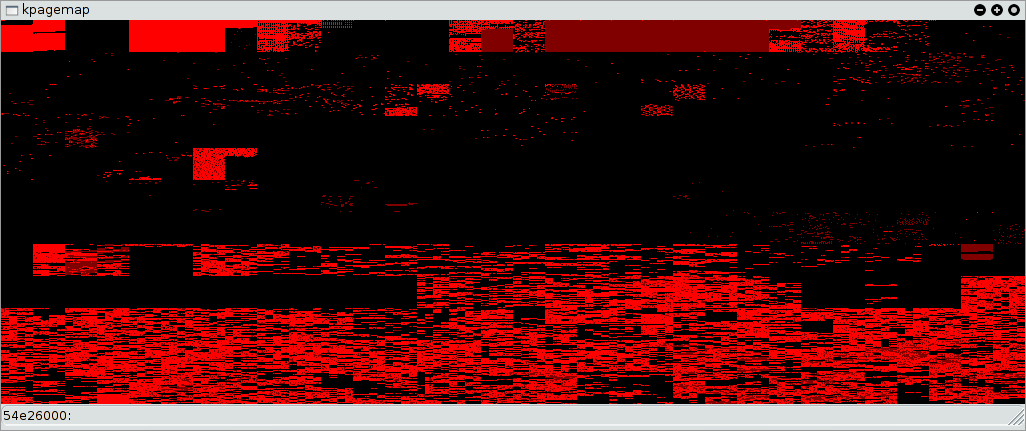
in a GUI written in Python. And Python is fairly horrible for drawing
bitmaps and such.

http://www.selenic.com/Screenshot-kpagemap.png

> So pmaps seems to be a clear winner :)

Except that it's only providing a subset of the data.

--
Mathematics is the supreme nostalgia of our time.

^ permalink raw reply	[flat|nested] 21+ messages in thread
[parent not found: <20070818024831.GA7856@mail.ustc.edu.cn>]
* Re: [PATCH 4/4] maps: /proc/<pid>/pmaps interface - memory maps in granularity of pages
       [not found]         ` <20070818024831.GA7856@mail.ustc.edu.cn>
@ 2007-08-18  2:48           ` Fengguang Wu
  2007-08-18  6:40           ` Matt Mackall
  1 sibling, 0 replies; 21+ messages in thread
From: Fengguang Wu @ 2007-08-18  2:48 UTC (permalink / raw)
  To: Matt Mackall
  Cc: Andrew Morton, Jeremy Fitzhardinge, David Rientjes, John Berthels,
	Nick Piggin, linux-kernel

Matt,

On Fri, Aug 17, 2007 at 11:58:08AM -0500, Matt Mackall wrote:
> On Fri, Aug 17, 2007 at 02:47:27PM +0800, Fengguang Wu wrote:
> > It's not easy to do direct performance comparisons between pmaps and
> > pagemap/kpagemap. However some close analyzes are still possible :)
> >
> > 1) code size
> > pmaps                   ~200 LOC
> > pagemap/kpagemap        ~300 LOC
> >
> > 2) dataset size
> > take for example my running firefox on Intel Core 2:
> > VSZ             400 MB
> > RSS              64 MB, or 16k pages
> > pmaps            64 KB, wc shows 2k lines, or so much page ranges
> > pagemap         800 KB, could be heavily optimized by returning partial data
>
> I take it you're in 64-bit mode?

Yes. That will be the common case.

> You're right, this data compresses well in many circumstances. I
> suspect it will suffer under memory pressure though. That will
> fragment the ranges in-memory and also fragment the active bits. The
> worst case here is huge, of course, but realistically I'd expect
> something like 2x-4x.

Not likely to degrade even under memory pressure ;)

The compress_ratio = (VSZ:RSS) * (RSS:page_ranges).
- On fresh startup and no memory pressure,
  - the VSZ:RSS ratio of ALL processes are 4516796KB:457048KB ~= 10:1.
  - the firefox case shows a (RSS:page_ranges) of 16k:2k ~= 8:1.
- On memory pressure,
  - as VSZ goes up, RSS will be bounded by physical memory.
    So VSZ:RSS ratio actually goes up with memory pressure.
  - page range is a good unit of locality. They are more likely to be
    reclaimed as a whole. So (RSS:page_ranges) wouldn't degrade as much.

> But there are still the downsides I have mentioned:
>
> - you don't get page frame numbers

True. I guess PFNs are meaningless to a normal user?

> - you can't do random access

Not for now.

It would be trivial to support seek-by-address semantic: the seqfile
operations already iterate by addresses. Only that we cannot do it via
the regular read/pread/seek interfaces. They have different semantic
on fpos. However, tricks like ioctl(begin_addr, end_addr) can be
employed if necessary.

> And how long does it take to pull the data out? My benchmarks show
> greater than 50MB/s (and that's with the version in -mm that's doing
> double buffering), so that 800K would take < .016s.

You are right :)

> > kpagemap        256 KB
> >
> > 3) runtime overheads
> > pmaps            2k lines of string processing(encode/decode)
> > kpagemap        16k seek()/read()s, and context switches (could be
> >                     optimized somehow by doing a PFN sort first, but
> >                     that's also non-trivial overheads)
>
> You can do anywhere between 16k small reads or 1 large read. Depends

No way to avoid the seeks if PFNs are discontinuous. Too bad the
memory get fragmented with uptime, at least for the current kernel.

But sure, sequential reads are viable when doing whole system memory
analysis, or for memory hog processes.

> what data you're trying to get. Right now, kpagemap is fast enough
> that I can do realtime displays of the whole of memory in my desktop
> in a GUI written in Python. And Python is fairly horrible for drawing
> bitmaps and such.
>
> http://www.selenic.com/Screenshot-kpagemap.png
>
> > So pmaps seems to be a clear winner :)
>
> Except that it's only providing a subset of the data.

Yes, and it's a nice graph :)


^ permalink raw reply	[flat|nested] 21+ messages in thread
* Re: [PATCH 4/4] maps: /proc/<pid>/pmaps interface - memory maps in granularity of pages
       [not found]         ` <20070818024831.GA7856@mail.ustc.edu.cn>
  2007-08-18  2:48           ` Fengguang Wu
@ 2007-08-18  6:40           ` Matt Mackall
       [not found]             ` <20070818103146.GA6744@mail.ustc.edu.cn>
       [not found]             ` <20070818084531.GB5277@mail.ustc.edu.cn>
  1 sibling, 2 replies; 21+ messages in thread
From: Matt Mackall @ 2007-08-18  6:40 UTC (permalink / raw)
  To: Fengguang Wu
  Cc: Andrew Morton, Jeremy Fitzhardinge, David Rientjes, John Berthels,
	Nick Piggin, linux-kernel

On Sat, Aug 18, 2007 at 10:48:31AM +0800, Fengguang Wu wrote:
> Matt,
>
> On Fri, Aug 17, 2007 at 11:58:08AM -0500, Matt Mackall wrote:
> > On Fri, Aug 17, 2007 at 02:47:27PM +0800, Fengguang Wu wrote:
> > > It's not easy to do direct performance comparisons between pmaps and
> > > pagemap/kpagemap. However some close analyzes are still possible :)
> > >
> > > 1) code size
> > > pmaps                   ~200 LOC
> > > pagemap/kpagemap        ~300 LOC
> > >
> > > 2) dataset size
> > > take for example my running firefox on Intel Core 2:
> > > VSZ             400 MB
> > > RSS              64 MB, or 16k pages
> > > pmaps            64 KB, wc shows 2k lines, or so much page ranges
> > > pagemap         800 KB, could be heavily optimized by returning partial data
> >
> > I take it you're in 64-bit mode?
>
> Yes. That will be the common case.
>
> > You're right, this data compresses well in many circumstances. I
> > suspect it will suffer under memory pressure though. That will
> > fragment the ranges in-memory and also fragment the active bits. The
> > worst case here is huge, of course, but realistically I'd expect
> > something like 2x-4x.
>
> Not likely to degrade even under memory pressure ;)
>
> The compress_ratio = (VSZ:RSS) * (RSS:page_ranges).
> - On fresh startup and no memory pressure,
>   - the VSZ:RSS ratio of ALL processes are 4516796KB:457048KB ~= 10:1.
>   - the firefox case shows a (RSS:page_ranges) of 16k:2k ~= 8:1.

Yes.

> - On memory pressure,
>   - as VSZ goes up, RSS will be bounded by physical memory.
>     So VSZ:RSS ratio actually goes up with memory pressure.

And yes.

But that's not what I'm talking about. You're likely to have more
holes in your ranges with memory pressure as things that aren't active
get paged or swapped out and back in. And because we're walking the
LRU more rapidly, we'll flip over a lot of the active bits more often
which will mean more output.

>   - page range is a good unit of locality. They are more likely to be
>     reclaimed as a whole. So (RSS:page_ranges) wouldn't degrade as much.

There is that. The relative magnitude of the different effects is
unclear. But it is clear that the worst case for pmap is much worse
than pagemap (two lines per page of RSS?).

> > But there are still the downsides I have mentioned:
> >
> > - you don't get page frame numbers
>
> True. I guess PFNs are meaningless to a normal user?

They're useful for anyone who's trying to look at the system as a
whole.

> > - you can't do random access
>
> Not for now.
>
> It would be trivial to support seek-by-address semantic: the seqfile
> operations already iterate by addresses. Only that we cannot do it via
> the regular read/pread/seek interfaces. They have different semantic
> on fpos. However, tricks like ioctl(begin_addr, end_addr) can be
> employed if necessary.

I suppose. But if you're willing to stomach that sort of thing, you
might as well use a simple binary interface.

--
Mathematics is the supreme nostalgia of our time.

^ permalink raw reply	[flat|nested] 21+ messages in thread
[parent not found: <20070818103146.GA6744@mail.ustc.edu.cn>]
* Re: [PATCH 4/4] maps: /proc/<pid>/pmaps interface - memory maps in granularity of pages
       [not found]             ` <20070818103146.GA6744@mail.ustc.edu.cn>
@ 2007-08-18 10:31               ` Fengguang Wu
  0 siblings, 0 replies; 21+ messages in thread
From: Fengguang Wu @ 2007-08-18 10:31 UTC (permalink / raw)
  To: Matt Mackall
  Cc: Andrew Morton, Jeremy Fitzhardinge, David Rientjes, John Berthels,
	Nick Piggin, linux-kernel

On Sat, Aug 18, 2007 at 01:40:42AM -0500, Matt Mackall wrote:
> > > - you don't get page frame numbers
> >
> > True. I guess PFNs are meaningless to a normal user?
>
> They're useful for anyone who's trying to look at the system as a
> whole.

To answer the question: "who are sharing this page with me"?
PFNs are not the only option. The tuple dev/ino/offset can also
uniquely identify the shared page :)


^ permalink raw reply	[flat|nested] 21+ messages in thread
[parent not found: <20070818084531.GB5277@mail.ustc.edu.cn>]
* Re: [PATCH 4/4] maps: /proc/<pid>/pmaps interface - memory maps in granularity of pages
       [not found]             ` <20070818084531.GB5277@mail.ustc.edu.cn>
@ 2007-08-18  8:45               ` Fengguang Wu
  2007-08-18 17:22               ` Matt Mackall
  1 sibling, 0 replies; 21+ messages in thread
From: Fengguang Wu @ 2007-08-18  8:45 UTC (permalink / raw)
  To: Matt Mackall
  Cc: Andrew Morton, Jeremy Fitzhardinge, David Rientjes, John Berthels,
	Nick Piggin, linux-kernel

Matt,

On Sat, Aug 18, 2007 at 01:40:42AM -0500, Matt Mackall wrote:
> > - On memory pressure,
> >   - as VSZ goes up, RSS will be bounded by physical memory.
> >     So VSZ:RSS ratio actually goes up with memory pressure.
>
> And yes.
>
> But that's not what I'm talking about. You're likely to have more
> holes in your ranges with memory pressure as things that aren't active
> get paged or swapped out and back in. And because we're walking the
> LRU more rapidly, we'll flip over a lot of the active bits more often
> which will mean more output.
>
> >   - page range is a good unit of locality. They are more likely to be
> >     reclaimed as a whole. So (RSS:page_ranges) wouldn't degrade as much.
>
> There is that. The relative magnitude of the different effects is
> unclear. But it is clear that the worst case for pmap is much worse

> than pagemap (two lines per page of RSS?).
It's one line per page. No sane app will make vmas proliferate.

So let's talk about the worst case.

pagemap's data set size is determined by VSZ.
4GB VSZ means 1M PFNs, hence 8MB pagemap data.

pmaps's data set size is bounded by RSS hence physical memory.
4GB RSS means up to 1M page ranges, hence ~20M pmaps data.
Not too bad :)

> > > But there are still the downsides I have mentioned:
> > >
> > > - you don't get page frame numbers
> >
> > True. I guess PFNs are meaningless to a normal user?
>
> They're useful for anyone who's trying to look at the system as a
> whole.
>
> > > - you can't do random access
> >
> > Not for now.
> >
> > It would be trivial to support seek-by-address semantic: the seqfile
> > operations already iterate by addresses. Only that we cannot do it via
> > the regular read/pread/seek interfaces. They have different semantic
> > on fpos. However, tricks like ioctl(begin_addr, end_addr) can be
> > employed if necessary.
>
> I suppose. But if you're willing to stomach that sort of thing, you
> might as well use a simple binary interface.

Python can do ioctl() :)

Anyway it's already a special interface.


^ permalink raw reply	[flat|nested] 21+ messages in thread
* Re: [PATCH 4/4] maps: /proc/<pid>/pmaps interface - memory maps in granularity of pages
       [not found]             ` <20070818084531.GB5277@mail.ustc.edu.cn>
  2007-08-18  8:45               ` Fengguang Wu
@ 2007-08-18 17:22               ` Matt Mackall
       [not found]                 ` <20070819004008.GA5297@mail.ustc.edu.cn>
  1 sibling, 1 reply; 21+ messages in thread
From: Matt Mackall @ 2007-08-18 17:22 UTC (permalink / raw)
  To: Fengguang Wu
  Cc: Andrew Morton, Jeremy Fitzhardinge, David Rientjes, John Berthels,
	Nick Piggin, linux-kernel

On Sat, Aug 18, 2007 at 04:45:31PM +0800, Fengguang Wu wrote:
> Matt,
>
> On Sat, Aug 18, 2007 at 01:40:42AM -0500, Matt Mackall wrote:
> > > - On memory pressure,
> > >   - as VSZ goes up, RSS will be bounded by physical memory.
> > >     So VSZ:RSS ratio actually goes up with memory pressure.
> >
> > And yes.
> >
> > But that's not what I'm talking about. You're likely to have more
> > holes in your ranges with memory pressure as things that aren't active
> > get paged or swapped out and back in. And because we're walking the
> > LRU more rapidly, we'll flip over a lot of the active bits more often
> > which will mean more output.
> >
> > >   - page range is a good unit of locality. They are more likely to be
> > >     reclaimed as a whole. So (RSS:page_ranges) wouldn't degrade as much.
> >
> > There is that. The relative magnitude of the different effects is
> > unclear. But it is clear that the worst case for pmap is much worse
>
> > than pagemap (two lines per page of RSS?).
> It's one line per page. No sane app will make vmas proliferate.

Sane apps are few and far between.

> So let's talk about the worst case.
>
> pagemap's data set size is determined by VSZ.
> 4GB VSZ means 1M PFNs, hence 8MB pagemap data.
>
> pmaps's data set size is bounded by RSS hence physical memory.
> 4GB RSS means up to 1M page ranges, hence ~20M pmaps data.
> Not too bad :)

Hmmm, I've been misreading the output.

What does it do with nonlinear VMAs?

--
Mathematics is the supreme nostalgia of our time.

^ permalink raw reply	[flat|nested] 21+ messages in thread
[parent not found: <20070819004008.GA5297@mail.ustc.edu.cn>]
* Re: [PATCH 4/4] maps: /proc/<pid>/pmaps interface - memory maps in granularity of pages
       [not found]                 ` <20070819004008.GA5297@mail.ustc.edu.cn>
@ 2007-08-19  0:40                   ` Fengguang Wu
  0 siblings, 0 replies; 21+ messages in thread
From: Fengguang Wu @ 2007-08-19  0:40 UTC (permalink / raw)
  To: Matt Mackall
  Cc: Andrew Morton, Jeremy Fitzhardinge, David Rientjes, John Berthels,
	Nick Piggin, linux-kernel

On Sat, Aug 18, 2007 at 12:22:26PM -0500, Matt Mackall wrote:
> > > >     So VSZ:RSS ratio actually goes up with memory pressure.
> > >
> > > And yes.
> > >
> > > But that's not what I'm talking about. You're likely to have more
> > > holes in your ranges with memory pressure as things that aren't active
> > > get paged or swapped out and back in. And because we're walking the
> > > LRU more rapidly, we'll flip over a lot of the active bits more often
> > > which will mean more output.
> > >
> > > >   - page range is a good unit of locality. They are more likely to be
> > > >     reclaimed as a whole. So (RSS:page_ranges) wouldn't degrade as much.
> > >
> > > There is that. The relative magnitude of the different effects is
> > > unclear. But it is clear that the worst case for pmap is much worse
> >
> > > than pagemap (two lines per page of RSS?).
> > It's one line per page. No sane app will make vmas proliferate.
>
> Sane apps are few and far between.

Very likely, and they will bloat maps/smaps/pmaps alike :(

> > So let's talk about the worst case.
> >
> > pagemap's data set size is determined by VSZ.
> > 4GB VSZ means 1M PFNs, hence 8MB pagemap data.
> >
> > pmaps's data set size is bounded by RSS hence physical memory.
> > 4GB RSS means up to 1M page ranges, hence ~20M pmaps data.
> > Not too bad :)
>
> Hmmm, I've been misreading the output.
>
> What does it do with nonlinear VMAs?

The implementation gets offset from page_index(page), so will work
the same way in linear/nonlinear VMAs. Depending how one does the
remap_file_ranges() calls, the output lines may be not strictly
ordered by offset, or overlap, or have small page ranges.


^ permalink raw reply	[flat|nested] 21+ messages in thread
[parent not found: <20070819075410.411207640@mail.ustc.edu.cn>]
[parent not found: <20070819075547.445659254@mail.ustc.edu.cn>]
* [PATCH 1/4] maps: PSS(proportional set size) accounting in smaps
       [not found] ` <20070819075547.445659254@mail.ustc.edu.cn>
@ 2007-08-19  7:54   ` Fengguang Wu
  0 siblings, 0 replies; 21+ messages in thread
From: Fengguang Wu @ 2007-08-19  7:54 UTC (permalink / raw)
  To: Andrew Morton; +Cc: Matt Mackall, John Berthels, linux-kernel

[-- Attachment #1: smaps-pss.patch --]
[-- Type: text/plain, Size: 3497 bytes --]

The "proportional set size" (PSS) of a process is the count of pages it has in
memory, where each page is divided by the number of processes sharing it. So if
a process has 1000 pages all to itself, and 1000 shared with one other process,
its PSS will be 1500.
               - lwn.net: "ELC: How much memory are applications really using?"

The PSS proposed by Matt Mackall is a very nice metic for measuring an process's
memory footprint. So collect and export it via /proc/<pid>/smaps.

Matt Mackall's pagemap/kpagemap and John Berthels's exmap can also do the job.
They are comprehensive tools. But for PSS, let's do it in the simple way.


Cc: John Berthels <jjberthels@gmail.com>
Acked-by: Matt Mackall <mpm@selenic.com>
Signed-off-by: Fengguang Wu <wfg@mail.ustc.edu.cn>
---
 fs/proc/task_mmu.c |   29 ++++++++++++++++++++++++++++-
 1 file changed, 28 insertions(+), 1 deletion(-)

--- linux-2.6.23-rc2-mm2.orig/fs/proc/task_mmu.c
+++ linux-2.6.23-rc2-mm2/fs/proc/task_mmu.c
@@ -324,6 +324,27 @@ struct mem_size_stats
 	unsigned long private_clean;
 	unsigned long private_dirty;
 	unsigned long referenced;
+
+	/*
+	 * Proportional Set Size(PSS): my share of RSS.
+	 *
+	 * PSS of a process is the count of pages it has in memory, where each
+	 * page is divided by the number of processes sharing it.  So if a
+	 * process has 1000 pages all to itself, and 1000 shared with one other
+	 * process, its PSS will be 1500.               - Matt Mackall, lwn.net
+	 */
+	u64 	      pss;
+	/*
+	 * To keep (accumulated) division errors low, we adopt 64bit pss and
+	 * use some low bits for division errors. So (pss >> PSS_ERROR_BITS)
+	 * would be the real byte count.
+	 *
+	 * A shift of 12 before division means(assuming 4K page size):
+	 * 	- 1M 3-user-pages add up to 8KB errors;
+	 * 	- supports mapcount up to 2^24, or 16M;
+	 * 	- supports PSS up to 2^52 bytes, or 4PB.
+	 */
+#define PSS_ERROR_BITS	12
 };

 struct smaps_arg
@@ -341,6 +362,7 @@ static int smaps_pte_range(pmd_t *pmd, u
 	pte_t *pte, ptent;
 	spinlock_t *ptl;
 	struct page *page;
+	int mapcount;

 	pte = pte_offset_map_lock(vma->vm_mm, pmd, addr, &ptl);
 	for (; addr != end; pte++, addr += PAGE_SIZE) {
@@ -357,16 +379,19 @@ static int smaps_pte_range(pmd_t *pmd, u
 		/* Accumulate the size in pages that have been accessed. */
 		if (pte_young(ptent) || PageReferenced(page))
 			mss->referenced += PAGE_SIZE;
-		if (page_mapcount(page) >= 2) {
+		mapcount = page_mapcount(page);
+		if (mapcount >= 2) {
 			if (pte_dirty(ptent))
 				mss->shared_dirty += PAGE_SIZE;
 			else
 				mss->shared_clean += PAGE_SIZE;
+			mss->pss += (PAGE_SIZE << PSS_ERROR_BITS) / mapcount;
 		} else {
 			if (pte_dirty(ptent))
 				mss->private_dirty += PAGE_SIZE;
 			else
 				mss->private_clean += PAGE_SIZE;
+			mss->pss += (PAGE_SIZE << PSS_ERROR_BITS);
 		}
 	}
 	pte_unmap_unlock(pte - 1, ptl);
@@ -395,6 +420,7 @@ static int show_smap(struct seq_file *m,
 	seq_printf(m,
 		   "Size:           %8lu kB\n"
 		   "Rss:            %8lu kB\n"
+		   "Pss:            %8lu kB\n"
 		   "Shared_Clean:   %8lu kB\n"
 		   "Shared_Dirty:   %8lu kB\n"
 		   "Private_Clean:  %8lu kB\n"
@@ -402,6 +428,7 @@ static int show_smap(struct seq_file *m,
 		   "Referenced:     %8lu kB\n",
 		   (vma->vm_end - vma->vm_start) >> 10,
 		   sarg.mss.resident >> 10,
+		   (unsigned long)(sarg.mss.pss >> (10 + PSS_ERROR_BITS)),
 		   sarg.mss.shared_clean  >> 10,
 		   sarg.mss.shared_dirty  >> 10,
 		   sarg.mss.private_clean >> 10,

--

^ permalink raw reply	[flat|nested] 21+ messages in thread
end of thread, other threads:[~2007-08-19  7:56 UTC | newest]

Thread overview: 21+ messages (download: mbox.gz follow: Atom feed
-- links below jump to the message on this page --
     [not found] <20070816220516.782145952@mail.ustc.edu.cn>
2007-08-16 22:05 ` [PATCH 0/4] process memory footprints in proc/<pid>/[s|p]maps Fengguang Wu
     [not found] ` <20070816220849.313377588@mail.ustc.edu.cn>
2007-08-16 22:05   ` [PATCH 3/4] maps: introduce generic_maps_open() Fengguang Wu
     [not found] ` <20070816220849.064901548@mail.ustc.edu.cn>
2007-08-16 22:05   ` [PATCH 1/4] maps: PSS(proportional set size) accounting in smaps Fengguang Wu
2007-08-17  2:13   ` Matt Mackall
     [not found]     ` <20070817024443.GA5521@mail.ustc.edu.cn>
2007-08-17  2:44       ` Fengguang Wu
     [not found] ` <20070816220849.192029043@mail.ustc.edu.cn>
2007-08-16 22:05   ` [PATCH 2/4] maps: address based vma walking Fengguang Wu
2007-08-17  2:16   ` Matt Mackall
     [not found]     ` <20070817025454.GB5521@mail.ustc.edu.cn>
2007-08-17  2:54       ` Fengguang Wu
     [not found] ` <20070816220849.472883642@mail.ustc.edu.cn>
2007-08-16 22:05   ` [PATCH 4/4] maps: /proc/<pid>/pmaps interface - memory maps in granularity of pages Fengguang Wu
2007-08-17  2:38   ` Matt Mackall
     [not found]     ` <20070817034437.GC5521@mail.ustc.edu.cn>
2007-08-17  3:44       ` Fengguang Wu
2007-08-17  3:56       ` Matt Mackall
     [not found]     ` <20070817064727.GA6723@mail.ustc.edu.cn>
2007-08-17  6:47       ` Fengguang Wu
2007-08-17 16:58       ` Matt Mackall
     [not found]         ` <20070818024831.GA7856@mail.ustc.edu.cn>
2007-08-18  2:48           ` Fengguang Wu
2007-08-18  6:40           ` Matt Mackall
     [not found]             ` <20070818103146.GA6744@mail.ustc.edu.cn>
2007-08-18 10:31               ` Fengguang Wu
     [not found]             ` <20070818084531.GB5277@mail.ustc.edu.cn>
2007-08-18  8:45               ` Fengguang Wu
2007-08-18 17:22               ` Matt Mackall
     [not found]                 ` <20070819004008.GA5297@mail.ustc.edu.cn>
2007-08-19  0:40                   ` Fengguang Wu
     [not found] <20070819075410.411207640@mail.ustc.edu.cn>
     [not found] ` <20070819075547.445659254@mail.ustc.edu.cn>
2007-08-19  7:54   ` [PATCH 1/4] maps: PSS(proportional set size) accounting in smaps Fengguang Wu
This is a public inbox, see mirroring instructions
for how to clone and mirror all data and code used for this inbox